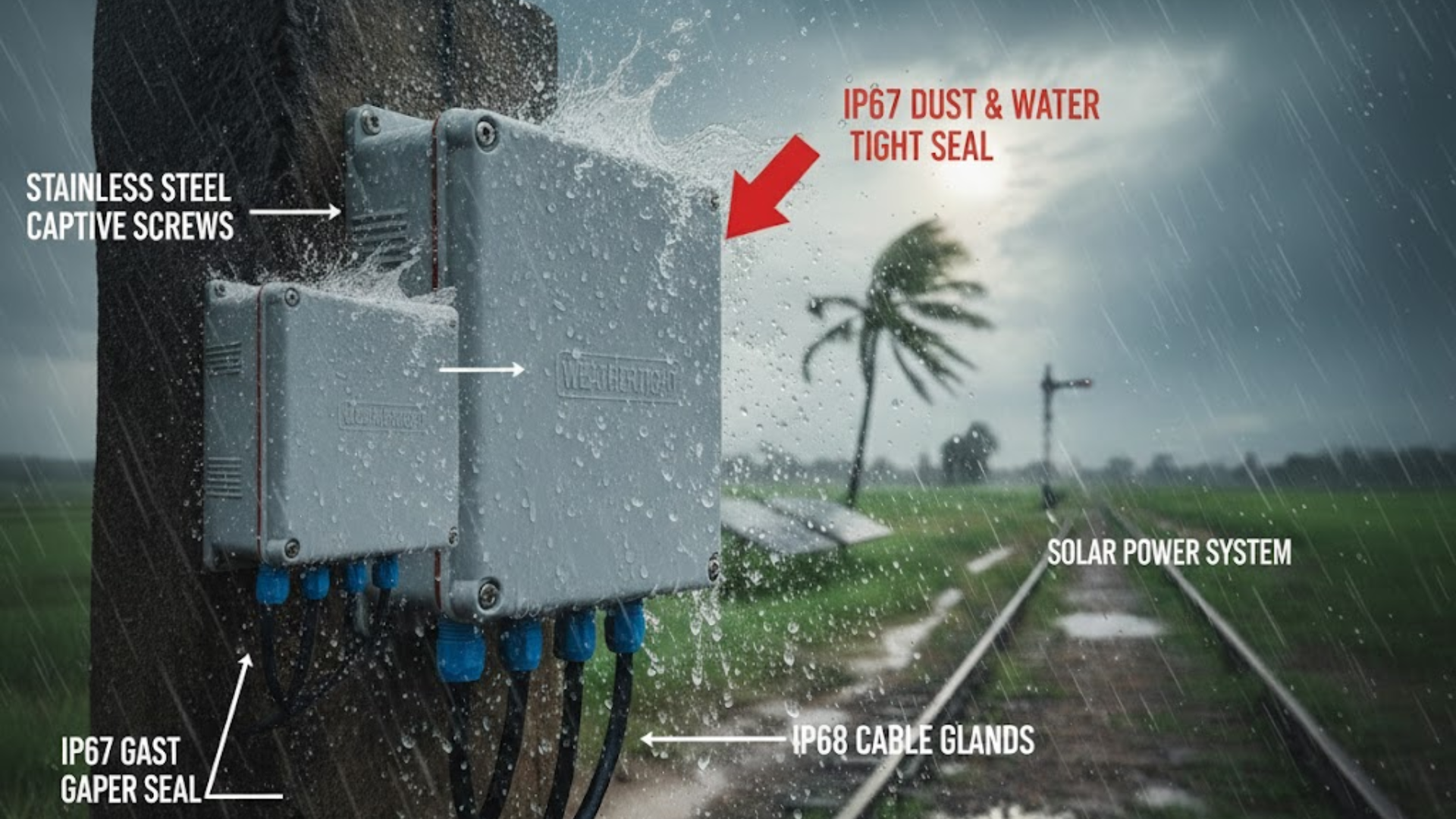
In the rapidly evolving landscape of Indian infrastructure—from Smart City projects in Indore to massive solar farms in Rajasthan—one humble component stands as the frontline of defense for our technology: the IP67 waterproof box.
When we talk about sensitive electronics, “almost waterproof” is the same as “broken.” Whether it’s a high-end CCTV camera controller or a simple IoT sensor for a farm, the difference between a functional system and a short-circuited disaster often comes down to the quality of the enclosure.
1. Deconstructing the IP67 Waterproof Box Rating: A Technical Deep Dive
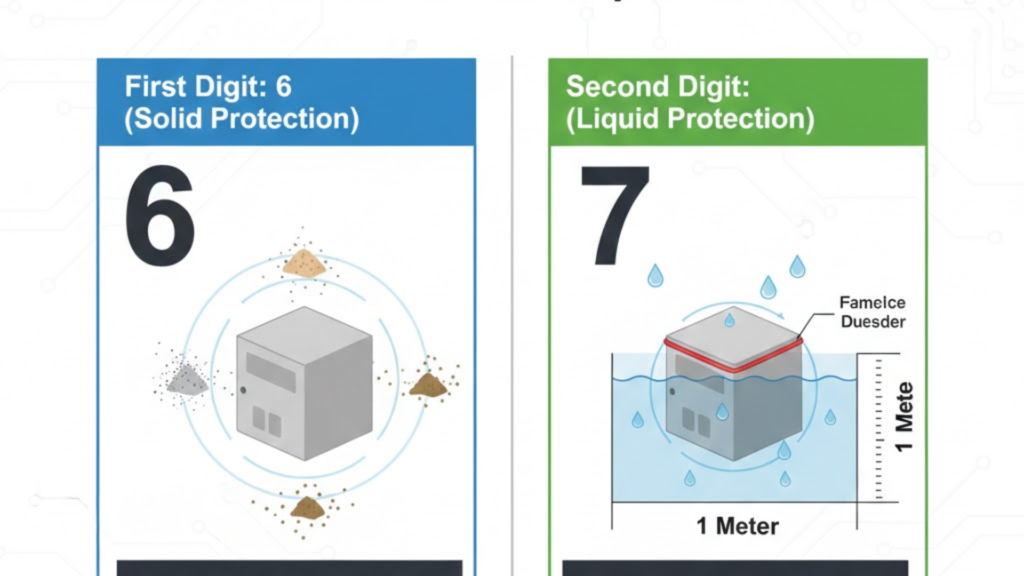
The “IP” (Ingress Protection) rating is governed by the international standard IEC 60529. It isn’t just a marketing buzzword; it is a laboratory-tested certification.
The First Digit: ‘6’ (Solid Ingress Protection)
The number 6 is the highest rating for solids. In the Indian context, this is crucial.
- Dust Resistance: The enclosure must be “Dust Tight.”
- The Test: In a vacuum-sealed chamber, fine talcum powder is circulated for up to 8 hours. If even a microscopic speck enters the box, it fails.
- Indian Relevance: This protects against the fine silt of the Indo-Gangetic plains and the industrial grime of cities like Kanpur or Surat.
The Second Digit: ‘7’ (Liquid Ingress Protection)
The number 7 indicates protection against Temporary Immersion.
- The Test: The box is submerged in water at a depth of 1 meter (approx. 3.3 feet) for exactly 30 minutes.
- The Result: The interior must remain completely dry.
- Why not IP68? IP68 is for continuous submersion (like a pool light). IP67 is the “Gold Standard” for anything exposed to heavy monsoon flooding or accidental drops into puddles.
2. Material Science: What is your IP67 waterproof box made of?
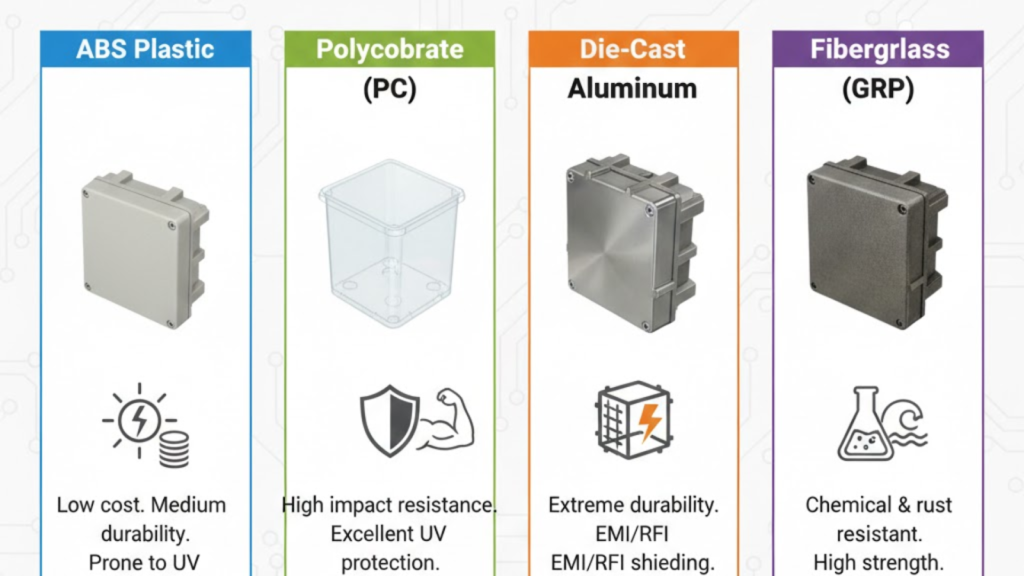
Not all IP67 waterproof boxes are created equal. The material determines how long the box will last under the Indian sun.
Comparison of Enclosure Materials
| Material Type | Durability | UV Resistance | Cost | Best Use Case |
| ABS Plastic | Medium | Low (can turn brittle) | Low | Indoor or shaded outdoor areas. |
| Polycarbonate (PC) | High | Very High | Medium | Direct sunlight, heavy impact areas. |
| Die-Cast Aluminum | Extremely High | Excellent | High | Industrial zones, EMI/RFI shielding. |
| Fiberglass (GRP) | High | High | High | Chemical plants, coastal (salty) areas. |
3. Critical Components of an IP67 Waterproof Box
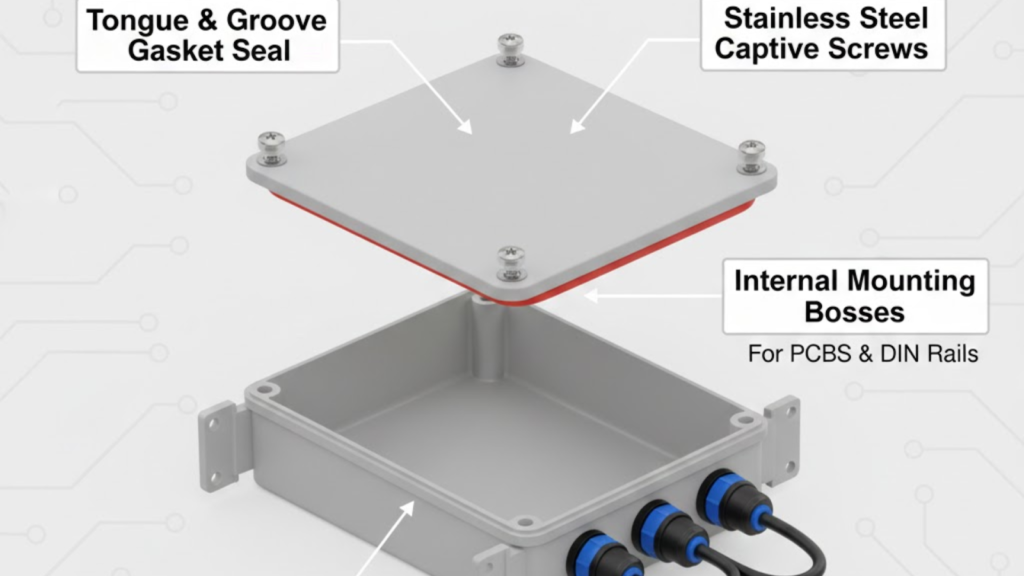
To maintain a 3,000-word level of detail, you must understand the “Trifecta of Sealing”:
A. The Gasket (The Seal of Life)
The gasket is the rubber ring between the lid and the base.
- EPDM Rubber: Great for weather resistance.
- Silicone: Best for extreme temperature fluctuations (common in North India).
- Neoprene: Resistant to oils and chemicals.
- Formatting Tip: Always check if the gasket is “Tongue and Groove” style, which provides a double mechanical barrier against water.
B. Captive Screws
A true IP67 waterproof box uses stainless steel captive screws. These don’t rust (essential for Mumbai/Chennai humidity) and stay attached to the lid so you don’t lose them during a 20-foot-high CCTV installation.
C. Mounting Flanges
Internal mounting bosses allow you to screw in a PCB or a DIN rail without piercing the outer wall of the box. Never drill through the back of a waterproof box to mount it to a wall; use external mounting feet instead.
4. Step-by-Step: How to Install an IP67 Box Correctly
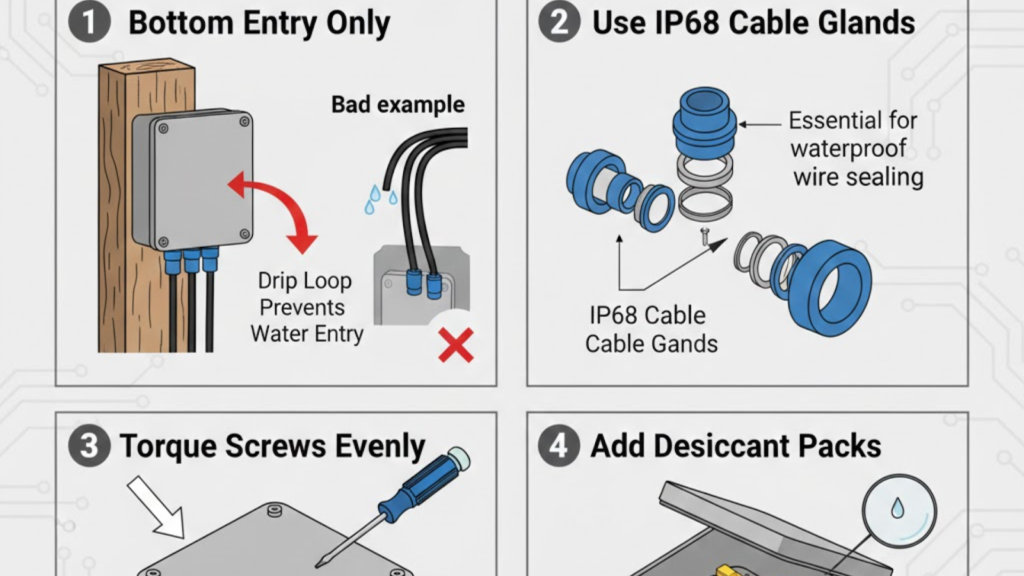
Even the best IP67 waterproof box will fail if the installation is poor. Follow this checklist:
- Select the Right Cable Glands: You cannot just poke a hole. Use IP68 rated nylon glands.
- Bottom Entry Only: Always bring cables in from the bottom of the box. This creates a “drip loop” where gravity pulls water away from the seal.
- Check the O-Rings: Ensure the O-ring on your cable gland is seated flat against the box surface.
- Torque the Screws: Tighten the lid screws in a “criss-cross” pattern to ensure even pressure on the gasket.
- Desiccant Packs: Pro-Tip: Place a small silica gel packet inside. Even if no water leaks in, the humidity trapped inside during installation can condense into droplets when the temperature drops at night.
5.Deep Dive: Why IP67 Waterproof Boxes are the Backbone of Indian Industry
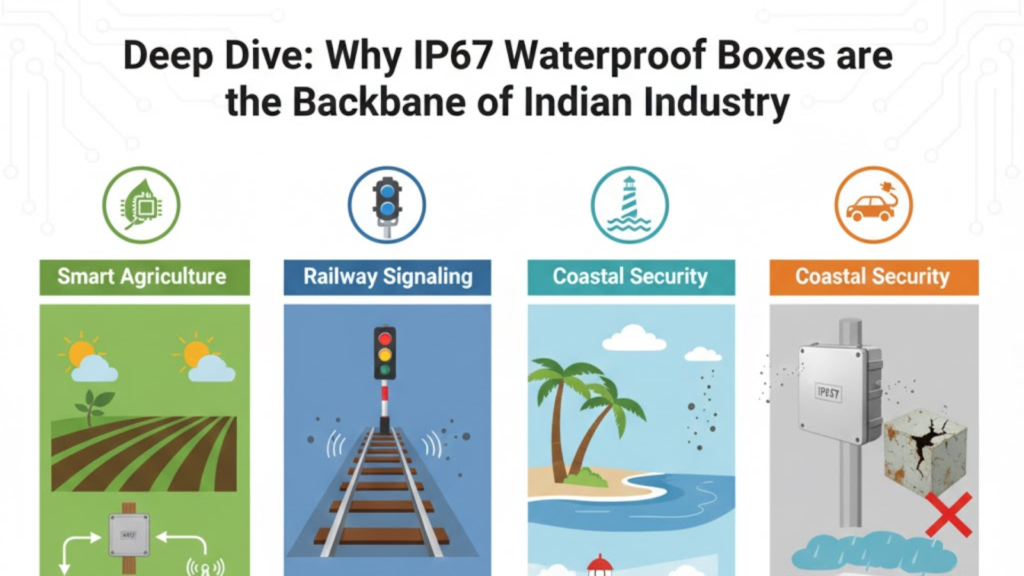
In a diverse landscape like India, a “one size fits all” approach doesn’t work. From the high-humidity coastal regions of Kerala to the sub-zero temperatures of Ladakh, an IP67 waterproof box must adapt to local challenges.
A. Smart Agriculture (Agri-Tech Revolution)
India is rapidly adopting IoT (Internet of Things) in farming. Smart sensors are now placed in open fields to monitor soil moisture, pH levels, and nutrient content.
- The Challenge: These devices sit in open fields under the scorching sun (reaching 48°C in Punjab/Haryana) and face heavy monsoon flooding.
- The Role of IP67: A LoRaWAN gateway or a sensor node is highly sensitive. If even a drop of pesticide-laden water enters the box, the circuitry will corrode instantly.
- Why IP67 is Critical: During irrigation, high-pressure sprinklers might spray the box directly. While IP65 handles splashes, IP67 ensures that even if the field gets waterlogged and the box is partially submerged for an hour, the expensive sensors remain functional.
- Indian Context: Small-scale farmers need “set it and forget it” technology. Using a high-quality IP67 enclosure reduces maintenance visits to remote rural fields.
B. Railway Signaling & Modernization
The Indian Railways is one of the largest networks in the world, and it is currently undergoing massive digital signaling upgrades (like the Kavach System).
- The Challenge: Tracks are environments of extreme vibration and metallic dust. When a train passes at 130 km/h, the ground shakes violently. Furthermore, “iron dust” from the friction of wheels on tracks is conductive.
- The IP67 Advantage:
- Vibration Resistance: High-quality IP67 boxes feature reinforced screw housings that don’t loosen under constant vibration.
- Dust Tightness: Since the first digit is ‘6’, no conductive iron dust can enter the box to cause a short circuit in the relay logic.
- Safety First: In railway signaling, a failure isn’t just a technical glitch; it’s a safety hazard. An IP67 waterproof box ensures that the signaling logic remains dry and dust-free 365 days a year.
C. Coastal Security & Marine Infrastructure
With a coastline of over 7,500 km, India has massive infrastructure in cities like Mumbai, Chennai, Vizag, and Kochi.
- The Challenge: Salt-Air Corrosion. The air near the ocean is saturated with salt and moisture. This combination acts as an electrolyte that eats through standard metal boxes within months.
- The Solution: Using Polycarbonate IP67 boxes instead of metal.
- Non-Corrosive: Polycarbonate does not rust.
- Hermetic Seal: The IP67 gasket prevents the salty “sea mist” from entering the enclosure and corroding the internal copper wiring.
- Use Case: Beach-side CCTV cameras and lighting controllers for ports and harbors depend entirely on these enclosures to survive the “Salt Spray” effect.
D. Electric Vehicle (EV) Charging Infrastructure
India is seeing an explosion in EV charging stations—from malls in Delhi to highway “Dhapas.”
- The Challenge: Most EV chargers are installed outdoors. During a heavy downpour, the internal high-voltage components (which handle 440V or more) must stay absolutely bone-dry.
- Fire Prevention: Water and high-voltage electricity are a deadly combination. If moisture enters a charging station’s brain (the controller), it can cause an electrical fire or a “ground fault.”
- The Requirement: Every outdoor EV charger relies on an internal IP67 waterproof box to house the communication modules and billing systems. This ensures the charger remains safe for the public to use, even during a thunderstorm.
Extensive FAQ: Clearing the Doubts
Q1: Can I bury an IP67 box underground?
A: It is not recommended. For underground use, soil pressure and constant moisture require an IP68 rating with resin-filling (potting).
Q2: Does “Waterproof” mean “Steam-proof”?
A: No. High-pressure steam or hot water jets require an IP69K rating. IP67 is for “static” water immersion.
Q3: Why did my IP67 box fail after a year in the sun?
A: Most likely UV Degradation. If the box was cheap ABS plastic, the sun’s rays cracked the molecular bonds, making the plastic porous or warping the lid so the seal no longer fits.
Q4: How do I know if the box I bought is genuine?
A: Look for the UL or CE certification marks stamped inside. Genuine manufacturers will also provide a “Test Report” upon request.
Conclusion: The Cost of Quality
When searching for an IP67 waterproof box, remember that you aren’t just buying a plastic container; you are buying uptime. In India, where maintenance costs are high and environmental conditions are unpredictable, choosing a high-quality, UV-stabilized IP67 enclosure is the most cost-effective decision a technician can make.