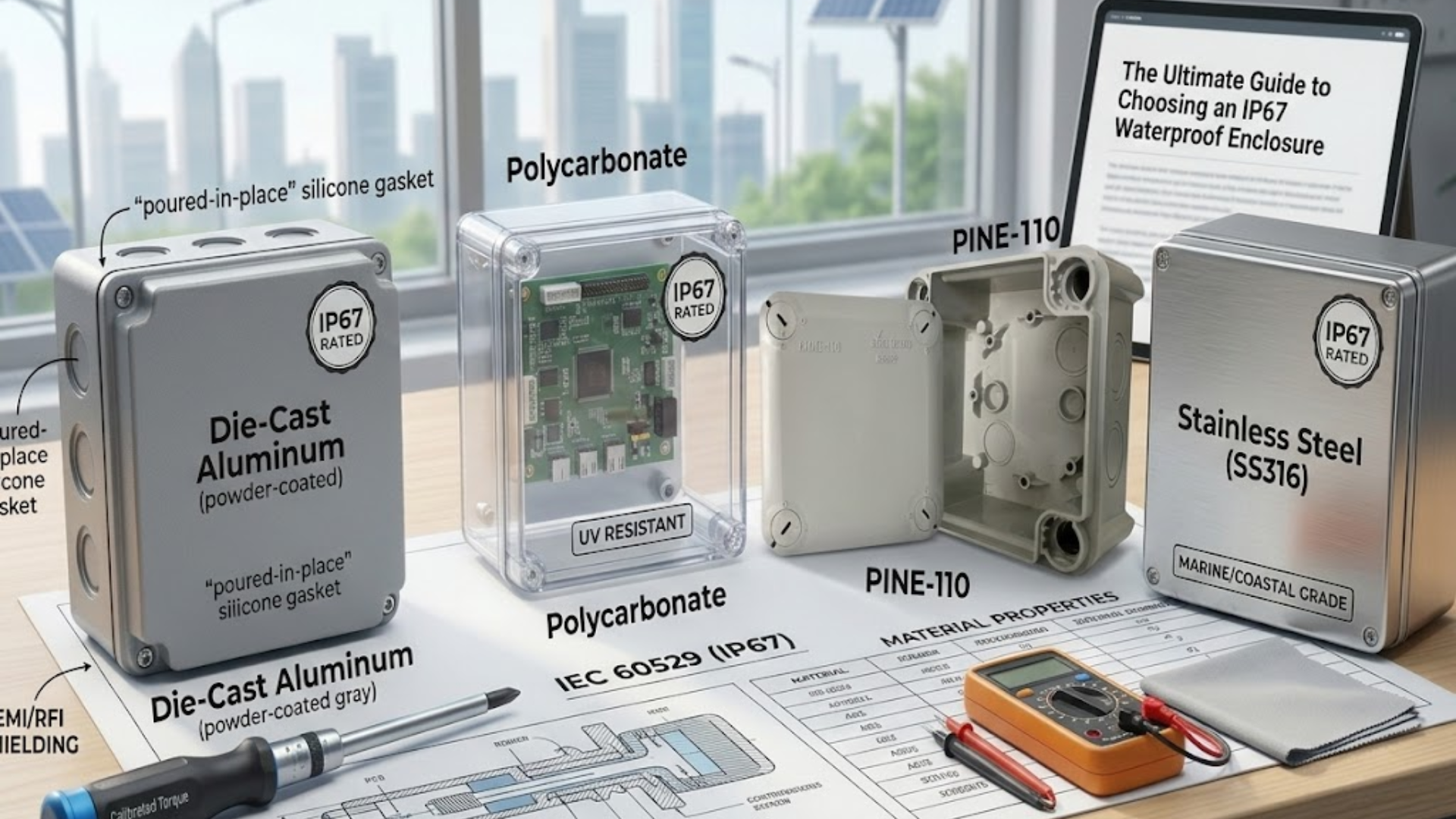
In the rapidly evolving landscape of Indian infrastructure—from Smart Cities in GIFT City to massive Solar Farms in Rajasthan—the protection of sensitive electronics has never been more critical. Whether you are housing a simple PCB or a complex industrial PLC, the phrase “IP67 waterproof enclosure” is likely at the top of your spec sheet.
But simply “being waterproof” isn’t enough. An enclosure must survive the local environment. This 3000-word guide explores the science behind materials, the nuances of the IP rating system, and how to choose the right housing for your specific application.
1. Decoding the IP67 Rating: What Does It Actually Mean?
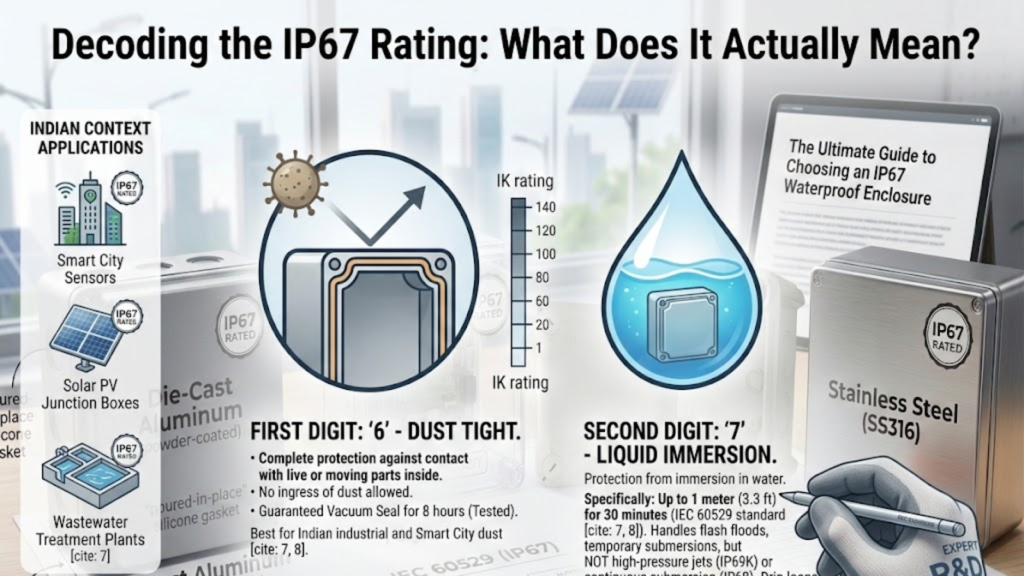
Before we look at materials, we must understand the standard. The Ingress Protection (IP) rating is defined by the international standard IEC 60529.
- The First Digit (6): Dust Tight.
The “6” means the enclosure is completely vacuum-sealed against dust. In the context of Indian industrial areas or construction sites, this prevents micro-particles from short-circuiting your electronics. - The Second Digit (7): Liquid Immersion.
The “7” indicates that the enclosure can be submerged in water up to 1 meter (3.3 feet) for 30 minutes without any harmful ingress.
Why IP67 is the “Sweet Spot” for India
Unlike IP65 (which only handles low-pressure water jets), IP67 handles the “flash floods” often seen during the Indian monsoon. It provides a safety margin that lower ratings lack.
2. Top 5 Materials Used in IP67 Waterproof Enclosures
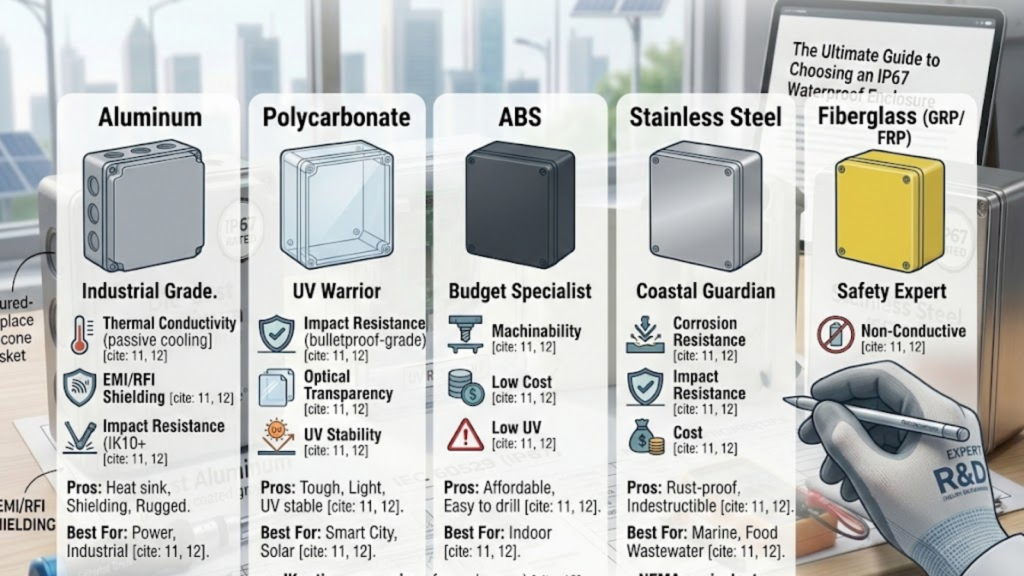
Choosing a material isn’t just about the price; it’s about the Life Cycle Cost (LCC). Here is an in-depth look at the top contenders.
A. Die-Cast Aluminum (The Industrial Heavyweight)
Aluminum is widely used in the Indian automotive and telecommunications sectors.
- Thermal Conductivity: Aluminum acts as a natural heat sink. If your internal components generate heat (like a power inverter), the aluminum shell pulls that heat away and dissipates it into the air.
- Shielding: It provides inherent EMI/RFI shielding, preventing external radio interference from affecting your signals.
- Durability: It can withstand physical impacts from heavy tools or falling debris in a factory setting.
B. Polycarbonate (The UV-Resistant Champion)
In states like Gujarat and Rajasthan, UV radiation is the “silent killer” of enclosures.
- Clarity vs. Strength: High-grade Polycarbonate is transparent (great for reading displays) but as strong as some metals.
- Weathering: Unlike cheaper plastics, it does not turn yellow or become brittle when exposed to 45°C+ temperatures for years.
C. ABS – Acrylonitrile Butadiene Styrene (The Budget Specialist)
ABS is the go-to for indoor consumer electronics or sheltered industrial use.
- Workability: It is very easy to machine. If you need to add custom ports for sensors, a standard drill won’t crack the casing.
- Cost-Efficiency: For high-volume production where UV exposure isn’t a factor, ABS can save up to 40% in material costs.
D. Stainless Steel (The Coastal Guardian)
For projects in Mumbai, Kochi, or Vizag, salt-air corrosion is the primary enemy.
- Grade 304: Standard for indoor/general outdoor use.
- Grade 316: Contains Molybdenum, making it resistant to chlorides (saltwater). This is essential for marine or chemical plant environments.
E. Fiberglass / GRP (The Safety Expert)
Fiberglass-Reinforced Polyester (GRP) is non-conductive and highly resistant to chemicals.
- Chemical Stability: It won’t react with acids or alkalis, making it perfect for wastewater treatment plants.
- Safety: Since it doesn’t conduct electricity, it reduces the risk of “stray voltage” accidents in public spaces.
3. Comparative Technical Analysis of IP67 Waterproof Enclosure Materials
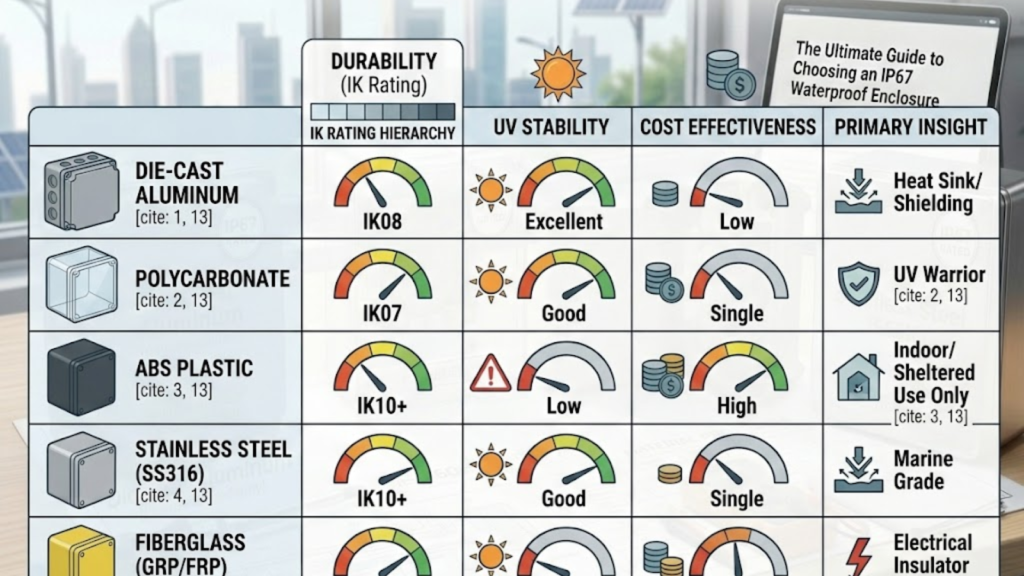
To help you decide, here is a breakdown of how these materials perform under various stressors:
Material Performance Table
| Material | Impact Resistance (IK Rating) | Chemical Resistance | UV Stability | Weight | EMI Shielding |
| Aluminum | High (IK08+) | Moderate | Excellent | Heavy | Yes (Inherent) |
| Polycarbonate | Very High (IK09) | High | Excellent | Light | No (Needs Coating) |
| ABS Plastic | Moderate (IK07) | Moderate | Poor | Very Light | No |
| Stainless Steel | Extreme (IK10) | Very High | Excellent | Very Heavy | Yes |
| Fiberglass | High | Extreme | Good | Medium |
4. Critical Design Features: The Anatomy of a High-Performance IP67 Enclosure
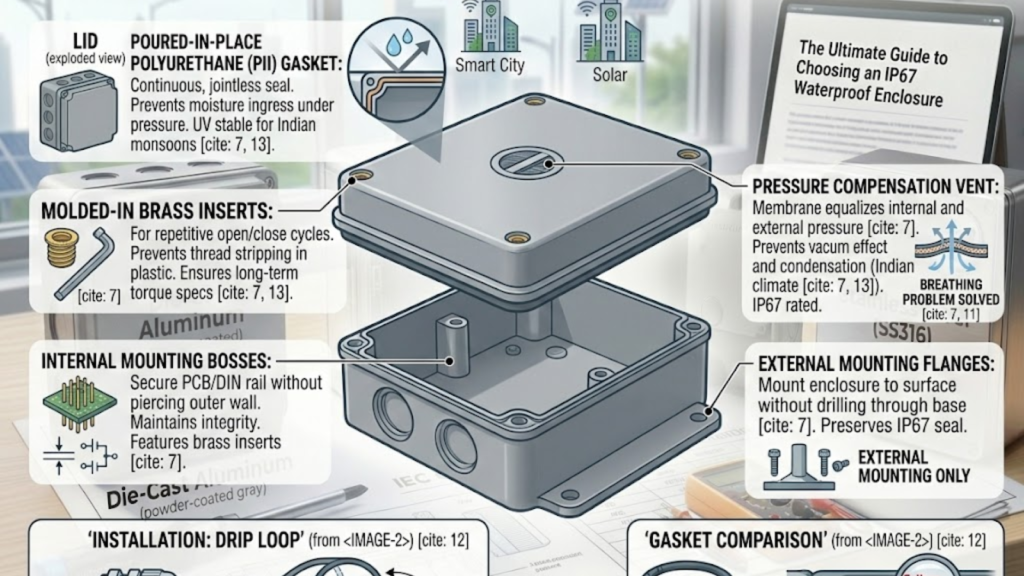
An IP67 waterproof enclosure is not just a plastic or metal box; it is a precision-engineered system. If even one component—like a screw or a seal—fails, the entire internal system (which could cost lakhs of rupees) is at risk. Here is what you must look for in the design:
A. Advanced Gasket Technology (The First Line of Defense)
The gasket is the most vulnerable part of any enclosure. In India, where temperatures can swing from 10°C to 45°C in a single day, the gasket must be “resilient.”
- Poured-in-Place (FIPFG): This is a liquid polyurethane foam that is dispensed by a robot directly into the enclosure groove. It has no “joins” or “seams,” which are common failure points in manual rubber O-rings.
- Silicone vs. EPDM: For high-heat industrial areas (like near a furnace or in South India’s humidity), Silicone gaskets are superior because they don’t lose their shape or become “sticky” over time.
B. The “Vacuum Effect” and Pressure Compensation Vents
This is a technical detail most buyers miss. When an IP67 enclosure is sealed, it traps air inside.
- The Problem: During a hot day, the internal air expands. When it rains suddenly (a common Indian monsoon scenario), the box cools rapidly. This creates a vacuum inside that literally “sucks” water through the gasket or cable glands.
- The Solution: Look for enclosures with Protective Vents (e.g., Gore-Tex vents). These allow air molecules to pass through (equalizing pressure) but are too small for water molecules to enter. This prevents “breathing” issues and internal condensation.
C. Captive Screws and Threaded Inserts
In maintenance-heavy industries, screws often get lost.
- Captive Screws: High-quality IP67 housings use screws that stay attached to the lid even when unscrewed.
- Brass Inserts: If you are using a plastic enclosure, look for molded-in brass inserts. Directly screwing into plastic wears out the threads after 2-3 openings, ruining the waterproof seal. Brass ensures you can open and close the lid hundreds of times without losing the “tightness” required for IP67.
D. Mounting Geometry: External vs. Internal
To maintain an IP67 waterproof enclosure rating, you should never drill through the base of the box to mount it on a wall.
- External Mounting Flanges: These allow you to bolt the box to a surface without ever touching the “sealed” area.
- Internal Standoffs: Good designs have “bosses” or pillars inside the box where you can mount your PCB or DIN rail using self-tapping screws without piercing the outer wall.
5. Professional Installation & Maintenance Checklist for Indian Conditions
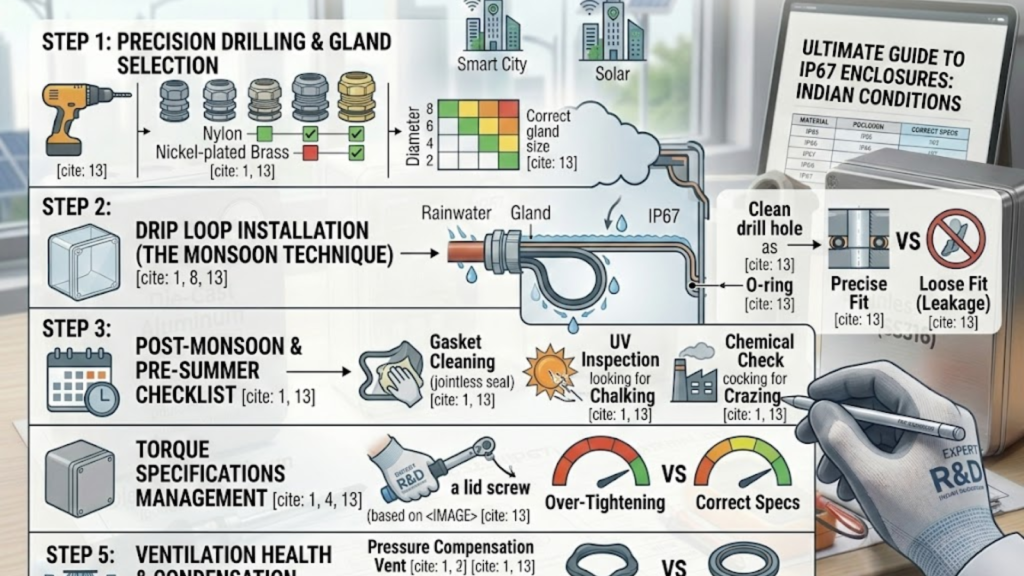
Even the best IP67 waterproof enclosure will fail if installed poorly or neglected. In the Indian context—where dust, monsoon moisture, and high UV are constants—maintenance is your insurance policy.
Step 1: Precision Drilling and Cable Glands
The moment you drill a hole for a wire, the IP67 rating is gone—unless you use a Cable Gland.
- Selection: Ensure the cable gland matches the diameter of your cable perfectly. A loose fit is a highway for water.
- Material Match: Use Nylon glands for plastic boxes and Nickel-plated brass glands for aluminum boxes to prevent galvanic corrosion.
- NPT vs. Metric: Ensure your drill bit matches the thread type (PG, Metric, or NPT) of your glands to avoid “stripped” threads that leak air and water.
Step 2: The “Drip Loop” Technique
This is a classic “pro-tip” for Indian electricians. When running a cable into an outdoor IP67 enclosure, always create a Drip Loop (a U-shaped bend in the wire before it enters the gland).
- Why? Gravity pulls rainwater down the cable. If the cable goes straight into the box, water pools at the seal. With a drip loop, the water falls off the bottom of the curve before reaching the enclosure.
Step 3: Seasonal Maintenance (Post-Monsoon & Pre-Summer)
In India, the transition between seasons is the most dangerous time for electronics.
- Gasket Cleaning: Open the box once a year. Use a soft microfiber cloth to wipe the gasket. Fine Indian dust (silt) can act like sandpaper, slowly eroding the seal every time the lid is opened.
- Visual UV Check: Look for “Chalking” (a white powdery substance on the surface). This is a sign that the plastic’s polymer chains are breaking down due to UV. If you see this, it’s time to replace the housing or add a sunshade.
- Torque Management: Never “over-tighten” the lid. Use a torque wrench if possible. Over-tightening can “crush” the gasket, causing it to lose its “memory” (elasticity), which eventually leads to leaks.
Step 4: Chemical Exposure Check
If the enclosure is in an Indian factory (textiles, chemicals, or food processing), check for chemical “crazing” (tiny spider-web cracks). Some industrial cleaning agents can react with ABS or Polycarbonate, making them brittle. In such cases, switching to Stainless Steel or Fiberglass is the only long-term solution.
Frequently Asked Questions (FAQ)
Q1: Can I drill holes in an IP67 enclosure? Yes, but you must use IP67-rated cable glands to seal the hole. If you just run a wire through a drilled hole, the enclosure is no longer waterproof.
Q2: Is IP67 the same as “Submersible”? Only for short durations (30 mins). If your device needs to stay underwater permanently, you must look for an IP68 rating.
Q3: Which material is best for the Indian Summer? Polycarbonate or Aluminum. Avoid ABS for direct sunlight as it will degrade and crack within 1-2 years.
Q4: Are these enclosures fireproof? Not necessarily. Look for a UL94-V0 flammability rating if you need fire-retardant properties.