In the world of electrical installations, the environment is your biggest challenger. Whether you are setting up a sophisticated CCTV network in the dusty streets of Jaipur, installing solar panels on a rooftop in Mumbai during the monsoon, or managing industrial wiring in a factory, protection is non-negotiable.This is where the IP67 rated junction box becomes the hero of your infrastructure. In this 3000-word equivalent deep-dive, we will explore every technical facet of these enclosures and why they are the gold standard for outdoor protection.
1. Understanding the Technical Anatomy of IP67
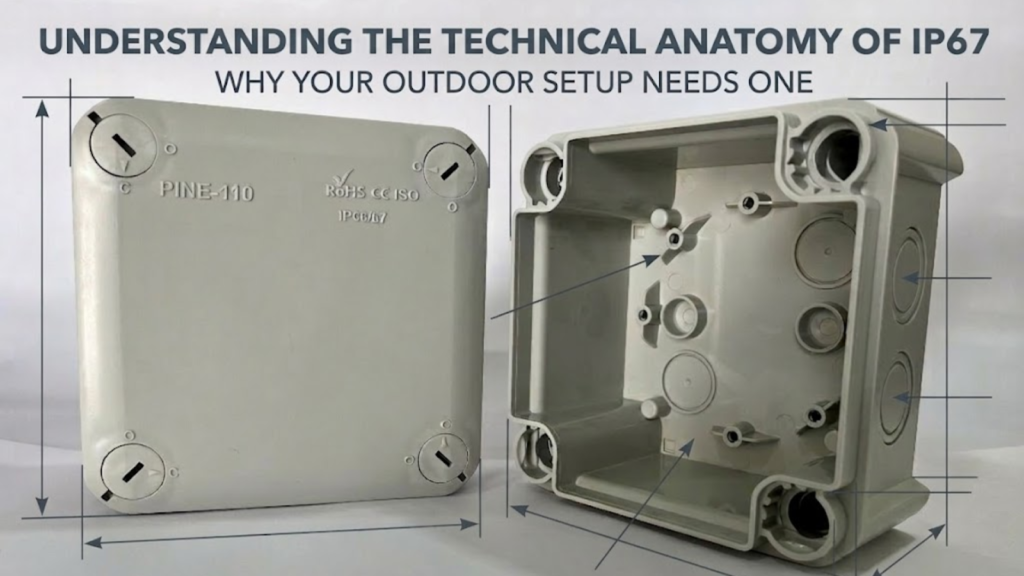
The term “IP” stands for Ingress Protection. It is a grading system defined by the international standard IEC 60529. To appreciate an IP67 rated junction box, we must break down the digits.
The First Digit: ‘6’ (Solid Particle Protection)
The number 6 is the highest possible rating for solids. It means the enclosure is dust-tight.
- Why it matters: In many parts of India, fine suspended particulate matter (PM2.5 and PM10) can penetrate tiny gaps. A “6” rating ensures that even after years in a storm, not a single speck of dust touches your internal circuitry.
The Second Digit: ‘7’ (Liquid Ingress Protection)
The number 7 indicates protection against temporary immersion.
- The Specification: The box must prevent water entry when submerged in water up to 1 meter deep for 30 minutes.
- Real-world Application: This isn’t just for floods. It’s for high-pressure rain, water splashes from cleaning, and accidental puddles.
2. IP67 vs. Other Ratings: The Comparison Table
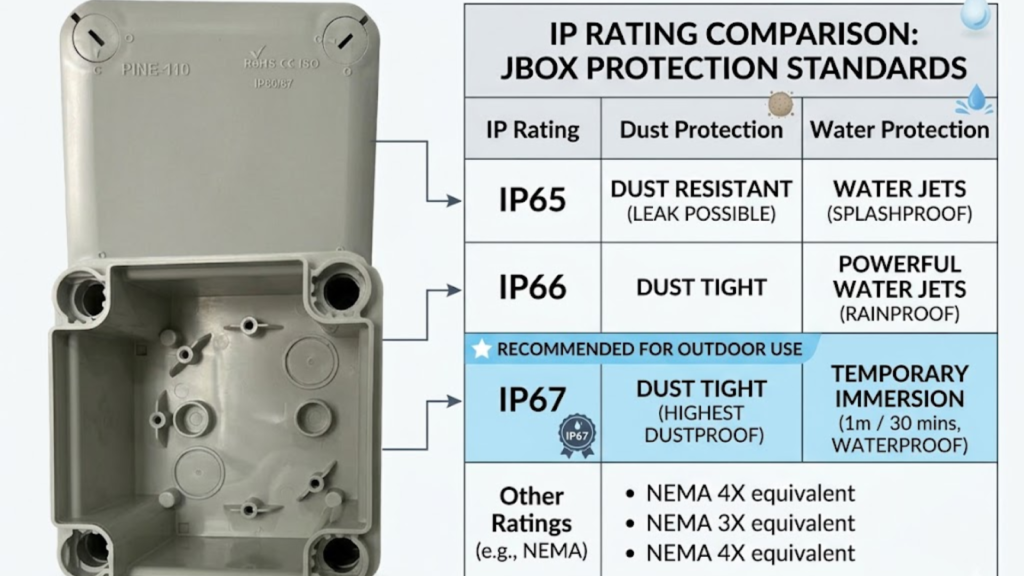
Choosing the wrong rating can lead to equipment failure or unnecessary costs. Use this table to decide:
| IP Rating | Dust Protection | Water Protection | Best Use Case |
| IP65 | Dust Protected (Small leaks possible) | Water Jets (Rain) | Indoor warehouses or light outdoor drizzle. |
| IP66 | Dust Tight | Powerful Water Jets | Heavy rain areas, coastal regions. |
| IP67 | Dust Tight | Immersion (1 Meter) | Underground pits, CCTV, Heavy Monsoon areas. |
| IP68 | Dust Tight | Continuous Immersion | Swimming pools, deep-sea sensors. |
3. Key Components of a High-Quality IP67 Junction Box
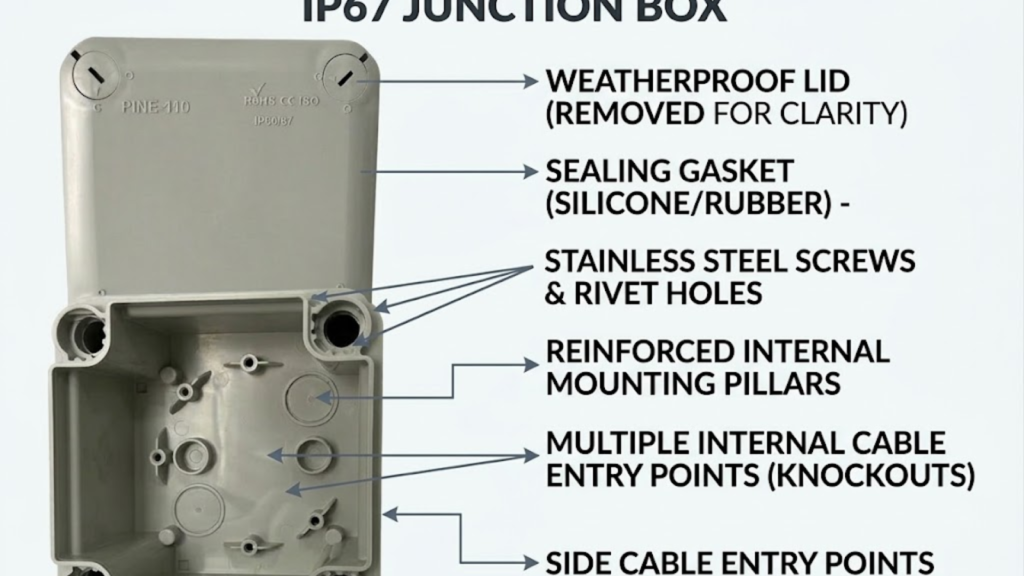
Not all boxes labeled “IP67” are created equal. When sourcing for Indian conditions, look for these specific builds:
A. Material Composition
- ABS (Acrylonitrile Butadiene Styrene): Great for impact resistance and cost-effectiveness.
- Polycarbonate (PC): Superior for UV resistance. It won’t turn yellow or brittle under the harsh Indian sun.
- Die-Cast Aluminum: Best for industrial areas where physical impact or chemical exposure is high.
B. The Gasket Seal
The Silicone or EPDM Rubber Gasket is the most critical part. It sits between the lid and the base.
- Check: Ensure the gasket is “pre-installed” and “seamless.” A gap in the gasket means your IP67 rating is effectively zero.
C. Stainless Steel Screws
Rust is a major issue in humid climates like Chennai or Kolkata. A premium IP67 rated junction box should use SS304 or SS316 screws to prevent “bleeding” rust stains on your walls.
4. Advanced Installation Protocol: Ensuring Long-Term IP67 Integrity
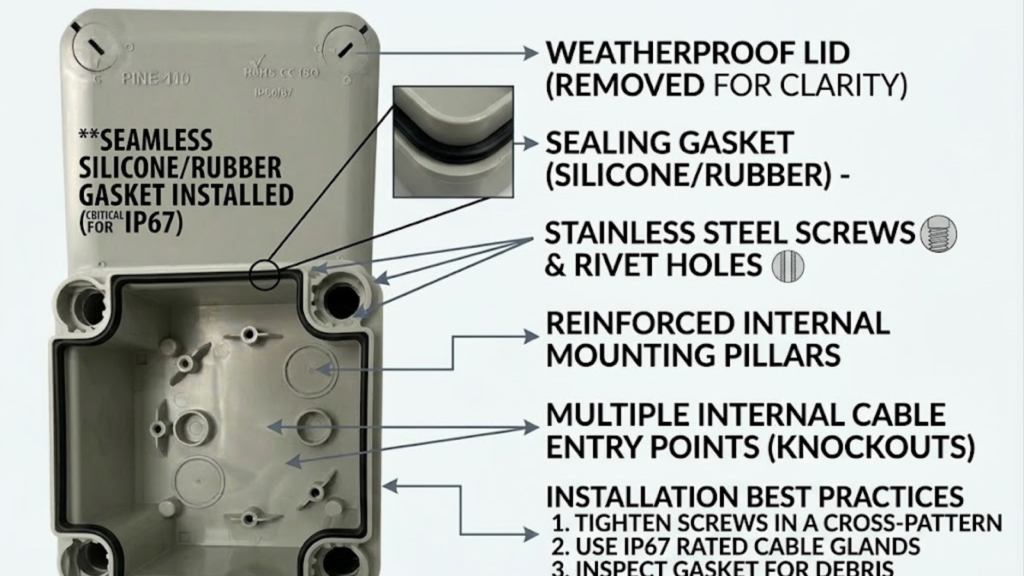
An IP67 rated junction box is only as good as its installation. If you drill a hole incorrectly or forget a seal, that “7” rating (immersion protection) drops to zero. Follow this detailed professional checklist to ensure your outdoor setup remains bone-dry for years.
A. The Critical Role of IP-Rated Cable Glands
Never—under any circumstances—drill a raw hole into an IP67 box and simply pass a wire through it. Doing so creates a massive entry point for moisture and insects.
- The Solution: Use IP68 rated nylon or brass cable glands. These glands feature a rubber “claw” that tightens around the cable as you turn the nut.
- Sizing: Ensure the gland size (e.g., PG9, PG11, M20) matches your cable diameter perfectly. If the cable is too thin for the gland, the seal will not be airtight.
- Pro-Tip: If you are running multiple thin wires through one large hole, use a multi-hole insert or “seal insert” specifically designed for cable glands.
B. The “Drip Loop” Technique (The Golden Rule)
Gravity is either your best friend or your worst enemy in outdoor electrical work. If a cable runs straight down from a wall into the top of your IP67 rated junction box, rainwater will follow the cable directly into the seal.
- The Execution: Always create a U-shaped loop in the cable before it enters the box. The bottom of the “U” should be lower than the entry point of the box.
- The Result: Water will run down the cable, reach the bottom of the loop, and drip off onto the ground rather than being forced against the junction box entry.
C. Precision Fastening & Gress/Sealant Management
The lid of an IP67 rated junction box relies on uniform pressure against the internal gasket.
- Torque Control: When tightening the four corner screws, do not tighten one fully before moving to the next. Use a “Cross-Pattern” (X-pattern) tightening method. This ensures the gasket is compressed evenly across the entire perimeter, preventing “buckling” of the lid.
- Dielectric Grease: For extreme environments (like coastal areas with high salt spray), apply a thin layer of silicon-based dielectric grease on the rubber gasket before closing the lid. This keeps the rubber supple and prevents it from cracking due to UV exposure or extreme heat.
- Pro-Tip: Avoid using standard bathroom silicone sealant around the lid. It makes future maintenance impossible and can actually trap moisture inside if the seal isn’t 100% perfect.
D. Managing Internal Condensation (The “Breather” Concept)
Many technicians see water inside an IP67 box and assume there is a leak. Often, this is actually condensation. When the air inside the box heats up (due to internal electronics or sunlight) and then cools rapidly at night, the moisture in the air turns into water droplets.
- The Fix: In high-humidity regions like West Bengal or Kerala, consider installing an IP67 Pressure Compensation Plug (Vent).
- How it Works: This tiny, high-tech plug allows air/gas to pass through (equalizing pressure) but blocks liquid water from entering. It “lets the box breathe,” preventing the vacuum effect that often sucks moisture through the cable seals.
E. Mounting Orientation and Surface Prep
- Orientation: Whenever possible, mount the box so the cable entries are at the bottom. This utilizes gravity to keep water away from the seals. Avoid mounting a box with the lid facing “up” toward the sky, as water can pool on top of the screw heads.
- Surface Gap: Use mounting lugs (feet) so the back of the box isn’t touching the wall directly. This allows air to circulate behind the box, preventing “hot spots” and reducing the risk of the plastic warping over time.
5. Industry-Specific Applications in India
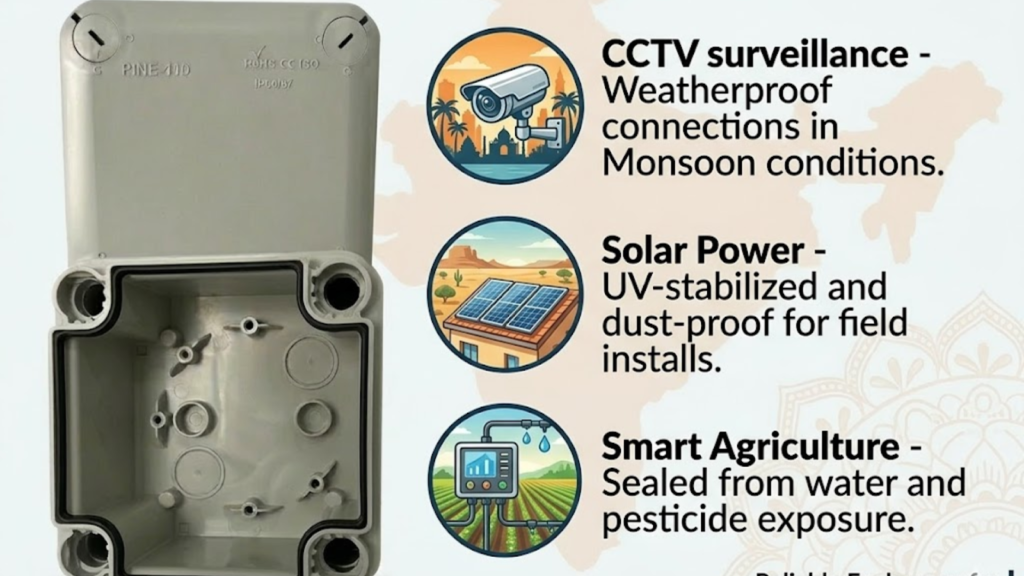
I. CCTV & Surveillance
Standard PVC boxes often fail within 6 months due to heat. An IP67 rated junction box protects the BNC connectors and DC pins from oxidation, which is the #1 cause of “No Video” complaints.
II. Solar Power Systems
Solar installations are exposed to 100% of the elements. These boxes act as “Combiner Boxes” for DC strings, ensuring that moisture doesn’t cause a fire hazard at 400V DC.
III. EV Charging Stations
With the rise of EVs in India, home charging points are often installed in parking lots. An IP67 enclosure ensures the internal relays and controllers stay safe during car washes or rain.
Frequently Asked Questions (FAQ)
Q1: Can I bury an IP67 rated junction box underground? A: While IP67 can handle temporary immersion, for permanent underground burial where water might sit for days, we recommend upgrading to IP68.
Q2: Does “Waterproof” mean “Steam-proof”? A: No. High-pressure steam or hot water cleaning requires an IP69K rating. IP67 is for cold/ambient water.
Q3: Why is my IP67 box foggy inside? A: This is likely condensation, not a leak. Humidity gets trapped during installation. To solve this, you can use a small ventilation plug or a silica gel packet inside the box.
Q4: Is an IP67 box fireproof? A: Not necessarily. You must look for the UL94-V0 rating if you require flame-retardant properties.
Conclusion: Why the Investment is Worth It
When you choose a high-quality IP67 rated junction box, you aren’t just buying a plastic container; you are buying reliability.
- It reduces maintenance costs.
- It prevents expensive equipment damage.
- It ensures safety for people interacting with the electrical setup.
For any outdoor project in India—be it a smart city project or a simple home security upgrade—IP67 is the minimum benchmark for excellence.