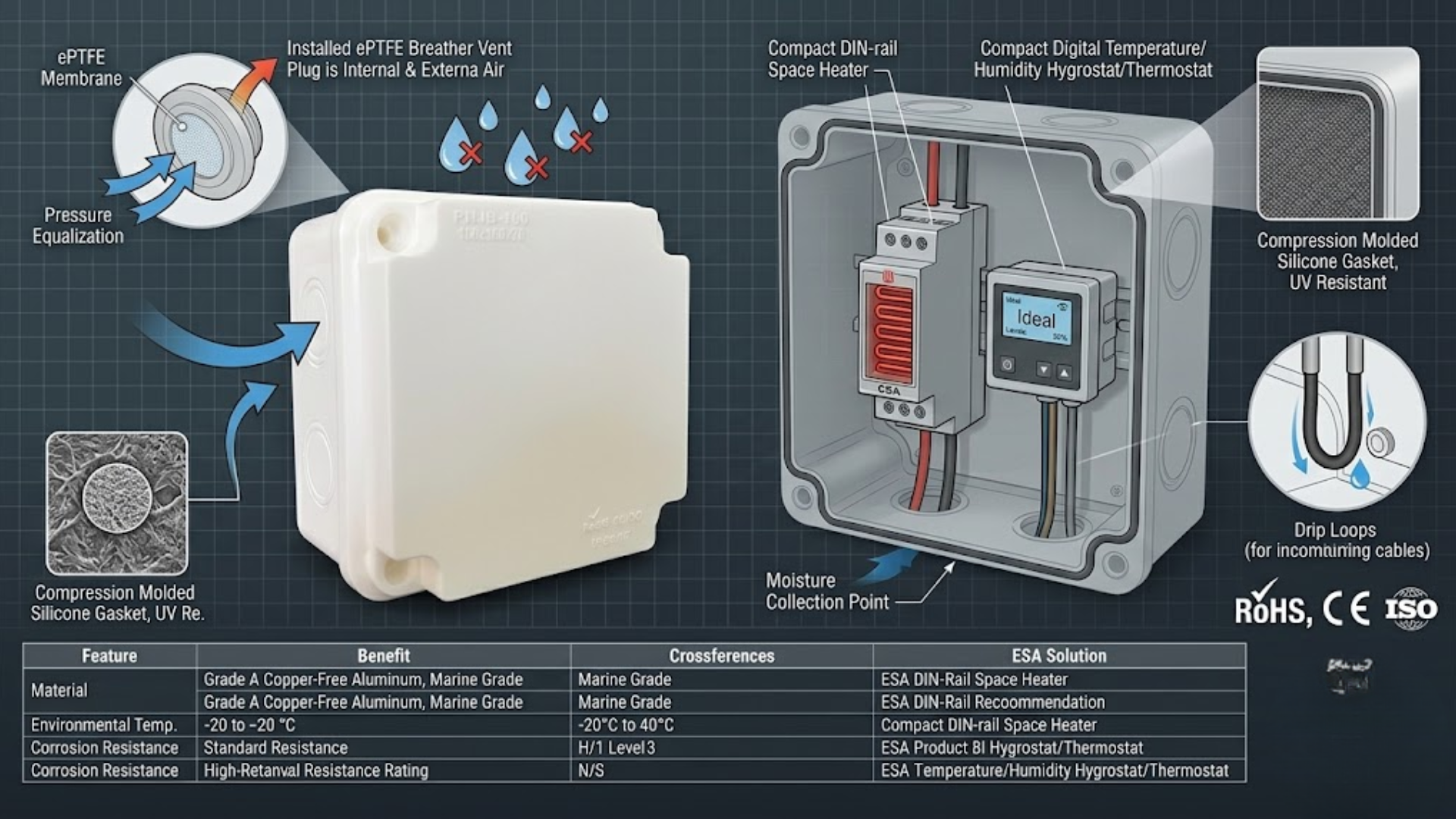
In the demanding landscape of Indian manufacturing—from the heavy industries in Bhilai to the sprawling solar farms in Rajasthan—the industrial IP67 junction box is a staple. It is the frontline defender for electrical terminations, sensors, and sensitive PLC modules. We trust the “IP67” certification to mean our electronics are safe from the monsoon rains, heavy wash-downs, and thick industrial dust.
However, many plant engineers face a frustrating mystery: Why is there water inside my perfectly sealed, brand-new IP67 box?This is not a failure of the seal; it is a failure to manage thermodynamics. This 3,000-word guide will break down everything you need to know about internal condensation, why your industrial IP67 junction box acts like a “moisture trap,” and how to implement professional-grade solutions to protect your assets.
1. Understanding the IP67 Standard in the Indian Context
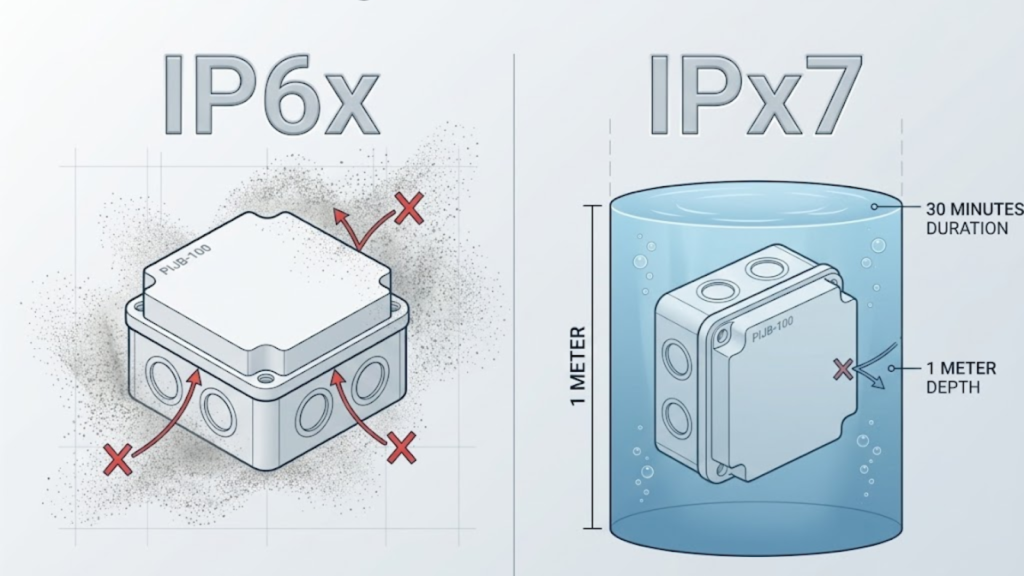
Before solving the moisture problem, we must understand what an industrial IP67 junction box actually promises.
- The ‘6’ (Dust Protection): Complete protection against dust ingress. No dust can enter the enclosure for the life of the product.
- The ‘7’ (Liquid Protection): Protection against immersion in water up to 1 meter for 30 minutes.
The “Airtight” Fallacy
In India, ambient temperatures can soar to 48°C during the day and drop to 20°C at night. An IP67 box is sealed so tightly that it creates its own micro-climate. When the air inside cannot escape, it undergoes massive pressure changes. This “airtight” nature is exactly what leads to condensation.
2. The Science of the “Sweating” Enclosure
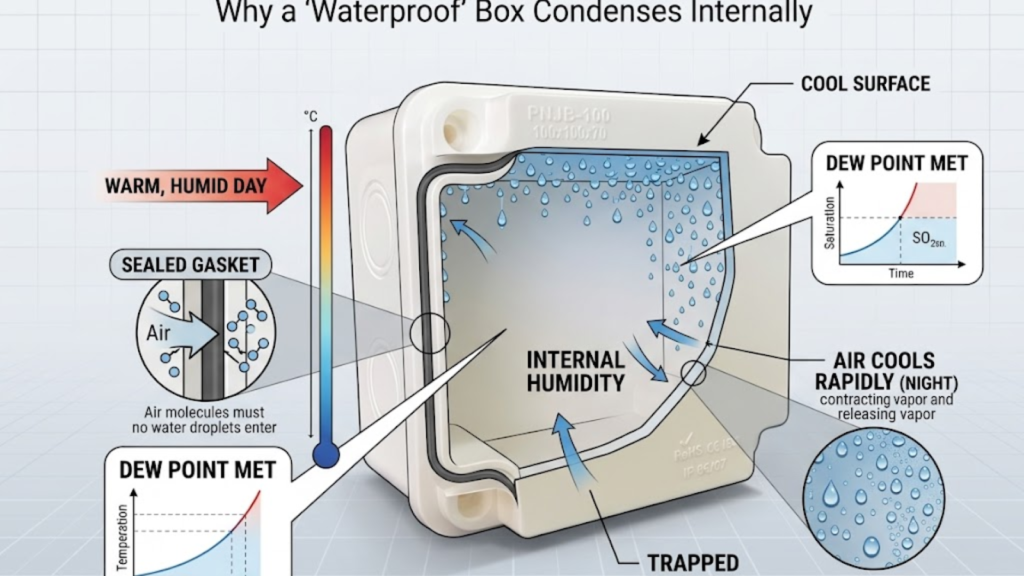
To solve the problem, we must look at the three primary drivers of internal moisture:
A. The Dew Point Phenomenon
Air contains water vapor. The warmer the air, the more moisture it can hold. When the sun hits an industrial IP67 junction box, the internal temperature rises, and the air absorbs any trace of moisture. At night, as the enclosure surface cools rapidly, the air inside hits its Dew Point.
Definition: The Dew Point is the temperature at which air becomes saturated and water vapor transforms into liquid droplets.
B. Thermal Cycling and Pressure Differentials
Industrial equipment generates heat. When a machine starts, the junction box warms up. When it shuts down, it cools. This “thermal cycling” creates a vacuum.
- High Pressure: Warm air tries to push out.
- Low Pressure (Vacuum): Cool air tries to suck in.
Even the best gaskets have “micro-pores.” Over time, the vacuum pulls in moist humid air from the outside.
C. Solar Radiation (The Greenhouse Effect)
In regions like Rajasthan or Gujarat, outdoor enclosures face intense UV and solar heat. Darker enclosures or metal boxes without proper shades can reach internal temperatures 20-30% higher than the ambient air, accelerating the condensation cycle.
3. Comprehensive Solutions: How to Keep Your Enclosures Bone-Dry
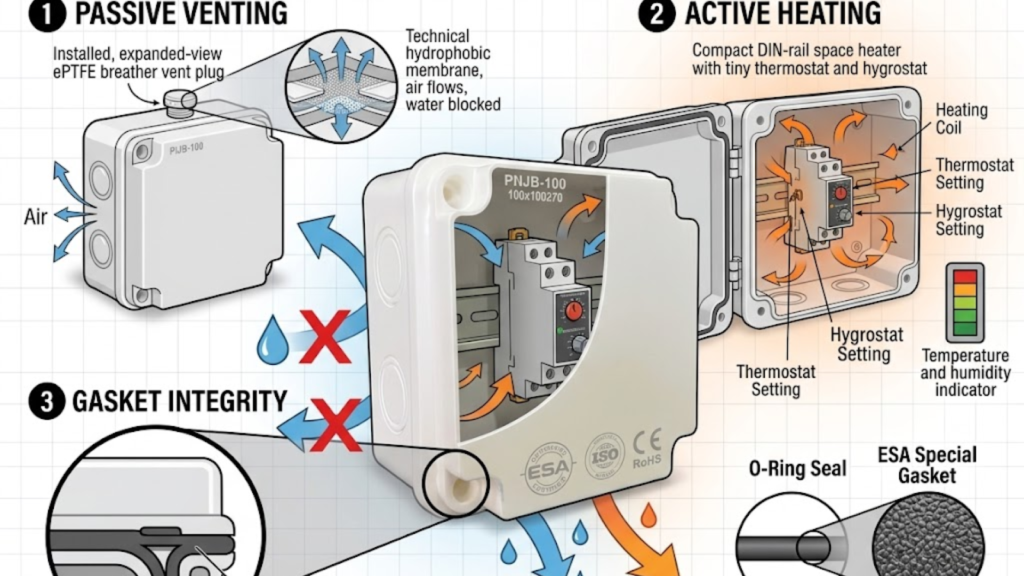
I. Mechanical Ventilation (The Best Long-Term Solution)
The most effective way to manage an industrial IP67 junction box is to stop it from being “airtight” while keeping it “watertight.”
- Breather Glands: These replace standard cable glands. They contain a semi-permeable membrane (often made of ePTFE) that allows air molecules to pass but blocks water molecules.
- Pressure Compensation Units (PCUs): These are small screw-in vents that equalize internal and external pressure, preventing the vacuum effect that sucks in moisture.
II. Active Climate Control
For mission-critical control panels, passive methods aren’t enough.
- Anti-Condensation Heaters: These maintain the internal temperature at roughly 5°C above the ambient temperature.
- Thermostats & Hygrostats: Use these to trigger heaters only when humidity levels cross 65-70%.
III. Proper Installation Techniques
- Drip Loops: Always create a “U” shape in the cable before it enters the gland. This ensures rain runs off the cable and drips to the ground rather than running directly into the gland.
- Conduit Sealing: Use a high-quality sealing compound (like duct seal) to plug the ends of conduits. This prevents moist air from the “warm” side of a building from traveling through the pipe into the “cool” junction box.
4. Material Comparison: Which Box is Right for You?
Choosing the right material for your industrial IP67 junction box can significantly impact moisture management.
| Material Type | Heat Dissipation | Corrosion Resistance | Best For |
| Aluminum (ESA Grade) | Excellent (Acts as a heat sink) | High (with powder coating) | Heavy Industry, High Heat |
| Stainless Steel | Moderate | Superior | Food & Pharma, Coastal Areas |
| Polycarbonate | Poor (Insulator) | High | Chemical Plants, Solar Arrays |
| ABS Plastic | Poor | Low UV Resistance | Indoor, Light Industrial |
5. Maintenance Checklist for Industrial Enclosures
To ensure your ESA products last for decades, follow this routine maintenance schedule:
- Check Gasket Elasticity: Every 6 months, inspect the lid gasket. If it feels brittle or flattened, replace it. A compressed gasket is the #1 cause of IP rating failure.
- Inspect Breather Membranes: Ensure breather plugs are not clogged with paint, oil, or thick dust. If the membrane is blocked, the box cannot breathe.
- Terminal Tightening: Thermal cycling can loosen screw terminals. Re-torque them to prevent “hot spots” that add unnecessary heat inside the box.
- Silica Gel Replacement: If using desiccants, check the color indicator. Pink means it is saturated; blue (or orange) means it is dry.
FAQ: Everything You Need to Know
Q1: Can I use a regular IP65 box instead of IP67 to save costs? A:
No. While IP65 protects against water jets, it does not offer the same protection against the vacuum-assisted moisture ingress that an industrial IP67 junction box is designed to handle in high-humidity zones.
Q2: Does “ESA” offer customized hole drilling for breather vents?
A: Yes. To maintain the integrity of the box, it is always recommended to have holes CNC-machined at the factory rather than using a hand drill on-site, which can cause micro-cracks.
Q3: How many breather vents do I need per box?
A: For a standard small junction box, one vent is enough. For larger enclosures (above 500mm), two vents (one high, one low) create a “chimney effect” for better airflow.
Q4: Is aluminum better than plastic for preventing condensation?
A: Aluminum is better at conducting heat. This means it reaches thermal equilibrium with the outside air faster, which can actually reduce the duration of the dew-point window compared to plastic.
Conclusion: Engineering Peace of Mind
Managing moisture in an industrial IP67 junction box requires more than just a tight seal—it requires an understanding of the environment. By combining ESA’s high-quality enclosure engineering with active ventilation and proper installation, you can eliminate the risk of condensation-related failures.
Don’t let a few drops of water shut down your production line. Invest in the right technology today.
Need a technical consultation for your plant? ESA specializes in high-durability enclosures for the most challenging Indian environments. Contact our engineering team today for a customized quote and technical drawing for your next project.