In any large-scale industrial facility—be it a sprawling petroleum refinery in Jamnagar or a high-tech automobile assembly line in Pune—the integrity of the electrical grid is paramount. At the center of this integrity lies the industrial junction box electrical enclosure. While it may appear to be a simple “metal box,” it is a sophisticated piece of safety equipment engineered to prevent catastrophic failures.
1. The Engineering Anatomy of an Industrial Junction Box
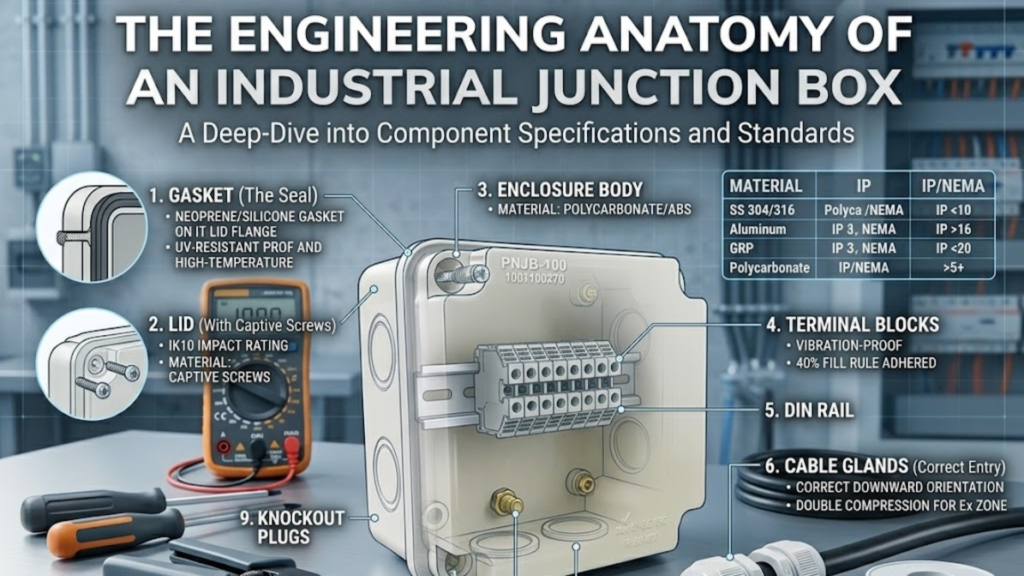
To understand why a specific box costs ₹500 while another costs ₹5,000, we must look at the anatomy. An industrial-grade enclosure is designed to manage thermal expansion, electrical interference, and physical impact.
Key Components and Their Functions:
- The Enclosure Body: The primary shell that provides the IK (Impact) rating. In heavy industries, an IK10 rating is often required to withstand falling objects or accidental hits by machinery.
- The Gasket (The Seal): This is the most critical part for IP ratings. High-quality boxes use Neoprene or Silicone gaskets that don’t crack under India’s extreme summer heat (reaching 45°C-50°C).
- Terminal Blocks: These are the internal “rail” systems (often DIN Rails) where wires meet. In an industrial junction box electrical setup, these must be vibration-proof to prevent wires from shaking loose over time.
- Mounting Brackets: These ensure that the box is not directly touching a vibrating machine, which helps in preventing “fretting corrosion” of the internal contacts.
2. Deep Dive: Material Science in Electrical Enclosures
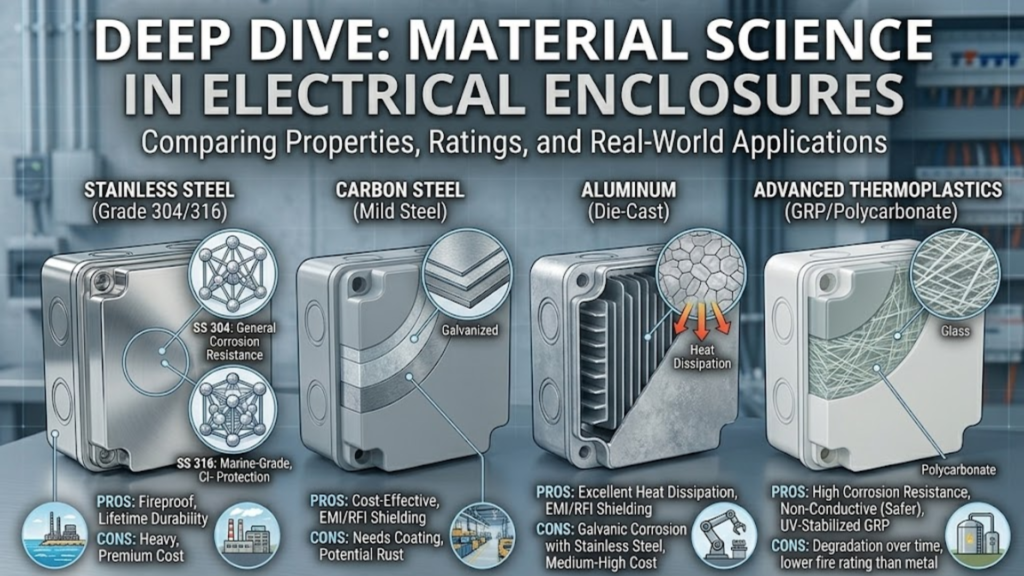
Choosing the wrong material can lead to “Galvanic Corrosion”—a chemical reaction that happens when two different metals touch in a humid environment.
A. Stainless Steel: The Gold Standard
Stainless steel is preferred in environments where hygiene and corrosion resistance are non-negotiable.
- Grade 304: Best for general indoor manufacturing where moisture is present.
- Grade 316: Known as “Marine Grade.” It contains 2% Molybdenum, which protects against chlorides (salt). If your facility is within 50km of the Indian coastline, 316 is mandatory.
B. Carbon Steel (Mild Steel)
Used primarily for indoor power distribution. However, in India, these must be Hot-Dip Galvanized or Powder Coated to prevent rust during the monsoon season.
C. Advanced Thermoplastics (GRP & Polycarbonate)
Modern engineering has made Glass Reinforced Polyester (GRP) almost as strong as metal.
- Benefits: It is an insulator. If a wire touches the inside of a GRP box, the box itself does not become “live,” reducing the risk of electrocution to workers.
3. The Technical Spectrum: IP Ratings and NEMA Standards
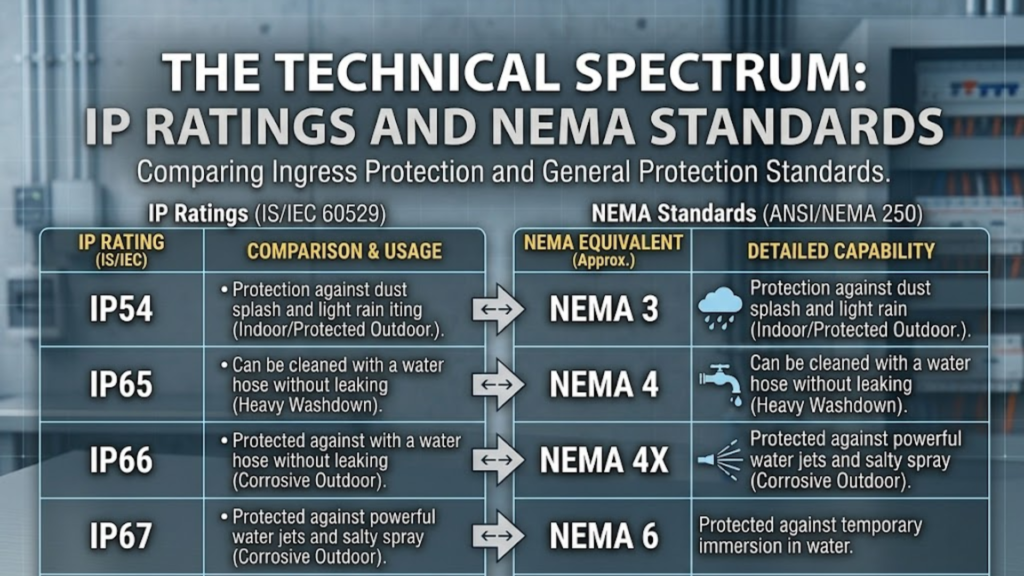
In India, we primarily follow the IEC (International Electrotechnical Commission) standards, but many MNCs also look for NEMA (National Electrical Manufacturers Association) ratings.
Comparison of Protection Standards
| IP Rating | NEMA Equivalent | Protection Environment | Detailed Capability |
| IP54 | NEMA 3 | Indoor/Protected Outdoor | Protects against dust splash and light rain. |
| IP65 | NEMA 4 | Heavy Washdown | Can be cleaned with a water hose without leaking. |
| IP66 | NEMA 4X | Corrosive Outdoor | Protected against powerful water jets and salty spray. |
| IP67/68 | NEMA 6P | Submersible | Can survive being underwater (monsoon flooding). |
4. Comprehensive Installation Strategy
A “fit and forget” approach is a recipe for disaster. Proper installation of an industrial junction box electrical unit requires a systematic approach.
Step-by-Step Installation Guide:
- Orientation: Always mount the box so that the cable entry points face downwards. This prevents water from running down the cable and entering the box via gravity.
- The “Drip Loop”: Before the cable enters the gland, let it hang slightly lower than the entry point. This ensures rain or condensation drips off the wire before reaching the seal.
- Torque Management: Use a torque screwdriver to tighten terminal connections. Over-tightening can snap the wire; under-tightening causes “arcing,” which is a leading cause of industrial fires.
- Breather Vents: In areas like Kerala or West Bengal with high humidity, temperature changes cause “breathing”—moisture gets sucked in and turns into condensation inside the box. Installing a small Breather Drain allows this moisture to escape without compromising the IP rating.
5. Hazardous Areas and Explosion-Proofing (Flameproof)
In industries like Oil & Gas (ONGC, Reliance) or Chemicals, the air may contain flammable gases. A standard junction box can create a spark when a switch is flipped.
- Ex-d (Flameproof): These boxes are heavy-duty. They are designed so that if an explosion happens inside the box, the box will contain the flame and cool down the gases before they can escape and ignite the outside atmosphere.
- Ex-e (Increased Safety): These focus on preventing sparks and heat from ever occurring inside the box.
Extensive FAQ: Clearing the Doubts of Indian Industrialists
Q1: Why is my junction box rusting despite being “Stainless Steel”?
A: This is likely “Tea Staining.” It happens when low-grade SS 304 is used in high-salt areas or if the surface was scratched by carbon steel tools during installation. Always use SS 316 and specialized tools for coastal facilities.
Q2: Can I drill my own holes in a pre-rated IP66 box?
A: Yes, but you must use IP-rated Cable Glands and sealing washers. If you drill a hole and leave it open or use a cheap PVC gland, the box’s rating immediately drops to IP20 (unsafe).
Q3: Is Aluminum better than Plastic for EMI shielding?
A: Yes. If your industrial junction box electrical system houses sensitive data cables or PLC signals, Aluminum or Steel acts as a “Faraday Cage,” blocking electromagnetic interference from nearby heavy motors.
Q4: What is the significance of the “IK Rating”?
A: While IP ratings are about water/dust, the IK rating (IK01 to IK10) measures resistance to kinetic energy (impact). In mining or heavy manufacturing, an IK10 rating is vital to ensure the box doesn’t crack when hit by a tool.
Conclusion
The industrial junction box electrical infrastructure is the silent guardian of your factory. By selecting the right material, ensuring a perfect IP-rated seal, and following rigorous installation standards, you protect your most valuable assets: your machinery and your people.
In the Indian context, where humidity, dust, and temperature fluctuations are extreme, “over-engineering” your junction box selection is not an expense—it is the best insurance policy you can buy.