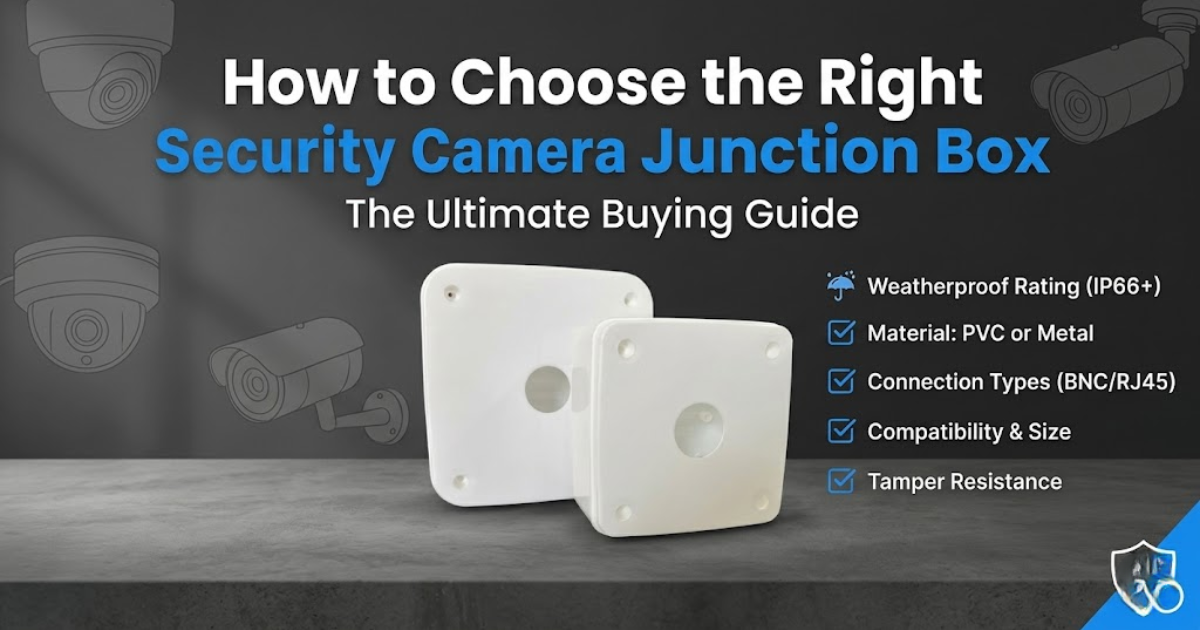
When planning a surveillance system, most homeowners and business owners in India spend weeks researching camera brands, megapixels, night vision ranges, and Network Video Recorder (NVR) storage capacities. They willingly spend tens of thousands of rupees on premium hardware but completely overlook a small, critical component that costs less than a fraction of the budget: the security camera junction box.
Leaving your CCTV cables, power connectors, and video baluns exposed to India’s harsh environmental conditions—ranging from the extreme summer heat of Rajasthan to the torrential monsoons of Mumbai and coastal salinity of Chennai—is a recipe for system failure.
This comprehensive, highly detailed guide covers everything you need to know about selecting, sizing, and installing the perfect security camera junction box to ensure your property remains protected 24/7 without interruption.
What is a Security Camera Junction Box and Why is it Non-Negotiable?
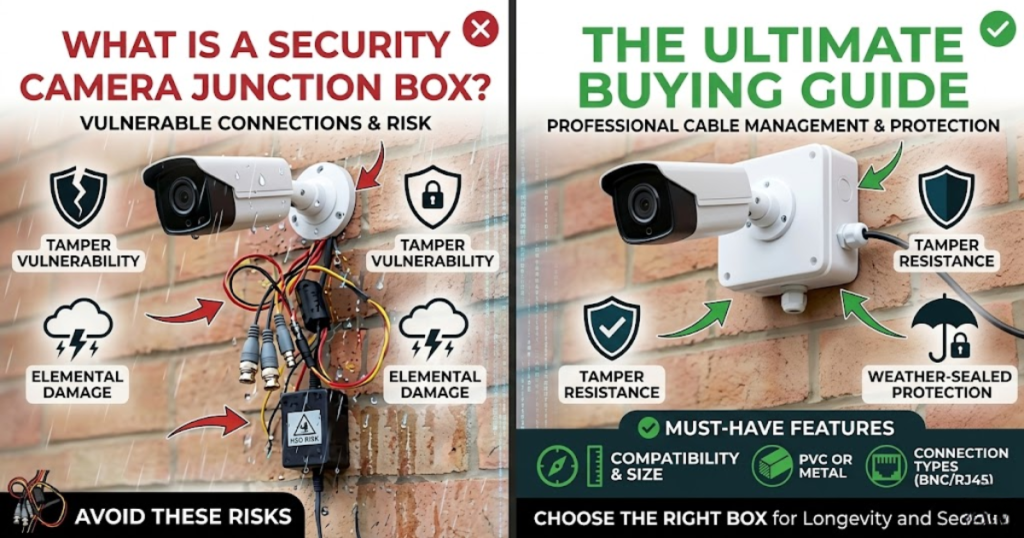
A security camera junction box is a specialized, protective enclosure designed to house the electrical connections, video cables (BNC or RJ45 Ethernet connectors), splitters, and power adapters of a surveillance camera. It serves as the physical mounting base for the camera itself, creating a self-contained, highly secure, and weather-sealed environment.
Many amateur installers or cost-cutting contractors will attempt to mount CCTV cameras directly to walls or ceilings, stuffing the vulnerable wire joints into a crude hole in the wall or behind plastic conduits. This practice exposes your security infrastructure to major operational risks.
The Core Benefits of Using a Dedicated Junction Box
- Absolute Weatherproof Protection: Moisture is the number one killer of outdoor electronics. In India, high humidity and heavy rainfall cause rapid corrosion of exposed copper contacts. A properly sealed junction box completely isolates these delicate connections from water ingress, dust storms, and ambient moisture.
- Tamper and Vandal Resistance: If a burglar or trespasser can see exposed cables trailing out of your camera, they can easily cut them with a basic pair of pliers or yank them down, blinding your security system instantly. A junction box completely conceals the cabling infrastructure, offering zero access points for manual tampering.
- Neat Cable Management and Professional Aesthetics: Dangling wires, messy insulation tape joints, and visible loose cables look incredibly unprofessional on commercial facades and ruin the aesthetic appeal of modern Indian homes. A junction box neatly bundles all excess wire length internally, providing a clean, flush, premium finish.
- Stable Structural Mounting Base: Walls made of hollow bricks, soft plaster, or loose concrete might not provide a stable grip for direct camera mounting screws over time. A junction box distributes the structural weight across multiple heavy-duty wall plugs, providing a rock-solid foundation that prevents camera shake during high winds.
Detailed Material Analysis: Plastic (PVC) vs. Aluminum (Metal)
The foundational choice when selecting your junction box centers around its manufacturing material. The two dominating categories in the Indian market have distinct structural profiles and operational limits.
1. High-Grade Plastic / PVC Enclosures
Polyvinyl Chloride (PVC) and high-impact polycarbonate junction boxes are incredibly popular due to their cost efficiency and ease of modification.
- Pros:
- 100% Rust-Proof: Completely immune to oxidation, making them brilliant choices for coastal areas like Mumbai, Goa, and Kolkata where salty sea air corrodes metals rapidly.
- Non-Conductive: Eliminates the risk of stray ground currents or electrical shocks passing through the camera housing.
- Easy Customization: Technicians can drill customized cable entry holes using standard hole saws in seconds without needing specialized metal bits.
- Cons:
- UV Degradation: Standard, low-quality PVC can become brittle and crack after prolonged exposure to the intense Indian summer sun.
- Lower Impact Resistance: Can be smashed open relatively easily with a heavy tool compared to metal enclosures.
- Best Suited For: Indoor installations, residential corridors, under balcony ceilings, or sheltered semi-outdoor locations.
2. Die-Cast Aluminum / Metal Enclosures
Engineered for industrial-grade protection, die-cast aluminum boxes are rugged, resilient, and highly secure.
- Pros:
- Maximum Vandal Protection: Extremely strong structures that can withstand impacts from stones, sticks, or deliberate blunt force attacks.
- High UV Resistance: Totally unaffected by UV rays, allowing them to withstand peak 45°C+ summer temperatures year after year without losing structural integrity.
- Perfect Shielding: Provides minor electromagnetic interference (EMI) shielding for video cables against nearby power lines.
- Cons:
- Susceptible to Oxidation: If the outer powder coating scratches off, raw metal exposed to monsoon rains can oxidize over time.
- Higher Cost: Significantly more expensive than basic PVC options.
- Best Suited For: Perimeter walls, open parking lots, commercial buildings, industrial zones, and any outdoor area completely exposed to rain and sun.
Understanding IP Ratings for Indian Climatic Zones
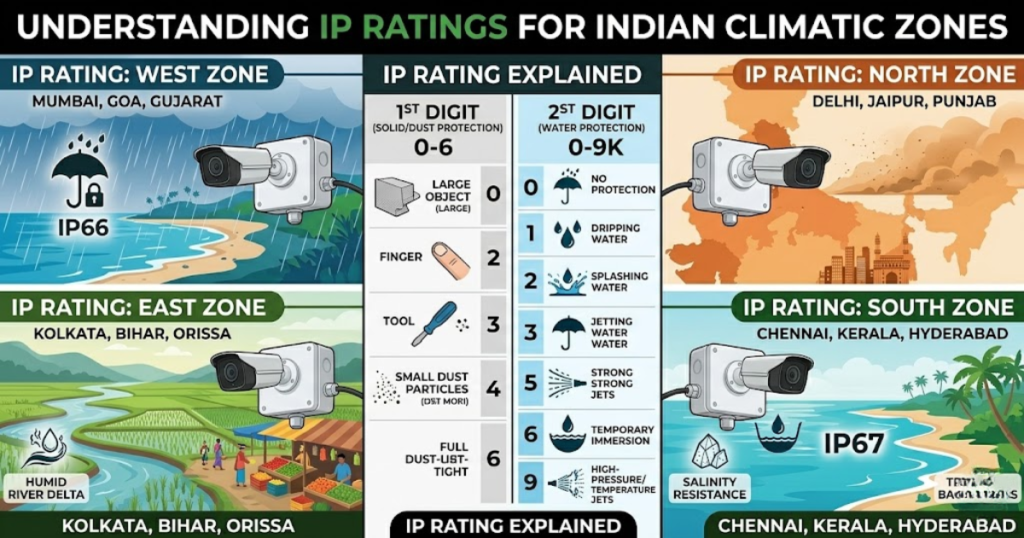
When shopping for an outdoor security camera junction box, you will encounter the term “IP Rating” (Ingress Protection). This international metric defines how effective the enclosure is against foreign particles and liquids.
The rating consists of two digits (e.g., IP66):
- The First Digit (0–6): Measures protection against solid objects like dust, dirt, and insects. A rating of 6 represents complete dust tightness.
- The Second Digit (0–9K): Measures protection against liquids. Higher numbers indicate resistance to stronger water pressures.
IP Rating Matrix for Surveillance Enclosures
| IP Rating | Level of Protection | Recommended Deployment Zone |
| IP65 | Fully dust-tight; resists low-pressure water jets from any direction. | Covered porches, semi-outdoor parking shades, building entryways. |
| IP66 | Fully dust-tight; resists heavy seas or powerful high-pressure water jets. | Standard Recommendation for Indian Monsoons. Open walls exposed to heavy downpours. |
| IP67 | Fully dust-tight; resists temporary immersion in water up to 1-meter depth. | Flood-prone low-lying areas, open industrial yards, coastal boundaries. |
Warning: Never buy an unrated, generic local box with no clear IP certification for outdoor use. Saving 50 rupees on an uncertified box could cost you a 5,000 rupee camera during the first heavy monsoon shower.
Camera Compatibility: Form Factors, Shapes, and Hole Patterns
A major logistical headache during installation is finding a box whose mounting holes align perfectly with the base plate of your camera.
Form-Factor Layout Matrix
| Camera Type | Ideal Box Shape | Structural Characteristics |
| Dome Camera | Deep Round (Circular) | Matches the clean circular base of the dome, hiding the box entirely beneath the camera profile for neat ceiling mounts. |
| Bullet Camera | Square (4×4 inches) or Rectangular | Provides a wide, flat structural surface area to securely anchor the heavy arm lever of bullet-style cameras on vertical walls. |
| PTZ (Pan-Tilt-Zoom) Camera | Heavy-Duty Dedicated Metal Box | Built with thick wall gauges to manage the active mechanical load, torque, and constant motion vibrations of moving cameras. |
Universal vs. Brand-Specific Boxes
- Brand-Specific Junction Boxes: Manufacturers like Hikvision, Dahua, CP Plus, and Honeywell design dedicated junction boxes custom-milled for their specific camera models. If your budget permits, always choose these. The screw holes line up perfectly, and the built-in rubber gaskets provide a flawless airtight seal.
- Universal Security Camera Junction Box: These are cost-effective, third-party boxes featuring a complex matrix of pre-drilled, multi-patterned screw tracks on the top cover. They are designed to fit 90% of standard dome and bullet cameras in the market. They are a highly flexible option if you are using mixed-brand setups or unbranded hardware.
Step-by-Step Selection Workflow
To ensure you select the correct configuration without making costly mistakes, follow this structural decision-making process:
[Determine Camera Form Factor: Dome or Bullet?]
[Identify Installation Location: Indoor or Outdoor?]
┌────────┴────────┐
▼
[Indoor] [Outdoor]
│ │
[Select PVC Box] [Select IP66+ Aluminum Metal Box]
│ │
└────────┬────────┘
▼
[Calculate Required Internal Volume for Wires & Power Adapters]
│
▼
[Verify Screw Pattern Compatibility (Universal vs. OEM Brand)]
Internal Volume Calculation: Avoiding Cable Pinching
One of the most common mistakes made by local technicians is selecting a junction box that is too shallow. Inside the box, you need to store several key elements depending on your system’s architecture:
1. For IP/PoE (Power over Ethernet) Systems
- An RJ45 waterproof gland connector.
- Around 6 to 12 inches of excess Cat6 Ethernet cable loop.
- The integrated camera pigtail cable splitter bundle.
- Required Depth: A standard 1.5-inch to 2-inch deep box is generally sufficient since power and data travel along a single slim cable.
2. For Traditional HD Analog (AHD/HD-TVI) Systems
- A bulky BNC video connector jack.
- A DC male/female power pin joint.
- A passive video balun (if using Cat5/Cat6 cables instead of traditional coaxial RG59 cable).
- A 12V local power supply adapter (if power isn’t centrally distributed from a centralized SMPS pool).
- Required Depth: You will mandatory require a deep-profile square box (at least 2 to 2.5 inches deep) to comfortably store these elements without crushing or bending the copper conductors past their legal bend radius limit.
Step by Step Professional Installation Guide – security camera junction box
Achieving a long-lasting, weatherproof surveillance node requires adherence to precise structural installation practices. Follow this sequence for an optimal setup:
1.Marking and Punching the Structural Base:Prerequisite: Check for hidden wall utilities.
Place the rear chassis of the junction box against the concrete wall or ceiling structure. Use a spirit level to check alignment, then mark the anchor screw points with a marker. Drill the holes using an appropriate hammer drill bit and tap premium nylon wall plugs firmly into the masonry.
2.Managing Cable Entry and Routing:Crucial: Maintain structural integrity of the seal.
Run your main conduit pipe directly into the rear or bottom knockouts of the junction box. If entering through the back via an internal wall hole, ensure the hole is clear of sharp debris. Use threaded PVC glands or tight rubber grommets to wrap the incoming cables snugly at the entry point.
3.Anchoring and External Wall Sealing:Prevents moisture tracking behind the enclosure.
Drive heavy-duty anti-corrosive screws through the box into the wall plugs until the chassis is completely rigid. Before fully tightening, apply a generous bead of high-performance exterior silicone sealant all along the top and side seams where the box contacts the rough wall surface. Leave the bottom edge clear to let condensation escape.
4.Terminating, Wrapping, and Packing Connections:The critical electrical phase.
Terminate your video and power lines cleanly. Wrap the physical connector nodes with specialized self-amalgamating rubber tape instead of basic adhesive electrical insulation tape. Neatly curl the excess cable loops along the interior parameter walls of the box, ensuring no wires are pinched when the lid closes.
5.Mounting the Camera and Testing the Seal:Final integration phase.
Run the camera’s pigtail lead through the top lid of the box. Securely screw the camera base onto the pre-drilled holes of the cover plate. Fasten the box lid tightly onto the main body chassis, making sure the integrated internal rubber gasket sits perfectly flat inside its tracking groove without twisting.
Pro-Tips for Optimizing Outdoor Camera Enclosures in India
- The Golden Rule of the Bottom-Entry Drip Loop: Never, under any circumstances, route a cable directly into the top or sides of an outdoor junction box without a protection loop. Always route the cable from the bottom entry point. Additionally, leave a intentional 3-inch U-shaped downward loop (a drip loop) in the cable right before it enters the box. This forces rainwater to slide down the cable, pool at the bottom of the curve, and drip harmlessly onto the ground rather than using gravity to track straight into the box entry seal.
- Silicone Gel Pack Trick: High ambient humidity during the monsoon season can lock moist air inside a tightly sealed box during installation. When the temperature drops sharply at night, this trapped moisture condenses into tiny water droplets inside the enclosure, leading to localized fogging issues on the camera lens or slow corrosion on the pins. To prevent this, toss a 10-gram silica gel moisture-absorbent pouch inside every outdoor junction box right before sealing the lid.
- Anti-Seize Lubricant for Screws: In high-humidity or industrial zones, steel lid screws can bind up or rust shut into aluminum box threads over time. Apply a tiny smear of graphite grease or anti-seize lubricant onto the mounting screw threads during initial setup. This ensures that if you need to open the box 3 years down the line for maintenance, the screws will turn freely without snapping or stripping out.
Frequently Asked Questions (FAQs)
Q1: Is it mandatory to use a junction box if my camera is already rated IP67 weatherproof?
Yes, absolutely. An IP67 rating on a security camera applies exclusively to the integrated camera body, lens array, and sealed chassis. It does not protect the tail end of the cable where it splits out into individual video, data, and power jacks. Those connections feature open copper interfaces that will short-circuit or corrode quickly if left exposed to open air and rain. The junction box protects these vulnerable joint connections.
Q2: Can I use standard modular electrical switch boxes (like a 4×4 PVC light box) as a CCTV box?
While you technically can use them as a cheap workaround for indoor setups, it is highly discouraged for outdoor locations. Standard household electrical switch boxes are made of thin, non-UV stabilized plastic that turns yellow, brittle, and cracks within a couple of seasons under intense sunlight. Furthermore, they lack the multi-patterned universal screw tracks required to safely anchor heavy security cameras, forcing you to make crude, unsealed DIY drill holes.
Q3: How do I handle junction box grounded connections for metal enclosures?
If you are running analog cameras on metal junction boxes anchored directly into industrial metal structures or tin roofs, you may encounter video ground loops. This shows up as rolling lines or distortion across your display screens. In such specialized scenarios, you must isolate the metal box from the building structure using a thick rubber insulating spacer plate or switch over to high-grade non-conductive polycarbonate plastic boxes.
Q4: Should I drill a tiny hole at the bottom of the box to let out trapped water?
If you have purchased a certified IP66 or IP67 weatherproof junction box and installed it correctly with high-quality cable glands, no water will enter, meaning there is zero need for a drainage hole. Drilling a manual hole destroys the certified IP rating of the box, creating an easy entryway for spiders, ants, geckos, and ambient moisture to get inside and nest directly on top of your warm power connections.
Q5: What is the average lifespan of a high-quality CCTV junction box in India?
A premium powder-coated die-cast aluminum or UV-stabilized polycarbonate junction box from an established brand will easily last between 7 to 10 years even under intense outdoor weather conditions. Conversely, cheap, unbranded generic PVC local market boxes bought for 30–40 rupees usually degrade, crack, or leak within 12 to 18 months of outdoor sun exposure.