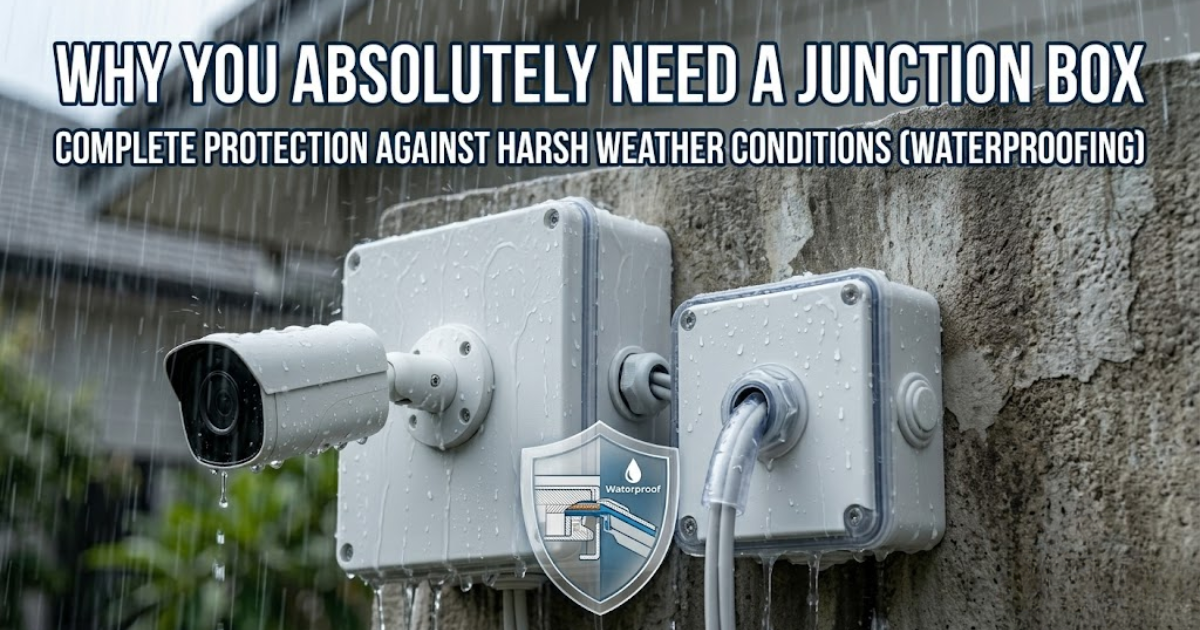
Investing in a high-quality CCTV surveillance system is the first line of defense for protecting your family, home, and commercial property. Most buyers spend days researching the best 4K resolution sensors, night-vision range, smart AI detection, and NVR storage capacities. However, a shocking number of installations fail within the first year due to a single overlooked component: the outdoor security camera junction box.
Skipping a junction box might save a few hundred rupees initially, but it leaves your expensive equipment completely vulnerable to torrential monsoons, extreme summer heat, direct vandalism, and local pests. Think of a junction box not as a cosmetic plastic or metal container, but as the essential armor that guarantees your security system works when you need it most.
In this exhaustive guide, we will break down exactly why an outdoor security camera junction box is non-negotiable for any outdoor surveillance setup in India.
What is an Outdoor Security Camera Junction Box?
Before diving into the core reasons, let us establish what this component actually does. A junction box is an enclosure mounted directly to an external wall, ceiling, or pole. The security camera is mounted directly onto the face of this box.
Inside the hollow body of the box, all vital wire connections—such as BNC connectors for analog systems, RJ45 Ethernet couplers for IP Power-over-Ethernet (PoE) systems, and DC power jacks—are neatly housed and sealed away from the external environment.
1. Complete Protection Against Harsh Weather Conditions (Waterproofing)
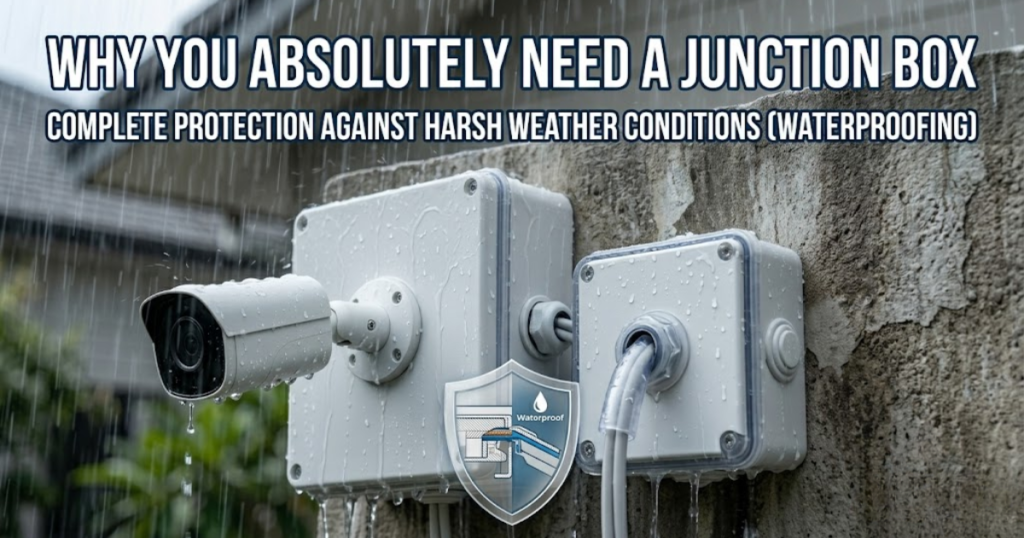
The Indian climate presents unique challenges for electronic equipment. From the relentless monsoon downpours of coastal regions to the intense, dusty heatwaves of the northern plains, outdoor equipment must endure extreme stress.
The Hidden Danger of Moisture and Dust
When security camera cables are left exposed behind the camera mounting bracket, they are vulnerable to moisture infiltration. Rainwater doesn’t just hit the wires directly; it runs down the walls and seeps into unsealed joints.
- Short Circuits: Water bridging the gap between positive and negative power terminals instantly fries the internal circuitry of your camera.
- Signal Degradation: Moisture inside video transmission lines creates resistance, leading to rolling lines, static screen noise, or complete video dropouts.
- Corrosion and Rusting: Copper and aluminum connectors oxidize rapidly when exposed to humid air. This creates a crusty green layer of rust inside the joints, permanently destroying the connection.
The Ingress Protection (IP) Standard
A proper outdoor security camera junction box features rubberized gaskets and silicone seals that carry strict weatherproofing certifications. When looking for a junction box, pay attention to the IP ratings:
| IP Rating | Dust Protection Level | Water Protection Level | Ideal Use Case |
| IP65 | Total protection against dust ingress. | Protected against low-pressure water jets from any angle. | Covered balconies, deep porch roofs, semi-outdoor spots. |
| IP66 | Total protection against dust ingress. | Protected against high-pressure, heavy seas or powerful jets. | Open external walls exposed to direct monsoon downpours. |
| IP67 | Total protection against dust ingress. | Protected against temporary immersion in water up to 1 meter. | Industrial areas, low-lying zones prone to waterlogging. |
2. Preventing Vandalism, Tampering, and Criminal Sabotage
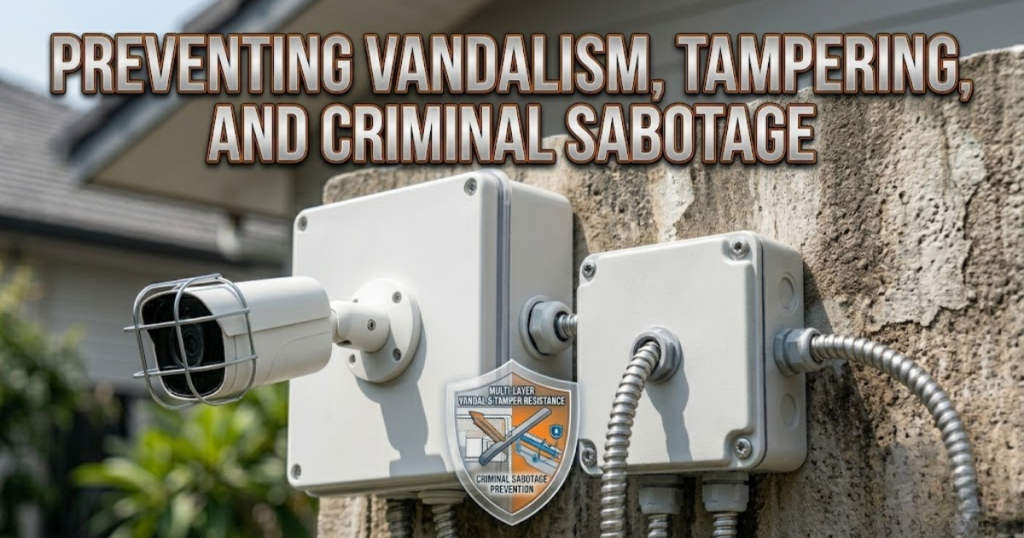
The primary purpose of installing security cameras is to deter criminals and capture unassailable evidence during a break-in. However, an experienced intruder understands the structural vulnerabilities of a standard CCTV installation.
Eliminating the “Easy Snip” Vulnerability
If your cameras are installed bare against a wall, the tail wires (the split pigtail cable extending from the back of the camera) are exposed. A trespasser does not need to smash the camera to disable it. They can simply:
- Reach up with a pair of basic wire cutters or scissors and snip the exposed cable line in less than two seconds.
- Grab the exposed loop of wire and yank it hard, ripping the internal connectors directly out of the camera body.
By installing a solid aluminum or heavy-duty polycarbonate outdoor security camera junction box, the entire cable length transitions seamlessly from inside the wall directly into the sealed box. There are zero exposed loops, hanging wires, or visible connections. A criminal looking up at the camera will see a solid, impenetrable block, forcing them to move away or risk getting caught on camera trying to dismantle a solid enclosure.
3. Combating Local Pests: The Unique Indian Context

Surveillance systems in India face specialized ecological challenges that standard Western installation guides rarely account for. Khuli wiring (open wiring) is an open invitation for local wildlife to disrupt your security infrastructure.
[ Exposed Tail Wires ]
│
┌──────────────────┴──────────────────┐
▼ ▼
[ Monkey Activity ] [ Rodent Infestation ]
• Pulling & swinging on loops • Chewing PVC insulation
• Snapping physical mountings • Creating exposed copper shorts
• Constant alignment displacement • Constant system-wide downtime
- The Monkey Menace: In many urban and semi-urban residential sectors across India, rhesus macaques and langurs are incredibly active. Monkeys are naturally curious and highly destructive. Hanging wires look like vines to them. They will grab, pull, and swing from exposed camera pigtails, easily ripping the camera off its mounts or breaking the sensitive data lines.
- Rodent Destruction: Rats and mice possess incisors that grow continuously throughout their lives. To keep them sharp, they chew on dense plastics. Exposed PVC insulation on video and power cables is a favorite target. A single rat bite can slice through a thin Cat6 or coaxial cable, causing intermittent video loss that takes hours for an engineer to diagnose.
A rugged junction box shields the delicate cables inside an impenetrable barrier that teeth cannot pierce and fingers cannot pry open.
4. Esthetics and Property Valuation (Neat & Professional Looks)
You spend lakhs of rupees designing a modern home facade, an elegant office entryway, or a polished retail storefront. Unmanaged wiring completely compromises the architectural beauty of your property.
- The “Wiring Nest” Effect: Without a box, the excess length of the video cable, the power splitter, and the electrical tape wraps sit bunched up behind or below the camera. Over time, dust, cobwebs, and dirt accumulate in this nest of wires, making your property look unkempt and unmaintained.
- Professional Cleanliness: A junction box serves as a concealment chamber. All slack cable length is coiled smoothly inside the box. The camera sits flush on top of the smooth plate. The result is a crisp, minimalistic, modern profile that blends naturally into the building’s structure rather than sticking out like an eyesore.
5. Long-Term Maintenance and Troubleshooting Simplicity
Electronic components occasionally require servicing. Camera sensors degrade, firmware updates might require hard power cycles, or lightning surges can damage a video balun.
The Diagnostic Nightmare vs. The Simple Fix
Imagine a scenario where one of your primary outdoor cameras goes offline. Here is how troubleshooting compares with and without a junction box:
- Without a Junction Box: The technician arrives. To check the connection, they must peel back layers of sticky, dirty insulation tape that has melted under the hot Indian sun. If the wires were pushed deep into a drilled hole in the brick wall to hide them, the technician has to fish them out with a wire hook, often skinning the insulation or snapping the fragile core wires in the process.
- With a Junction Box: The technician simply unfastens four screws on the front panel of the box. The faceplate opens smoothly, revealing clean, dry, perfectly organized connectors. They can plug in their test monitor instantly, check the voltage with a multimeter, replace a bad connector within five minutes, and seal the box back up.
This saves you thousands of rupees in technician labor costs over the life of your security system.
Material Comparison: Aluminum vs. Plastic (PVC) Junction Boxes
Choosing the right material for your outdoor security camera junction box depends entirely on your budget, environmental exposure, and camera type. Let us examine the specific differences:
Aluminum Junction Boxes
- Durability: Extremely high. Can withstand direct impacts from stones, heavy branches, or attempted vandalism.
- Weather Resistance: Excellent against UV rays. Will not become brittle or crack even after a decade under direct sunlight.
- Weight Capacity: Designed to hold heavy, commercial-grade varifocal bullet and large PTZ (Pan-Tilt-Zoom) dome cameras.
- Cost: Moderately expensive but offers a lifetime of durability.
Heavy-Duty PVC / Polycarbonate Boxes
- Durability: Moderate. Good for standard residential areas, but can crack under high mechanical impacts.
- Weather Resistance: Good, provided it is treated with UV-stabilizer additives. Cheap plastic boxes yellow, warp, and crack within two years of direct sun exposure.
- Weight Capacity: Perfect for lightweight dome and mini-bullet cameras typically used in homes.
- Cost: Highly economical and non-conductive, minimizing the risk of grounding loops or electrical leakage.
Step-by-Step Installation Best Practices
If you are working with an installation agency or taking on a DIY home improvement project, ensure these crucial rules are followed for mounting an outdoor camera box:
- Apply Silicone Sealant: Always run a thin bead of outdoor-rated silicone sealant around the upper edge and sides of the junction box where it meets the wall. Leave the very bottom edge unsealed to allow any accidental condensation to drain away.
- Point Drip Loops Downward: When bringing the main cable feed out of a conduit into the junction box, ensure the cable bends downward slightly before entering the box. This creates a “drip loop,” forcing rainwater to drop off the wire rather than tracking along it into the box entry hole.
- Use Threaded Cable Glands: Never leave the conduit entry holes on the side of the box wide open. Use properly fitted, rubber-grommeted cable glands to grip the incoming conduit securely and lock out moisture and insects.
Comprehensive FAQ Section
Q1: Can I just wrap my camera wires in waterproof electrical tape instead of buying a box?
Answer: Absolutely not. While high-grade self-amalgamating waterproof tape provides temporary moisture protection, it degrades rapidly under solar UV radiation. Within a few months, the adhesive turns into a sticky goo, traps moisture inside, and fails to offer any structural defense against physical impacts, pests, or vandalism.
Q2: Do major camera brands like Hikvision, CP Plus, and Dahua make specific junction boxes?
Answer: Yes. Premium manufacturers produce dedicated aluminum brackets and deep base junction boxes tailored to match the screw-hole patterns of their specific camera models perfectly. If brand-specific models are out of your budget, high-quality heavy-duty universal PVC junction boxes work perfectly well for any standard camera system.
Q3: How do I prevent condensation from forming inside the junction box during high humidity?
Answer: Ensure the box gaskets are perfectly seated during installation. For high-humidity coastal zones (like Mumbai, Chennai, or Kolkata), placing a small pouch of silica gel inside the junction box before sealing it absorbs any residual ambient moisture and keeps the interior perfectly dry.
Q4: If my camera is already weatherproof, why do I still need a separate weatherproof junction box?
Answer: A camera’s weatherproofing rating (e.g., an IP67 bullet camera) only applies to the camera housing itself. The connection point where the camera’s pigtail cable meets your main running cable is not weatherproof. The junction box exists specifically to shield that vulnerable joint.
Conclusion: Protect Your Investment Securely
A professional surveillance setup is an asset designed to last for years. Cutting corners by excluding an outdoor security camera junction box leaves your entire property vulnerable to sudden security blind spots and unexpected repair bills.
For a negligible cost of ₹150 to ₹400 per camera location, a junction box guarantees that your video lines remain bone-dry, your cables stay completely out of reach of criminals and pests, and your property maintains a clean, modern aesthetic. When setting up your home or business security perimeter, make sure a rugged junction box is included in your equipment manifest.