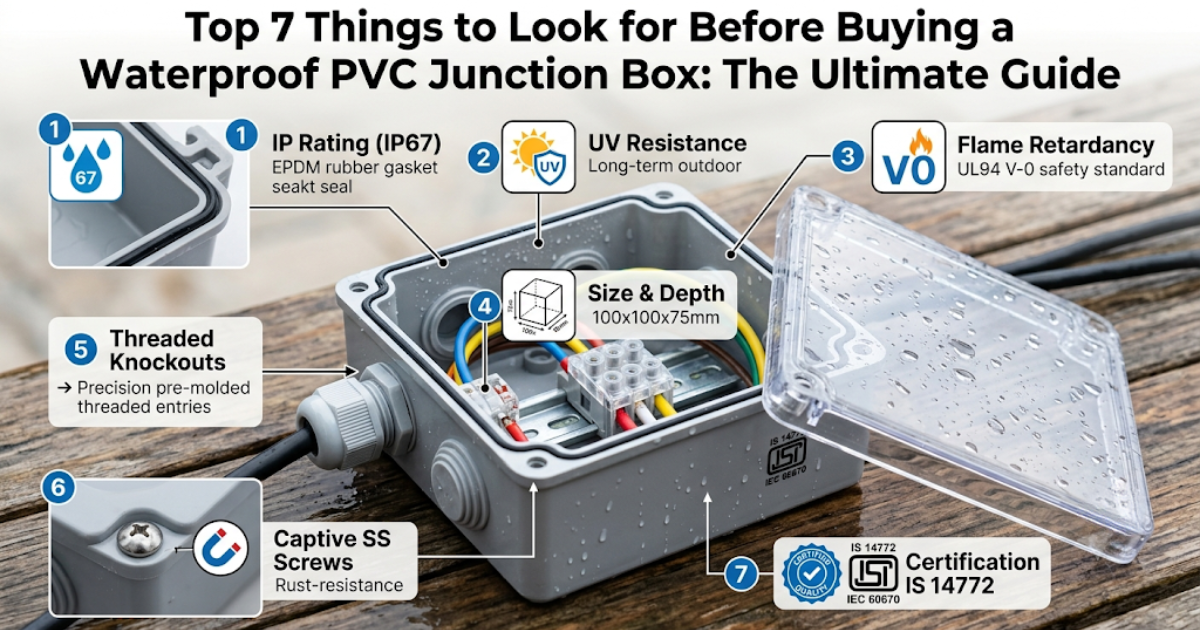
When planning electrical wiring for outdoor residential spaces, commercial properties, or heavy industrial setups, safety, longevity, and structural durability are non-negotiable requirements. In a diverse and demanding climate like India’s—where equipment is routinely exposed to torrential monsoon downpours, scorching summer heat, ambient dust, and coastal humidity—unprotected electrical wiring is a disaster waiting to happen. Exposed wire joints, improper terminals, and sub-standard enclosures can lead to frequent short circuits, equipment failure, expensive downtime, and catastrophic fire hazards.This is precisely where choosing the right waterproof PVC junction box becomes critical to your infrastructure.
A PVC (Polyvinyl Chloride) junction box serves as a protective housing unit where electrical cables meet, terminate, or branch out. However, not all plastic enclosures on the market offer genuine protection. Buying a cheap, unrated box can compromise your entire electrical system. Whether you are an electrical contractor, an EPC solar installer, an industrial site engineer, or a meticulous homeowner, understanding the core technical specifications is vital.
Below is an exhaustive, in-depth guide detailing the top 7 critical parameters you must evaluate before purchasing a waterproof PVC junction box, along with technical comparisons, installation best practices, and answers to frequently asked questions.
What is a PVC Junction Box and Why is it Essential?
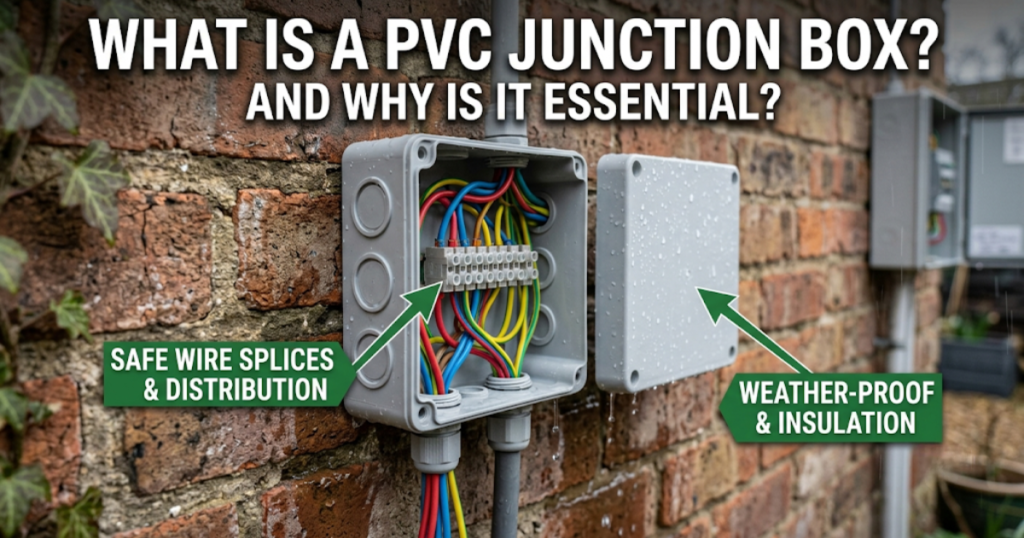
A junction box acts as the central hub for electrical distribution and wire splicing. Unlike metallic junction boxes (made of cast aluminum, mild steel, or stainless steel), high-grade PVC junction boxes offer inherent advantages:
- Corrosion Immunity: PVC does not rust, degrade, or oxidize when exposed to salt-laden air, acids, moisture, or industrial chemicals.
- Electrical Insulation: Being a non-conductive polymer, high-grade PVC eliminates the risk of electric shocks caused by accidental internal wire touching the enclosure walls.
- Lightweight and Adaptable: Easy to transport, cut, drill, and mount at high elevations or inside tight spaces.
- Cost Efficiency: Delivers superior longevity at a fraction of the cost of heavy-duty stainless steel or explosion-proof cast aluminum enclosures.
1. Verify the Ingress Protection (IP) and IK Rating
The term “waterproof” is often thrown around loosely in the electrical trade. To ensure true environmental protection, you must verify the enclosure’s official Ingress Protection (IP) rating, governed by the international standard IEC 60529.
An IP rating consists of two digits:
- First Digit (0–6): Level of protection against solid objects and dust ingress.
- Second Digit (0–8): Level of protection against liquids and water ingress.
IP 6 7
│ │
│ └─ Water Protection: 7 = Temporary Submersion (1m depth for 30 min)
└─── Dust Protection: 6 = Complete Dust-Tight Enclosure
Understanding IP Ratings for Indian Environmental Conditions
- IP55 Rated Enclosures: Offers basic dust protection and defense against low-pressure water sprays from any direction. Recommended strictly for indoor factory environments, indoor parking garages, or covered utility areas.
- IP65 Rated Enclosures: Completely dust-tight and resistant to low-to-medium pressure water jets (such as rainwater blown by strong winds or light washdown hoses). Ideal for general outdoor building walls, street lighting poles, and standard residential exterior wiring.
- IP67 Rated Enclosures: Fully dust-tight and capable of withstanding temporary water immersion up to a depth of 1 meter for 30 minutes. Essential for Indian monsoon zones, solar array combiner boxes, garden installations prone to puddling, rooftop wiring, and washdown-heavy food processing facilities.
- IP68 Rated Enclosures: Continuous underwater submersion under specified pressure conditions. Required for submersible pump junctions, fountain lighting, and underground utility pits.
Don’t Ignore the Impact Resistance (IK Rating)
In addition to liquid and dust protection, evaluate the IK Rating (IEC 62262), which measures mechanical impact resistance on a scale from IK00 (no protection) to IK10 (protected against 20 Joules of impact). For outdoor public areas, busy construction sites, or industrial floors where heavy tools or debris might strike the box, insist on an IK08 or higher rating to prevent physical cracking.
2. Evaluate UV Stabilization and Material Quality
India experiences intense direct sunlight, with ambient UV index levels soaring during summer months. Exposure to ultraviolet radiation causes standard, non-stabilized plastics to break down through a process known as photodegradation.
What Happens to Low-Quality Plastic Outdoors?
- Color Fading & Discoloration: The box turns yellow, dull, or chalky.
- Embrittlement: Polymer chains break down, making the plastic housing brittle like glass.
- Structural Cracking: Vibrations or thermal expansion cause micro-cracks along the corners and screw points, allowing water to seep directly onto active electrical connections.
What to Demand in Material Specifications
When selecting a waterproof PVC junction box, ensure it is manufactured using 100% Virgin UV-Stabilized Polyvinyl Chloride or high-performance Polycarbonate/ABS Blends.
- Virgin PVC vs. Recycled Plastic: Virgin PVC retains its molecular elasticity, structural density, and flame-retardant chemistry. Recycled plastic contains unknown impurities, residual moisture, and weak polymer links that degrade rapidly outdoors.
- UV Stabilizers (Carbon Black & HALS): Premium manufacturers blend Hindered Amine Light Stabilizers (HALS) into the raw plastic compound during molding. This allows the junction box to absorb and dissipate UV energy safely without altering the plastic structure.
3. Inspect the Quality and Mechanism of the Gasket Seal
A waterproof PVC junction box is only as reliable as its sealing gasket. Even if the outer shell is virtually indestructible, a cheap, poorly fitted rubber strip will compress, harden, and leak within months.
Types of Sealing Gaskets Used in Enclosures
- Polyurethane (PU) Formed-in-Place Foam Gaskets: This is the gold standard for industrial enclosures. High-end manufacturers use automated robotic dispensers to inject liquid PU directly into the inner cover channel. It cures into a continuous, seamless, joint-free seal that perfectly conforms to the mating base ridge, ensuring zero leak points.
- Molded EPDM Rubber Gaskets: Ethylene Propylene Diene Monomer (EPDM) rubber strips offer exceptional resilience against ozone, extreme heat, and water pressure. Ensure the EPDM strip is continuous or vulcanized securely at the joint.
- Low-Grade Foam / PVC Stripping: Common in cheap, unbranded boxes. These consist of flat, glued-on foam strips with visible end-gaps. Over time, heat flattens them completely, destroying their sealing capability.
Key Rule of Thumb: Inspect the cover groove. The seal must be elastic, snugly fitted, memory-retaining (bounces back after compression), and completely free of joint gaps or air bubbles.
4. Prioritize Flame Retardancy and Thermal Safety Ratings
Electrical connections inherently generate heat. Loose wire terminals, voltage spikes, or short circuits can produce electrical arcing, reaching temperatures high enough to melt standard plastic and ignite nearby structural materials.
To safeguard your premises, ensure your chosen PVC junction box conforms to strict thermal and fire safety standards.
Crucial Fire Safety Certifications to Look For
- UL 94 Flammability Standard: This standard tests the plastic’s tendency to extinguish or spread a flame after ignition.
- UL 94 V-0 (Best): Burning stops within 10 seconds on a vertical specimen; dripping particles of plastic are allowed as long as they are not inflamed.
- UL 94 V-1: Burning stops within 30 seconds; no flaming drips.
- UL 94 V-2: Burning stops within 30 seconds; flaming drips are allowed.
- Always specify UL 94 V-0 for critical commercial, solar, and industrial installations.
- FRLS (Flame Retardant Low Smoke): In the event of an internal electrical fire, FRLS-grade PVC self-extinguishes and emits minimal toxic halogens and smoke, providing critical visibility and oxygen safety for personnel evacuating the building.
- Glow Wire Test (IEC 60695-2-11): Verifies that the plastic material does not ignite or sustain combustion when brought into contact with an electrically heated wire coil at 650°C to 850°C.
5. Assess Internal Dimensions, Depth, and Cable Gland Knockouts
A common error made by field electricians is underestimating the volume required inside the junction box. Overcrowding wires and forcing thick cables into a tight space leads to insulation damage, loose wire nuts, localized heat buildup, and difficult maintenance.
Selecting the Right Size and Depth
When calculating the dimensions of your junction box, account for:
- The Main Terminal Block or DIN Rail Size: Ensure there is a minimum clearance of at least 25–30 mm between the terminal block and the inner walls for comfortable wire routing.
- Bending Radius of Heavy Cables: Heavy-duty Armored PVC cables (e.g., 4-core 6 sq. mm or 10 sq. mm) require a generous bending radius. Forcing a stiff cable into a shallow box places structural stress on both the cable glands and the terminal posts.
- Auxiliary Components: If you plan to house relays, miniature circuit breakers (MCBs), fuses, or solar surge protection devices (SPDs), select a deep-cover variant designed with built-in DIN rail mounting bosses.
Cable Entry Knockouts and Gland Compatibility
Waterproof integrity is instantly destroyed if you cut sloppy, oversized holes into a pristine box using a knife or improper hole saw.
- Look for boxes equipped with precision pre-molded threaded knockouts or concentric metric/PG knockouts.
- Ensure these knockouts match standard IP68 Cable Glands (e.g., PG9, PG11, PG13.5, PG21 or M12, M16, M20, M25 sizes).
- Always install rubber washers and locknuts with cable glands to form a 100% airtight and watertight seal around incoming and outgoing cables.
6. Check Structural Construction, Screws, and Mounting Design
How a junction box opens, closes, and attaches to a wall determines its operational lifespan in real-world conditions. Repeated maintenance checks require removing and re-tightening the cover screws—a process that easily ruins low-quality boxes.
Key Hardware Features to Look For
- Captive Stainless Steel (SS 304 or SS 316) Cover Screws: Rust is the enemy of outdoor hardware. Standard iron screws rust instantly in high humidity, fusing into the plastic casing and snapping off when turned. Stainless steel screws eliminate rust. Captive screws are engineered so they remain attached to the cover lid even when loosened fully, preventing them from falling off roofs or into high grass during maintenance.
- Brass Threaded Inserts in Screw Posts: Low-end boxes feature plastic threads tapped directly into the base molding. Screwing into raw plastic more than 2 or 3 times strips the threads permanently, making it impossible to seal the box tight again. High-quality boxes feature solid brass female inserts embedded directly into the plastic posts during injection molding, allowing endless opening and closing cycles.
- External Wall-Mounting Lugs/Brackets: To mount a junction box onto a wall, pole, or steel frame, you must fasten it securely. If you drill mounting screws directly through the rear floor of the box, water will travel along those screw threads right into the electrical chamber! Choose a box designed with isolated external mounting ears/lugs or sealed rear screw chambers kept entirely separate from the main interior wiring cavity.
7. Verify Compliance with Indian & International Standards
When executing commercial contracts, solar power projects, or industrial facility installations, installing non-certified electrical hardware can result in safety audit failures, rejected insurance claims, and severe liability.
Always verify that your supplier’s PVC junction boxes conform to internationally recognized technical manufacturing standards:
- IS 14772: The Indian Standard specification covering enclosures and boxes for electrical accessories used in fixed electrical installations.
- IEC 60670 / EN 60670: The global benchmark standard for boxes and enclosures housing circuit protection, switches, and wiring accessories.
- RoHS Certification (Restriction of Hazardous Substances): Guarantees that the PVC compound is free from dangerous heavy metals like lead, mercury, cadmium, and hexavalent chromium.
- CE Marking: Confirms compliance with essential European safety, health, and environmental protection standards.
Technical Comparison: Cheap Commercial PVC Box vs. Industrial-Grade Waterproof PVC Box
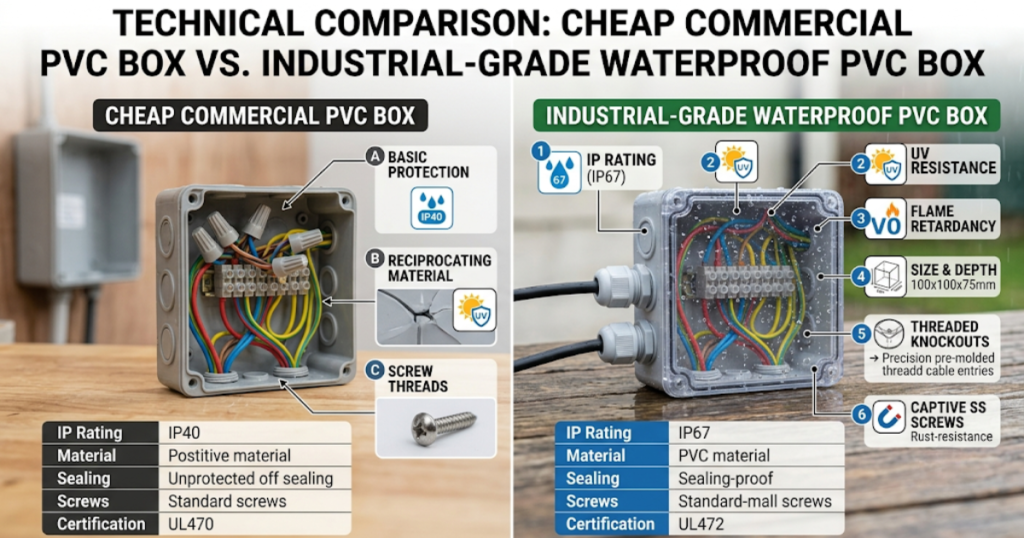
To help you visualize the crucial differences before making a purchase, review this comprehensive side-by-side technical breakdown:
| Technical Feature | Standard Low-Cost Commercial PVC Box | High-Grade Waterproof Industrial PVC Junction Box |
| Primary Material | Recycled / Unstabilized Scrap PVC | 100% Virgin UV-Stabilized High-Impact PVC |
| Ingress Protection Rating | Unrated or Basic IP44 | Certified IP65, IP67, or IP68 |
| Impact Resistance | Low (IK04–IK06) – Cracks easily | High (IK08–IK10) – Resists tool impacts |
| UV Weatherability | Cracks, turns yellow/brittle in 6–12 months | 10+ years of direct outdoor sunlight resistance |
| Sealing Gasket Type | Thin glued foam tape or missing completely | Formed-in-Place Continuous Polyurethane (PU) or EPDM |
| Fire Safety Rating | Highly Flammable / Emits thick black smoke | Flame Retardant (UL 94 V-0 / FRLS compliant) |
| Cover Screws | Mild Steel / Iron (Rusts quickly) | Rust-Proof Captive Stainless Steel (SS 304 / SS 316) |
| Screw Post Design | Direct Plastic Tapped Threads (Strips easily) | Molded Brass Threaded Inserts |
| Cable Entry Points | Crude, uneven knockouts requiring manual cutting | Precision Metric/PG Threaded Knockouts |
| Mounting Mechanism | Holes drilled inside the main cavity (Leaks) | External Isolated Mounting Lugs |
| Ideal Applications | Basic indoor junction points | Solar arrays, streetlights, industrial plants, outdoor setups |
Step-by-Step Guide: How to Properly Install a Waterproof PVC Junction Box
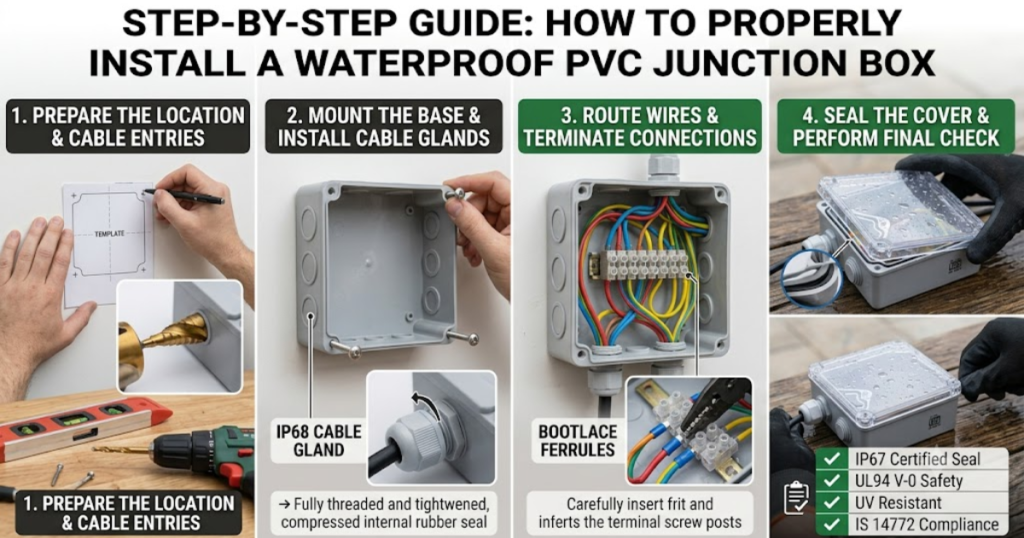
Purchasing the highest-quality IP67 junction box will not prevent water ingress if the installation itself is done incorrectly. Follow these step-by-step best practices to guarantee a watertight, safe, and long-lasting installation:
INCORRECT INSTALLATION CORRECT INSTALLATION
(Top/Direct Side Entry) (Bottom Entry with Drip Loop)
┌───────────┐ ┌───────────┐
====│= Cable │ │ │
│ │ │ PVC Box │
└───────────┘ └─────┬─────┘
│ (IP68 Gland)
│
└───┐ <– Drip Loop
│
▲ (Water drips off here)
- Plan Cable Entry Points carefully:
- Rule #1: Whenever possible, enter the junction box from the bottom face.
- Entering from the top allows gravity to pool rainwater directly over the cable glands, increasing the risk of seepage over time. If side entry is unavoidable, always form a “drip loop” in the cable below the box so running water drops off before reaching the gland.
- Select and Install Correct IP68 Cable Glands:
- Match the cable outer diameter (OD) precisely to the gland’s clamping range.
- Tighten the gland’s dome nut until the internal rubber claw compresses firmly around the cable jacket. Do not over-tighten to the point of distorting the cable geometry.
- Use Thread Sealant or Rubber Washers:
- Thread the cable gland into the box wall using an O-ring rubber washer on the outer surface and a locknut on the inside to seal the knockout opening completely.
- Prepare Internal Wires Cleanly:
- Strip wire ends cleanly using precision wire strippers. Use insulated bootlace ferrules or crimp lug terminals on stranded copper wires before inserting them into terminal blocks.
- Avoid messy wire nuts or exposed electrical tape wraps inside outdoor boxes.
- Cross-Tighten Cover Screws:
- Place the top lid evenly over the base gasket.
- Tighten the four corner screws in a diagonal/cross pattern (Top-Left $\rightarrow$ Bottom-Right $\rightarrow$ Top-Right $\rightarrow$ Bottom-Left) to apply equal compression pressure along the entire perimeter of the gasket.
Frequently Asked Questions (FAQs)
Q1. What is the difference between an IP65, IP67, and IP68 PVC junction box?
An IP65 box protects against low-pressure water jets from any angle (great for normal rain and outdoor walls). An IP67 box can withstand total immersion in water up to 1 meter deep for 30 minutes, making it essential for flood-prone outdoor areas, rooftop solar setups, and monsoons. An IP68 box is designed for continuous underwater submersion, such as inside swimming pools, fountains, or underground drainage sumps.
Q2. Can I use a PVC junction box for high-voltage industrial applications?
Yes! High-grade PVC is an excellent electrical insulator with high dielectric strength. As long as the junction box is rated for the correct operating temperature, fits the required cable sizes, and uses flame-retardant (UL 94 V-0) virgin material, it can safely house industrial 415V three-phase connections, terminal blocks, DIN rails, and switchgear.
Q3. Why did my outdoor PVC junction box become brittle and crack after a year?
Your box likely failed because it was made from cheap, recycled plastic lacking UV-stabilizing additives. Standard plastics decompose when exposed to solar ultraviolet radiation. Always buy junction boxes explicitly labeled as UV-Stabilized Virgin PVC or Polycarbonate for outdoor installations in hot climates.
Q4. Are plastic PVC junction boxes better than metal (aluminum/steel) boxes?
For most outdoor, humid, and corrosive environments, yes. Metallic boxes can rust, require earthing/grounding connections to avoid electrical shock hazards, and are heavier to mount. PVC boxes are completely corrosion-proof, non-conductive, lightweight, and easier to install. However, for specialized hazardous locations requiring explosion-proof certification (Ex-d), heavy cast aluminum or stainless steel enclosures remain mandatory.
Q5. How do I maintain the IP rating when drilling cable entry holes?
Never drill crude, irregular holes with standard drill bits or step drills without finishing them properly. Use a clean hole-saw bit matching the exact size of an IP68-rated cable gland. Install the gland with an exterior rubber O-ring seal and tighten the locknut on the inside. Unused knockouts should remain sealed with IP-rated blanking plugs.