
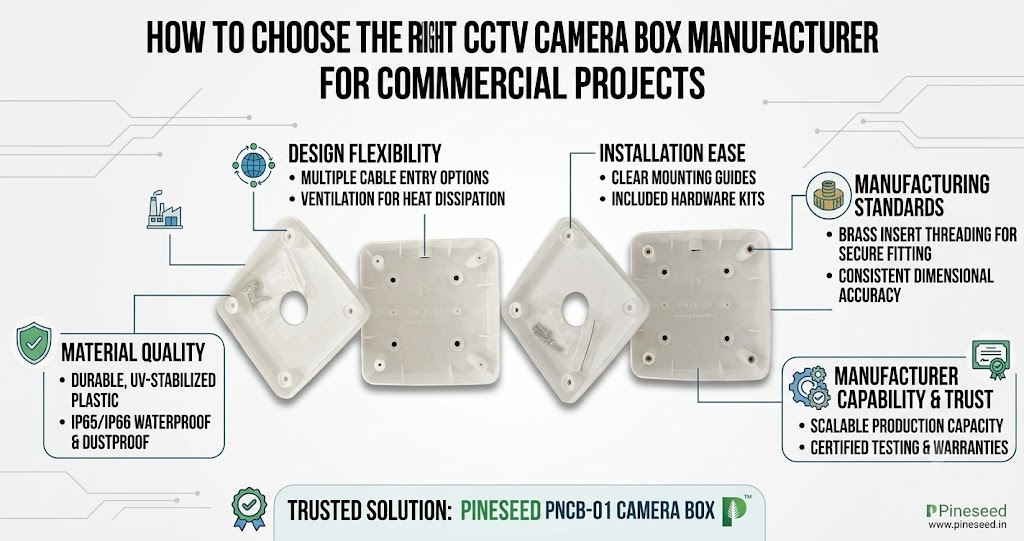
When designing and executing large-scale surveillance infrastructure—whether for manufacturing plants, residential townships, warehouses, highway monitoring systems, or corporate IT parks—project managers typically focus heavily on selecting high-resolution IP cameras, Network Video Recorders (NVRs), and high-grade optic fiber cabling. However, in real-world field deployments, system downtime is rarely caused by the cameras themselves. Instead, it is most frequently caused by a single weak link: poor-quality junction boxes.Selecting a trusted, high-volume CCTV Camera Box Manufacturer is one of the most critical decisions in commercial security planning. Substandard enclosures lead to moisture accumulation, rusted connectors, short circuits, signal loss, and recurring maintenance expenses that destroy project profitability.
In this detailed guide, we explain every technical parameter, material specification, structural feature, and supply chain consideration commercial procurement managers must evaluate before partnering with a manufacturing vendor in India.
1. The Critical Role of CCTV Junction Boxes in Commercial Infrastructure
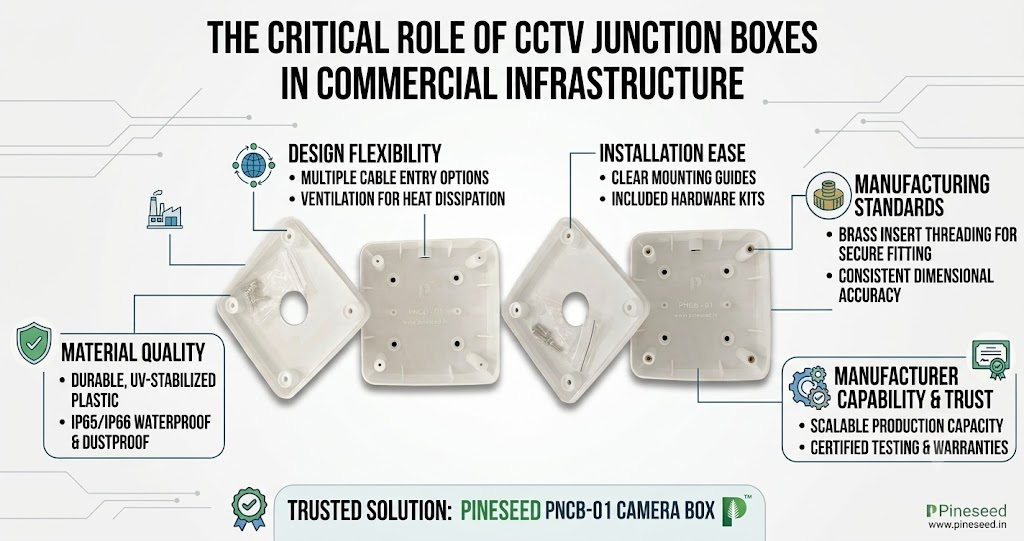
A CCTV junction box (also known as a camera enclosure box or mounting base) serves as the protective shield for sensitive wire connections, power adapters, BNC/DC connectors, and RJ45 couplers.
In commercial and industrial environments, security camera boxes face continuous stress from harsh weather, ambient heat, industrial dust, vibration, and manual handling during periodic servicing.
Key Risks of Using Cheap, Unbranded Camera Boxes:
- Water Seepage & Short Circuits: Moisture penetration corrodes copper wiring, causes video signal noise, and short-circuits power supplies.
- UV Degradation: Inferior plastic becomes brittle, turns yellow, and cracks after 6 to 12 months under direct sun exposure.
- Stripped Screw Threads: Soft plastic threads strip easily after two or three maintenance cycles, rendering the enclosure unusable.
- Increased System Maintenance Costs: Replacing a ₹30 junction box often costs ₹500–₹1,000 in technician labor, transport, and ladder/scaffolding setup.
2. Evaluating Plastic Material Quality: ABS Plastic vs. Recycled PVC
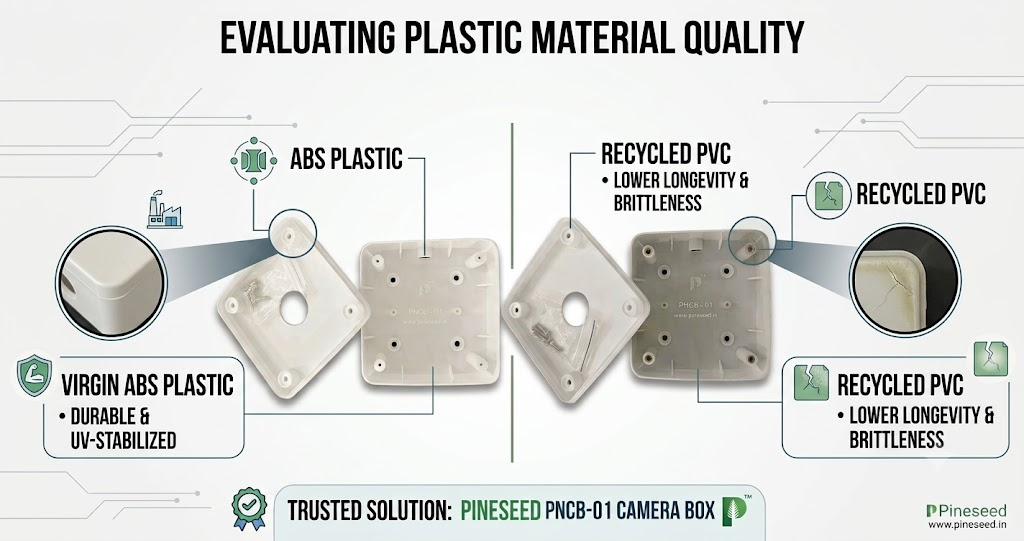
The foundation of any durable CCTV enclosure is the raw material used during the injection molding process. Not all plastic camera boxes offer equal performance.
+———————————————————————————–+
| RAW MATERIAL PERFORMANCE |
+————————–+—————————–+————————–+
| Parameter | Virgin ABS Plastic | Recycled Plastic / PVC |
————————–+—————————–+————————–+
| Impact Resistance | High (Shock Proof) | Low (Brittle) |
UV Resistance | Excellent (Non-Degrading) | Very Poor (Cracks easily)|
Lifespan in Outdoor Sun | 5 to 10 Years | 6 to 12 Months |
Temperature Endurance | -20°C to +80°C | -5°C to +50°C |
+————————–+—————————–+————————–+
Critical Material Standards to Request from Your Manufacturer:
- Virgin ABS Plastic: Always insist on 100% virgin ABS (Acrylonitrile Butadiene Styrene) resin. It provides superior structural rigidity, high impact resistance, and long-term durability.
- UV Stabilization Fillers: Outdoor camera boxes must contain UV-inhibitor additives during molding to prevent breakdown caused by continuous exposure to sunlight.
- Flame Retardancy (UL94 Standard): In industrial settings such as chemical plants, textile units, and power sub-stations, junction boxes should meet flame-retardant standards to prevent fire hazards.
3. Fitting Mechanism Analysis: Screw Type vs. Brass Insert Type
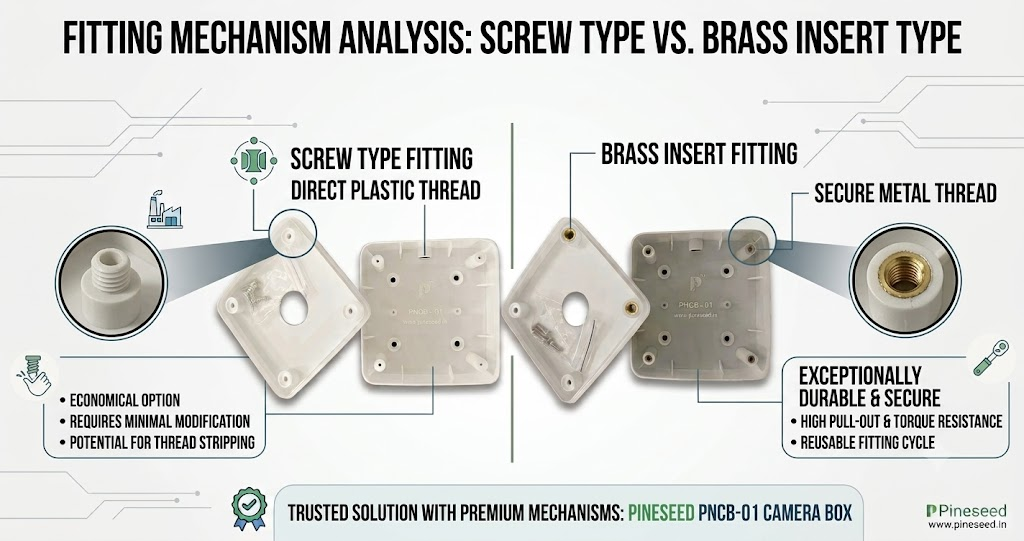
The internal thread mechanism determines how reliably a junction box can be opened and re-sealed during maintenance. Leading manufacturers offer two distinct fitting variations to cater to different budget and performance needs.
Detailed Comparison Table
| Feature / Metric | Screw Type Fitting | Brass Insert Type Fitting |
| Thread Material | Direct Molded ABS Plastic | High-Grade Machined Brass Inserts |
| Re-Screw Longevity | 3 to 5 opening cycles max | Infinite re-screw capability |
| Screw Holding Force | Moderate | High (Resists wind vibration & mechanical stress) |
| Best Suited For | Fixed Indoor / Low-Maintenance Sites | Commercial, Industrial & Outdoor Projects |
| Cost Efficiency | Highly economical | Premium value with zero long-term failure |
Why Brass Insert Fitting is Ideal for Commercial Contracts:
In commercial projects, technicians frequently open junction boxes to adjust camera angles, clean lenses, inspect cable terminations, or test PoE voltage. Standard plastic threads strip quickly when over-tightened with electric screwdrivers.
Choosing a manufacturer that provides Brass Insert Type Fittings (such as PNCB-01 / PNCB-02 series) ensures metal-on-metal threading that never wears out, preserving the watertight seal even after dozens of service visits.
4. Ingress Protection (IP Ratings) and Weatherproofing Features
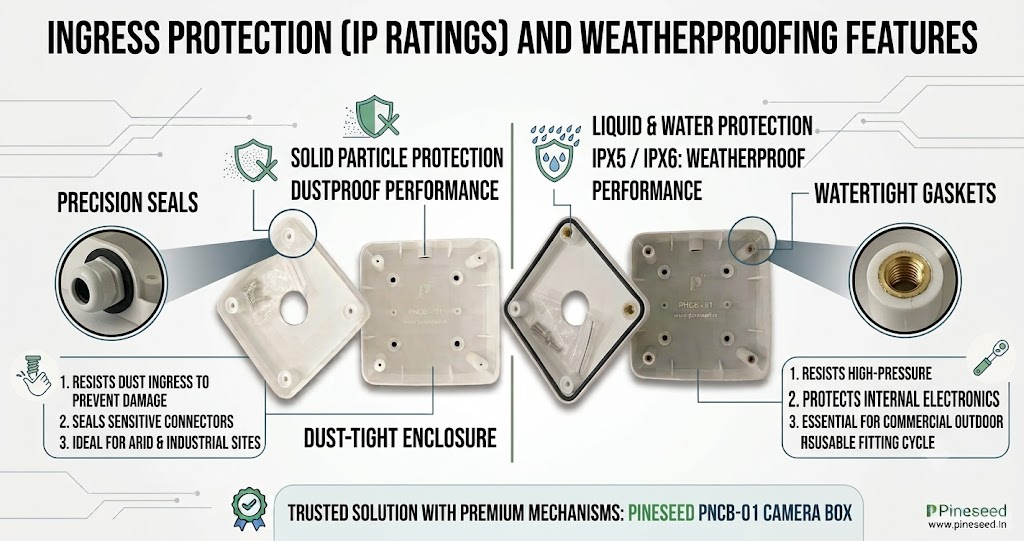
Commercial outdoor installations demand verified protection against dust, torrential rainfall, and atmospheric humidity.
IP RATING BREAKDOWN
IP [ 6 ] [ 5 ] —> Liquid Protection Level (Protected against water jets)
|
+————-> Dust Protection Level (100% Dust Tight)
Essential Weatherproofing Components to Inspect:
- Silicone Rubber Gaskets: The top cover must incorporate a continuous inner rubber or silicone seal ring that creates an airtight seal when screwed down.
- Pre-Molded Cable Knockouts: Clean, sealed cable entry ports allow smooth conduit fitting without requiring manual hole-drilling that ruins IP integrity.
- Bottom Water Drain Channels: Well-engineered enclosures feature subtle internal slope designs or condensation drainage paths to protect cable joints from trapped humidity.
5. Mechanical Space Management and Internal Mounting Layout
A major issue faced by field installers is overcrowding inside the camera box. Poorly proportioned boxes make wire management difficult and crush sensitive connectors.
Ideal Dimensions & Structural Layout Checklist:
- Ample Internal Depth: Must comfortably house 12V power adapters, passive PoE splitters, BNC/DC connectors, or RJ45 network couplers without severe bending of cables.
- Universal Camera Mounting Grid: The face of the junction box cover should feature pre-molded mounting hole patterns that match standard bullet and dome camera baseplates (e.g., Hikvision, CP Plus, Dahua, Honeywell).
- Reinforced Mounting Pillars: Internal brass pillars or plastic screw bosses should be structural thick-walled cylinders capable of carrying camera weights up to 2.5 kg under strong wind loads.
6. Manufacturing Capacity, B2B Pricing, and Supply Chain Reliability
For large commercial infrastructure bids, product quality alone is not enough—the manufacturer’s production scalability and delivery speed are equally vital.
What to Verify Before Signing a Supply Agreement:
- Daily Factory Production Output: Ensure the vendor operates high-tonnage automatic injection molding machines capable of fulfilling volume orders (1,000 to 10,000+ units) without delay.
- Batch-to-Batch Color Consistency: Commercial architects demand uniform visual appearance. The manufacturer must maintain strict color control (standard off-white / light grey / black) across all production batches.
- Direct Wholesale Tier Pricing: Cut out middle-tier trading layers by contracting directly with primary manufacturers, yielding 20% to 35% cost savings on bill of materials (BOM).
- Custom OEM Branding Services: For large enterprise clients or Government EPC projects, check if the manufacturer can mold or print custom company logos directly on the enclosure lid.
Frequently Asked Questions (FAQs)
Q1. Why shouldn’t we mount CCTV cameras directly onto concrete walls or metal poles?
Ans: Mounting cameras directly onto surfaces exposes video connectors and power joints to rain, dirt, rust, and physical tampering. A dedicated weatherproof junction box conceals all cable connections, isolates electronic lines from surface electrical grounding interference, and extends overall system lifespan.
Q2. What is the difference between PNCB-01 and PNCB-02 model designations?
Ans: PNCB series designations generally indicate physical dimension variations, cover depth, or base mounting configurations. PNCB-01 typically serves standard dome and bullet cameras, while PNCB-02 caters to heavy-duty industrial IP cameras requiring larger internal space for PoE splitters and thick wiring harnesses.
Q3. Can plastic CCTV camera boxes handle extreme heat during Indian summers?
Ans: Yes, provided they are manufactured using 100% Virgin ABS Plastic with UV stabilization. High-grade ABS enclosures maintain structural stability in ambient temperatures up to +80°C without warping, softening, or cracking.
Q4. Are Brass Insert junction boxes worth the higher price point compared to standard screw types?
Ans: Absolutely. While brass insert boxes carry a minor price premium, they eliminate thread-stripping failures entirely. In commercial infrastructure where a single service call costs significantly more than the box itself, brass insert enclosures deliver far lower total cost of ownership (TCO).
Q5. How can B2B buyers order bulk quantities directly from a CCTV box manufacturer in India?
Ans: B2B buyers, system integrators, and distributors can submit minimum order quantity (MOQ) requirements, project specs, and location details directly to certified manufacturers like Pineseed Industries to receive wholesale tier quotations, sample testing kits, and dispatch timelines.
