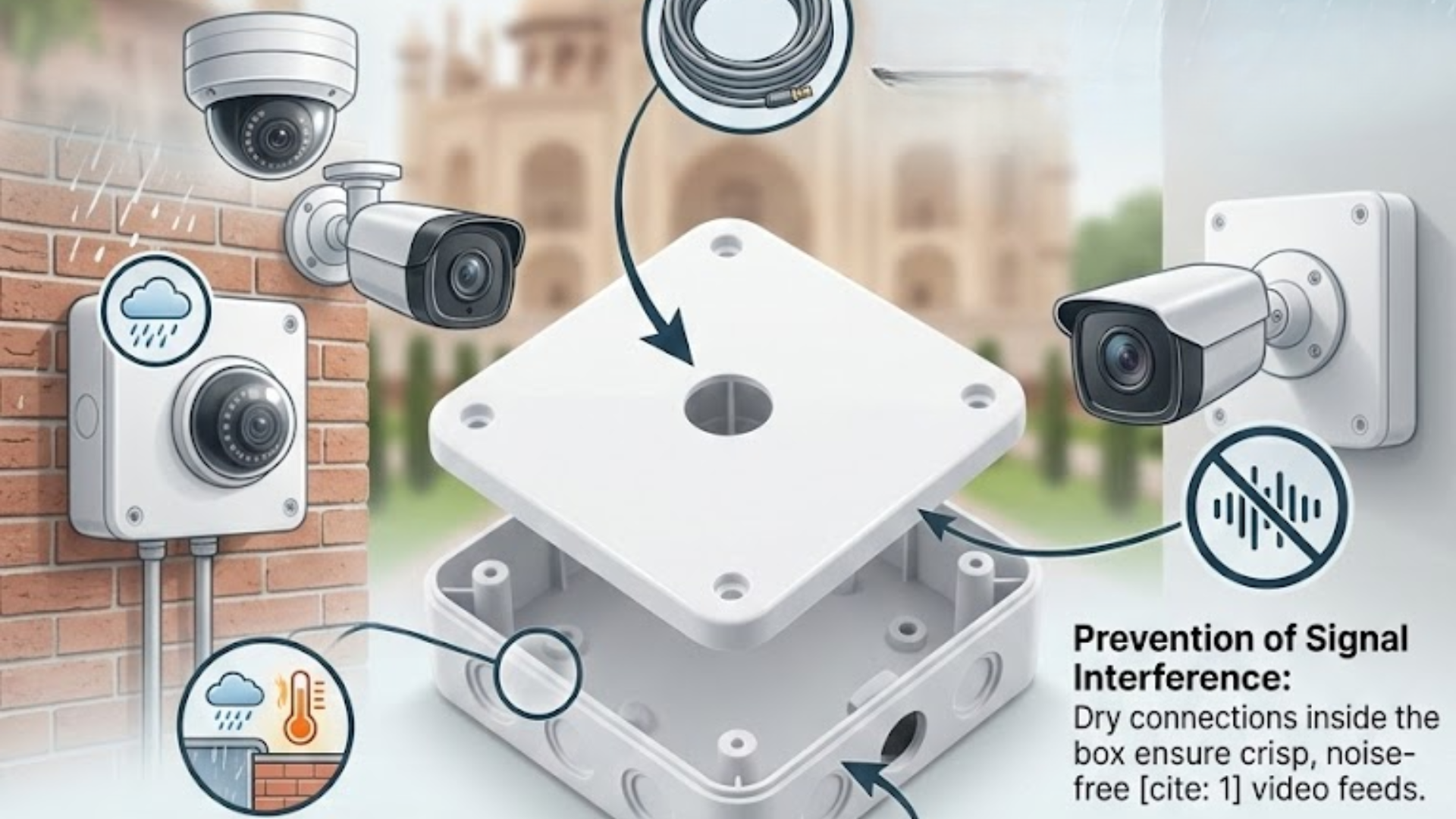
Security is no longer a luxury in India; it’s a necessity. Whether it’s a small Kirana store in a crowded lane or a high-end corporate office in Gurgaon, CCTV cameras are everywhere. However, an expensive camera is only as good as its weakest link—the wiring.This is where the CCTV camera junction box becomes the most critical “small” investment you will ever make.
1. Understanding the Core Purpose: Why a “Junction Box” is Not Optional
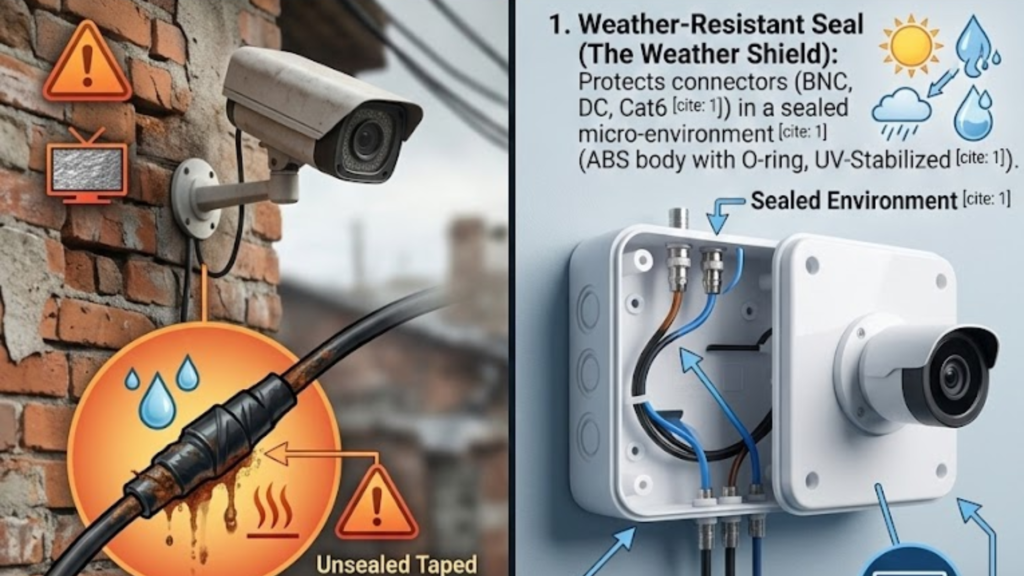
In the early days of CCTV in India, installers used to drill a hole, push the wire through, and tape the connectors with black PVC tape. This led to massive failure rates during the first monsoon. A CCTV camera junction box serves four primary purposes:
A. Environmental Protection (The Weather Shield)
India experiences extreme weather. From the 48°C heat of Rajasthan to the 100% humidity of Mumbai, cables can degrade quickly. The junction box creates a sealed environment for your connectors (BNC, DC, or RJ45), preventing oxidation and rust.
B. Prevention of Signal Interference
When video cables are exposed to moisture, the impedance changes. This results in “lines” on the screen or “ghosting” effects. A dry connection inside a box ensures a crisp, noise-free video feed.
C. Aesthetic and Structural Integrity
A camera hanging off a wall with a bunch of wires looks unprofessional and decreases property value. A junction box acts as a sturdy mounting base, providing a flat surface for the camera even on uneven brick walls.
2. Material Science: Choosing the Right “Body”
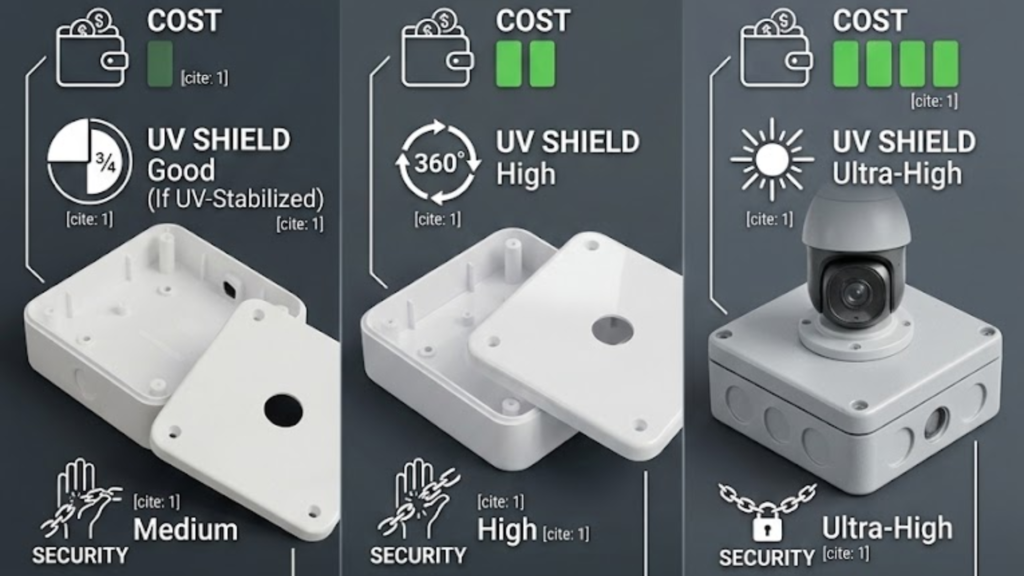
When searching for a CCTV camera junction box, you will encounter various materials. Choosing the wrong one can lead to “yellowing” or cracking within months.
I. ABS Plastic (Acrylonitrile Butadiene Styrene)
This is the most popular choice in India due to its cost-effectiveness.
- Pros: Non-conductive (won’t give a shock), rust-proof, and easy to drill.
- Cons: Low-quality ABS turns brittle under UV rays. Always look for UV-Stabilized ABS for outdoor use.
II. Polycarbonate (PC)
Slightly more expensive than ABS but much tougher. It has high impact resistance—if a cricket ball hits it, it won’t shatter easily.
III. Aluminum Die-Cast
This is the “Gold Standard.”
- Heat Dissipation: Metal boxes act as a heat sink, drawing heat away from the camera’s internal processor—crucial for 4K cameras that run hot.
- Security: It is nearly impossible to tear an aluminum box off the wall without heavy tools.
3. The Technical Table: Direct Comparison
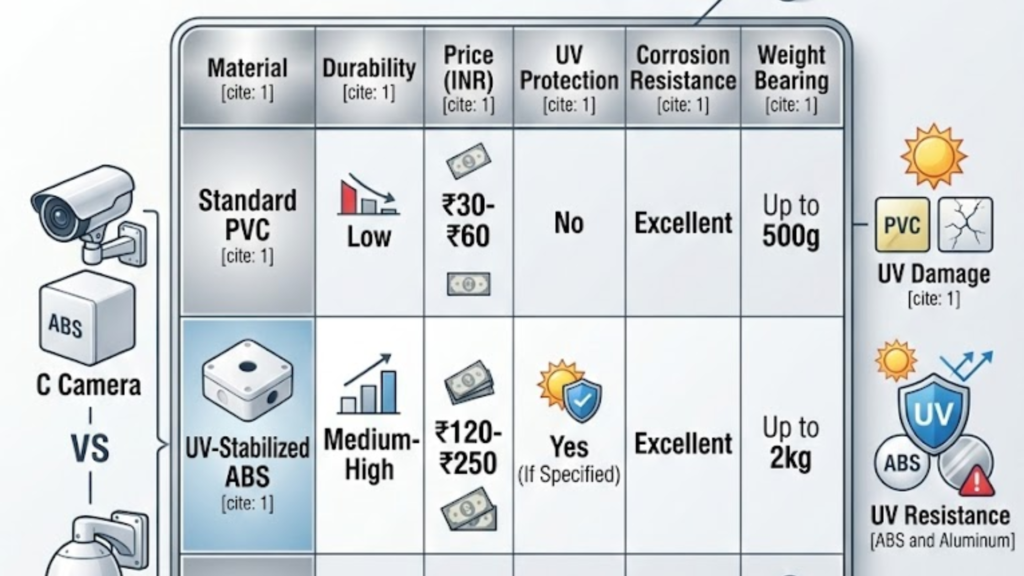
| Feature | PVC Standard | High-Grade ABS | Aluminum Die-Cast |
| Durability Grade | Low | Medium-High | Ultra-High |
| Typical Price (INR) | ₹30 – ₹60 | ₹120 – ₹250 | ₹400 – ₹950 |
| UV Protection | No | Yes (If specified) | Excellent |
| Corrosion Resistance | Excellent | Excellent | Requires Powder Coating |
| Weight Bearing | Up to 500g | Up to 2kg | Up to 10kg (PTZ) |
4. IP Ratings: Decoding the “Waterproof” Myth
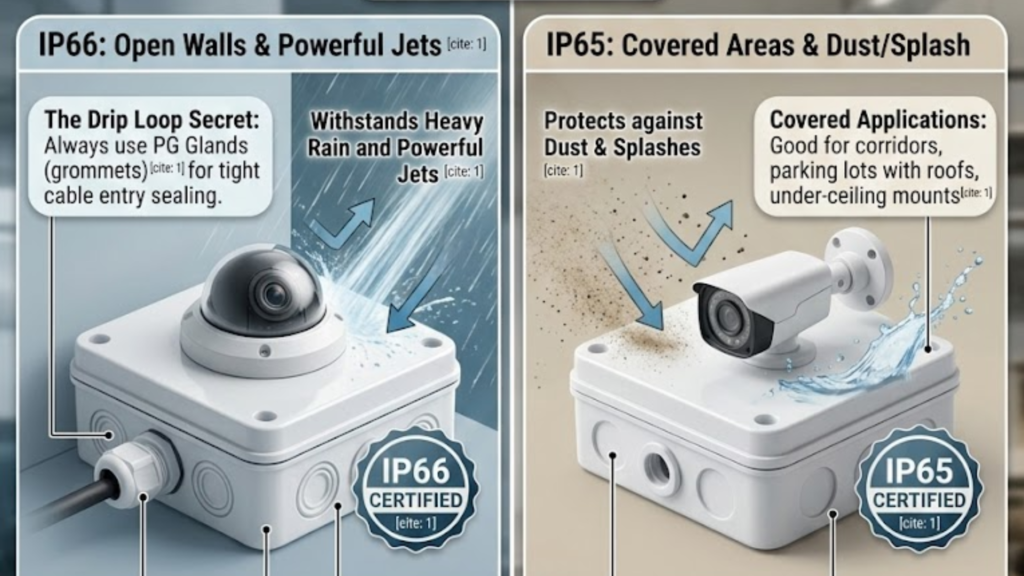
In India, vendors often say “waterproof haina” (it’s waterproof), but you must verify the IP code.
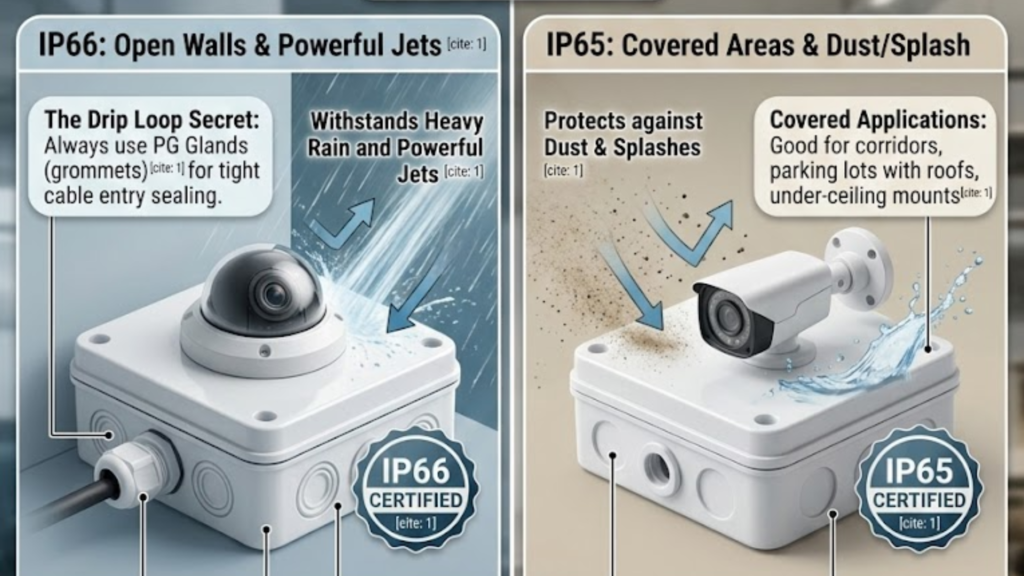
- IP65 (Dust & Splash Proof): Good for corridors, parking lots with roofs, and under-ceiling mounts.
- IP66 (Powerful Water Jets): Necessary for open walls. It can withstand heavy rain “baurish” without letting a drop inside.
- IP67 (Immersion Protection): For areas like basement parking that might flood up to 1 meter for 30 minutes.
The “Gland” Secret
Even an IP67 box will fail if the cable entry point is loose. Always use PG Glands (rubber grommets) to seal the wire entry.
5. Size and Depth: Why “Spatial Engineering” Matters
In the world of security installations, the “Size” of your CCTV camera junction box is the difference between a system that runs 24/7 and one that suffers from mysterious signal drops. Many amateur installers in India try to cram cables into the smallest box possible to save ₹20, but this is a recipe for disaster.
A. The “Kink” Factor: Protecting Copper and Fiber
Cables, whether they are Coaxial (3+1) or Ethernet (Cat6), have a specific Minimum Bend Radius.
- The Science: If you bend a Cat6 cable too sharply to fit it into a small 4×4 box, you create “Micro-fractures” in the internal copper strands.
- The Result: This leads to “Packet Loss” in IP cameras. You might see the video stuttering or the camera restarting randomly because the power (PoE) isn’t flowing smoothly.
- The Solution: A Deep Base Junction Box (typically 2.5 to 3 inches deep) allows the cable to loop naturally without stress.
B. Thermal Management (Heat Dissipation)
India is a hot country. During May and June, temperatures inside a sealed plastic box can reach 60°C to 70°C.
- The Processor Heat: Modern 5MP and 8MP (4K) cameras have powerful processors that generate their own heat.
- Air Gap: If the junction box is too small, there is no air trapped inside to act as an insulator. The heat from the camera’s base transfers directly to the connectors. Over time, this “cooks” the plastic casing of your BNC or RJ45 pins, making them brittle and causing them to melt or fuse together.
- The Rule of Thumb: Ensure at least 30% of the box volume remains empty to allow for internal air circulation.
C. Categorizing Boxes by Camera Type
| Camera Type | Recommended Box Size | Why This Size? |
| Analog / HD-TVI Dome | 4″ x 4″ Standard | Analog connectors (BNC/DC) are slim and can fold easily. |
| Standard IP Bullet | 5″ x 5″ Deep Base | Needs room for the bulky “Waterproof Pigtail” connector provided by the manufacturer. |
| Varifocal / Zoom Cameras | 6″ x 6″ Large | These cameras have thicker cables and often require extra space for manual adjustment tools. |
| PTZ (Pan-Tilt-Zoom) | Specialized Bracket Box | PTZ cameras are heavy (2kg – 5kg) and need a load-bearing metal junction box with reinforced screw points. |
D. The “Service Loop” Strategy
A professional Indian installer always leaves a “Service Loop” (extra 6-12 inches of wire) inside or behind the junction box.
- Why? If a connector gets rusted or burnt after 2 years, you need enough “slack” in the wire to cut the old tip and crimp a new one.
- If you use a tiny box, you won’t have space for this extra wire. When the connector fails, you’ll have to pull a whole new wire from the DVR—costing you thousands in labor and material.
E. Accommodating Accessories
The CCTV camera junction box is often used as a “mini-hub.” You might need to fit the following items inside:
- Video Baluns: For running analog cameras over Cat5/6 cable.
- PoE Splitters: To separate power and data for non-PoE cameras.
- DC Power Jacks: To connect a local 12V adapter.
- Lightning Arrestors: Small modules that protect the camera from electrical surges during Indian thunderstorms.
Expert Verdict: If you are confused between two sizes, always go one size larger. A slightly larger box on your wall is barely noticeable, but a box that is too small will destroy your cables and overheat your hardware.
6. Installation Best Practices for Indian Conditions
To ensure your CCTV camera junction box installation lasts 10+ years, follow these steps:
Step 1: Direction of Entry
Always bring the cable from the bottom or the side of the box. Never bring it from the top. If you do, rainwater will follow the cable directly into the box through gravity.
Step 2: The Drip Loop
Create a small “U” shape in the cable before it enters the box. This ensures that water falls off the bottom of the loop instead of entering the junction box.
Step 3: Use Wall Plugs (Gitti)
In India, walls are often made of hollow bricks or soft plaster. Use high-quality nylon wall plugs rather than local plastic ones to ensure the box doesn’t sag over time.
7. Frequently Asked Questions (FAQ)
Q1: Do I need a junction box for indoor dome cameras?
Answer: While not strictly for waterproofing, a box is recommended for “False Ceilings.” It prevents the heavy camera from tearing the POP/Gypsum board and hides the messy wires above the ceiling.
Q2: Will a metal junction box interfere with my 4G/Wi-Fi camera?
Answer: Yes, potentially. Metal reflects signals. If you are using a 4G SIM-based camera or a Wi-Fi camera, a high-quality Plastic (ABS) junction box is safer for signal strength.
Q3: My junction box is collecting fog inside. Why?
Answer: This is “Condensation.” It happens when hot air inside the box meets the cold rain outside. Solution: Place a small packet of Silica Gel (the stuff you find in shoe boxes) inside the junction box to absorb moisture.
Q4: Can monkeys break these boxes?
Answer: In India, monkeys are a real threat to CCTV. Plastic boxes can be chewed or ripped. For monkey-prone areas, only use Aluminum Die-Cast boxes with metal flexible conduits for the wires.