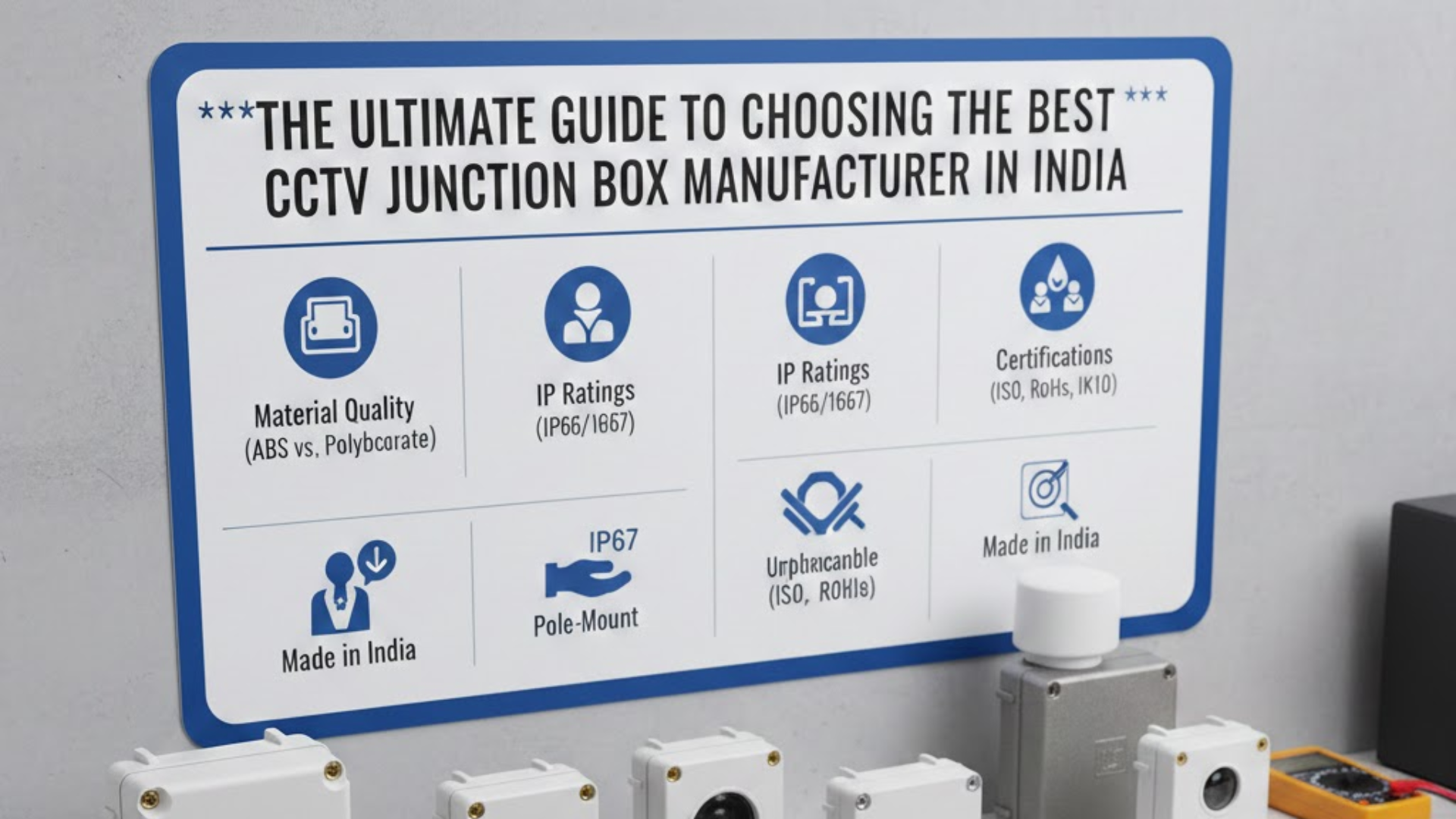
In the modern security landscape, a surveillance system is only as strong as its weakest connection. While installers often obsess over megapixels and NVR channels, the seasoned experts know that longevity depends on the CCTV junction box. In the diverse and often harsh climatic conditions of India—ranging from the humid coasts of Kerala to the scorching heat of Rajasthan—selecting the right CCTV junction box manufacturer in India is a decision that dictates the ROI of your entire security infrastructure.
1. Why Choosing the Right CCTV Junction Box Manufacturer in India is Non-Negotiable
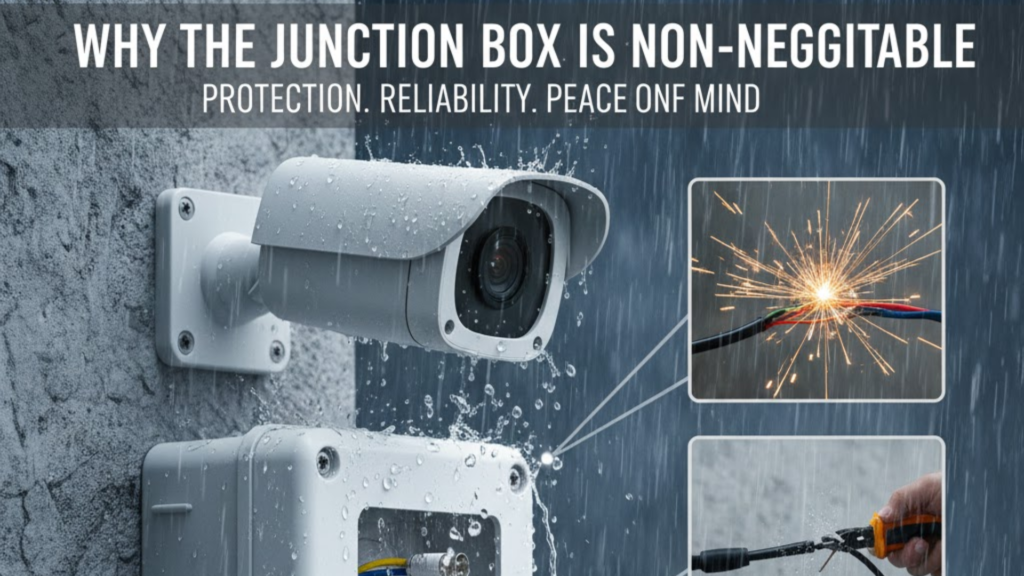
A CCTV junction box (often called a camera base or mounting box) serves three primary purposes:
- Cable Management: It houses the messy loops of BNC, DC, or RJ45 connectors.
- Environmental Protection: It shields connectors from oxidation, moisture, and dust.
- Security: It prevents “cable snipping” by vandals.
The Impact of Choosing a Poor Manufacturer
If you source from an unverified CCTV junction box manufacturer in India, you risk:
- Plastic Degradation: Cheap recycled plastic turns yellow and cracks within 6 months.
- Short Circuits: Poor waterproofing leads to water seepage, frying the camera’s motherboard.
- Maintenance Costs: Frequent “No Video” complaints due to rusted connectors.
2. Technical Standards: What Separates the Best CCTV Junction Box Manufacturer in India from the Rest
When evaluating a manufacturer, look for these specific technical benchmarks.
A. Material Composition: The “Virgin” Advantage
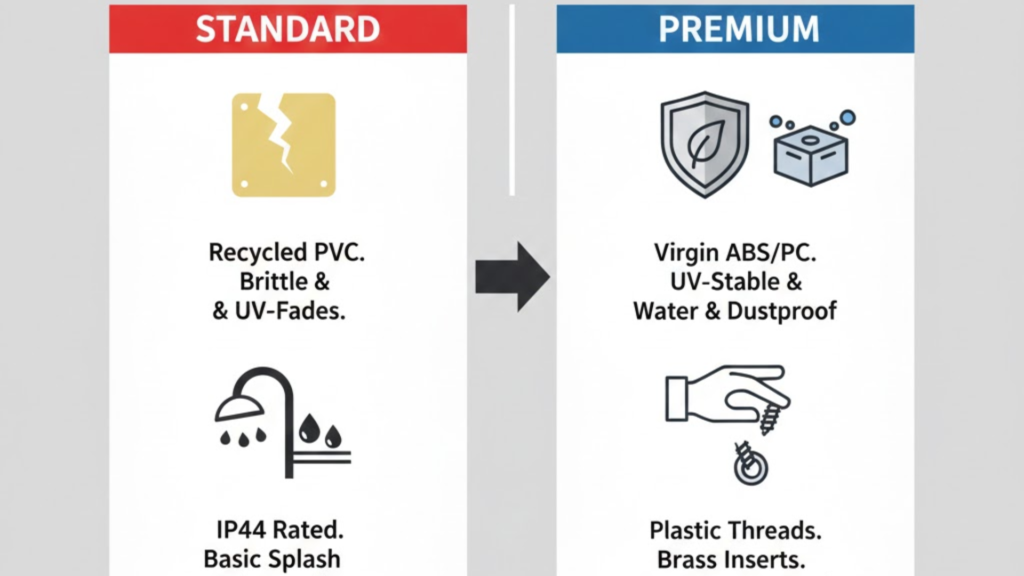
The Indian market is flooded with “regrind” (recycled) plastic. However, a top-tier CCTV junction box manufacturer in India will strictly use 100% Virgin ABS (Acrylonitrile Butadiene Styrene) or Polycarbonate.
- UV Stabilization: Essential for Indian summers. UV-stabilized boxes do not become brittle under direct sunlight.
- Flame Retardancy: Look for UL94-V0 or V1 ratings. This ensures the box won’t act as fuel in case of an electrical fire.
B. IP Ratings (Ingress Protection) Explained
| IP Rating | Level of Protection | Suitability for India |
| IP44 | Protection against splashes | Indoor use only (Offices/Homes) |
| IP65 | Protection against water jets | Standard Outdoor (Balconies/Eaves) |
| IP67 | Submersible up to 1 meter | Heavy Monsoon Areas (Mumbai/Kolkata) |
| IP68 | Hermetically sealed | Industrial/Marine environments |
3. Key Features to Look for in a Premium CCTV Junction Box Manufacturer in India
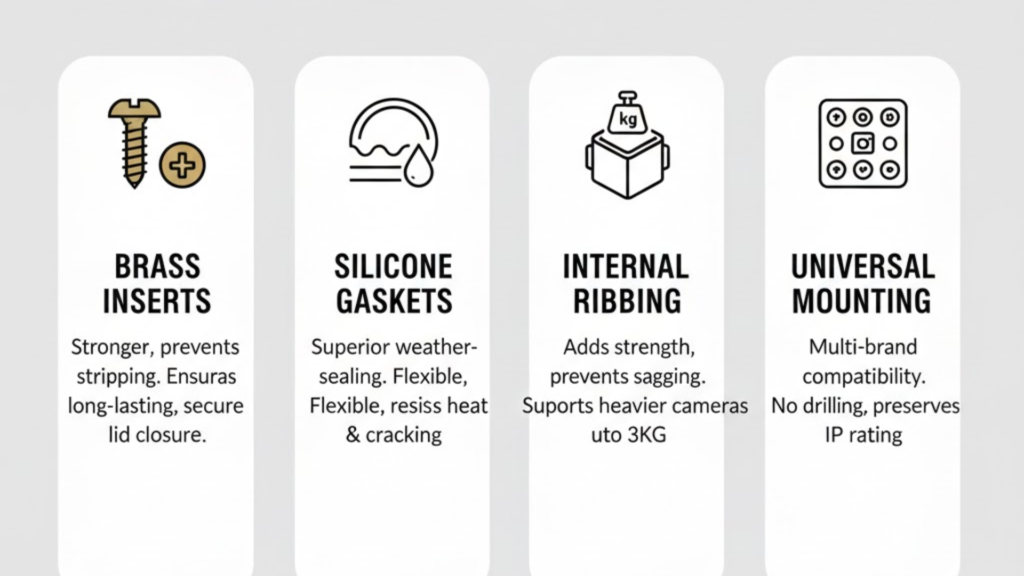
The difference between a generic plastic container and a high-end engineering enclosure lies in the finer details. When negotiating with a CCTV junction box manufacturer in India, pay close attention to these structural elements:
- Brass Inserts vs. Plastic Threads: In budget-grade boxes, screws are driven directly into the plastic. After opening the box two or three times for maintenance, the plastic threads strip away, leaving the lid loose and vulnerable. Premium manufacturers integrate threaded Brass (Pital) inserts directly into the mold. This ensures a “metal-on-metal” connection that allows for hundreds of service cycles without losing structural integrity.
- Silicone vs. Rubber Gaskets: Standard rubber gaskets tend to dry out, crack, and lose elasticity when exposed to the Indian sun. High-grade Silicone gaskets remain flexible across extreme temperature ranges (from -10°C to 70°C). They provide a “compression seal” that creates a vacuum-like barrier against moisture and fine dust particles.
- Internal Ribbing & Load-Bearing Architecture: As CCTV cameras (especially heavy IP Bullet or PTZ cameras) exert constant downward pressure, a thin-walled box will eventually “sag” or warp. Top-tier manufacturers design boxes with internal reinforcement ribs and thick-walled construction. This allows the enclosure to support weights up to 3kg without deforming over time.
- Universal Mounting Flexibility: The Indian market is diverse, using brands like Hikvision, CP Plus, Dahua, and Honeywell. A professional manufacturer provides a Multi-Point Universal Drill Pattern on the lid. This allows installers to mount any camera brand without drilling additional holes, which preserves the box’s IP rating and aesthetic finish.
4. Top Manufacturing Hubs in India (Regional Analysis)
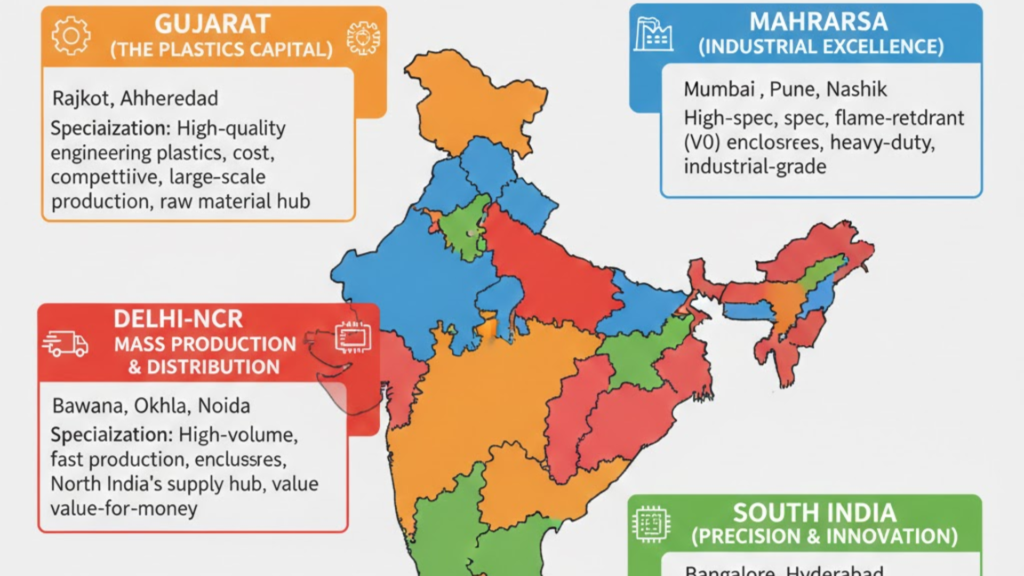
India is a massive manufacturing landscape, and different regions specialize in different grades of production. Knowing these hubs is vital for bulk sourcing:
- Gujarat (The Plastic Capital): Centered around Rajkot and Ahmedabad, this region hosts India’s most advanced injection molding facilities. Manufacturers here operate on an “Economy of Scale,” offering the best balance between high-grade virgin materials and competitive pricing. Gujarat-made boxes are renowned for their superior finish and consistent color matching.
- Maharashtra (Industrial Excellence): The Mumbai-Pune-Nashik industrial belt focuses on high-spec, heavy-duty enclosures. If your project requires Flame-Retardant (V0 Grade) boxes for hazardous environments like chemical plants, oil refineries, or massive warehouses, Maharashtra-based manufacturers are the industry leaders.
- Delhi-NCR (The Mass Distribution Hub): Hubs like Bawana, Okhla, and Noida prioritize production speed and variety. This region caters to the massive demand in North India, offering everything from entry-level “white-label” products to high-end branded solutions. It is the best place for sourcing a wide variety of sizes in a single shipment.
- South India (Precision & Smart Infrastructure): In Bangalore and Hyderabad, the focus is on “Aesthetic Precision.” These manufacturers often supply Smart City projects and IT corridors. Their junction boxes are designed to be sleek and discreet, fitting perfectly into modern, high-tech architectural environments.
5. List of Must-Have Certifications (Deep Dive)
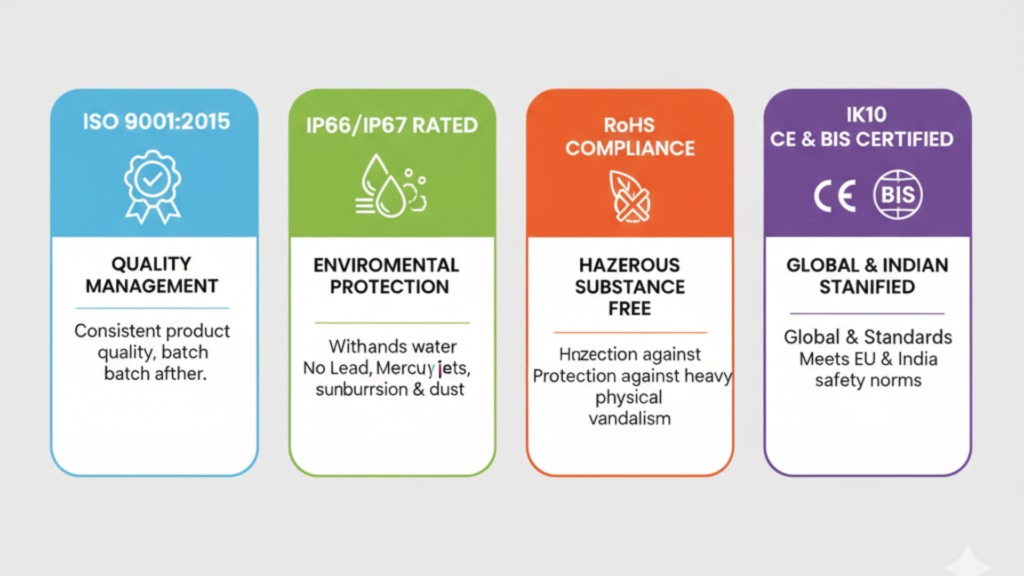
Certifications are not just paperwork; they are a manufacturer’s guarantee of reliability. A trustworthy CCTV junction box manufacturer in India should hold the following:
- ISO 9001:2015 (Quality Management): This ensures that the manufacturing process is standardized. It guarantees that the 1,000th box you receive is identical in quality to the 1st box.
- IP66/IP67 Certification (NABL Accredited): Verify that the manufacturer has a report from a lab accredited by the National Accreditation Board for Testing and Calibration Laboratories (NABL). This proves the box can truly withstand high-pressure water jets or temporary immersion during heavy Indian monsoons.
- RoHS (Restriction of Hazardous Substances): This certifies that the plastic is free from toxic heavy metals like lead or cadmium. This is mandatory for corporate contracts and environmentally conscious projects.
- CE Marking: If you intend to export these boxes or use them in high-profile projects (like Airports or Metro Stations), a CE mark confirms that the product meets international safety and health protection standards.
- IK10 (Vandal Resistance): This rating measures the “Impact Protection” level. An IK10-certified box can withstand a 20-joule impact (equivalent to a 5kg weight dropped from 40cm), making it essential for public installations prone to tampering.
6. Comparison: Plastic vs. Aluminum vs. Polycarbonate
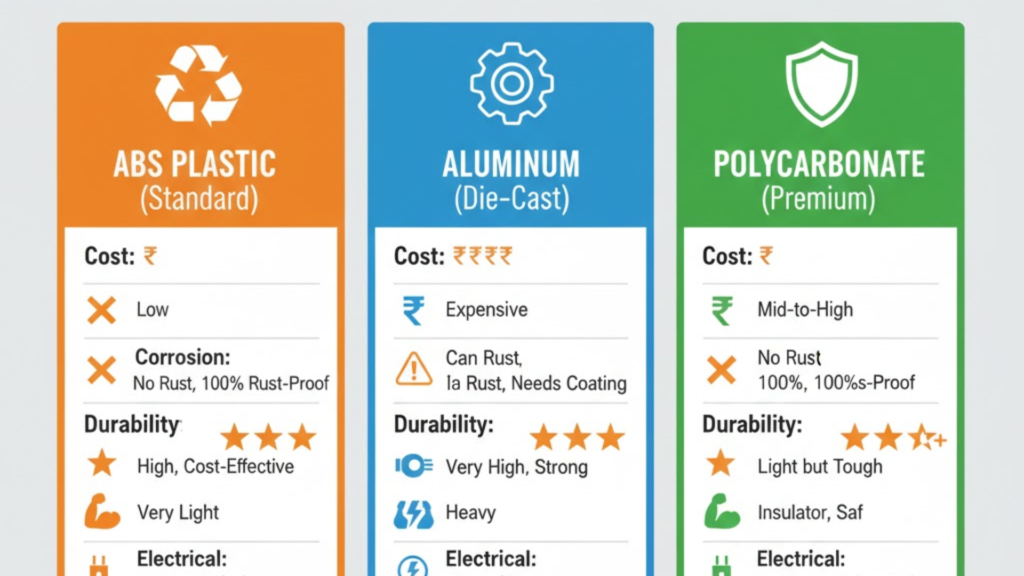
Choosing the right material is critical for the specific environment of the installation. Use the table and analysis below to make an informed choice:
Material Comparison Table
| Feature | ABS Plastic (Standard) | Aluminum Die-Cast | Polycarbonate (Premium) |
| Durability | High | Very High | Extreme |
| Rust Protection | 100% Rust-Proof | Requires Powder Coating | 100% Rust-Proof |
| Weight | Very Light | Heavy | Light but Tough |
| Electrical Safety | Insulator (Safe) | Conductor (Grounding Required) | Insulator (Safe) |
| Price Point | Budget Friendly | Expensive | Mid-to-High |
Deep Insights into Materials:
- ABS Plastic: This material dominates 85% of the Indian market. It is cost-effective, easy to drill, and completely immune to rust. It is the ideal choice for residential, retail, and standard office installations.
- Die-Cast Aluminum: Reserved for environments requiring extreme physical strength, such as prisons, military bases, or high-traffic railway stations. However, it is heavy and, if the powder coating is chipped, it can eventually oxidize and corrode. It also requires proper grounding to avoid electrical hazards.
- Polycarbonate: Often referred to as “Bulletproof Plastic,” Polycarbonate is significantly stronger than ABS. It offers incredible heat resistance and is virtually unbreakable. It is the gold standard for coastal areas (like Goa, Chennai, or Mumbai) where the salt-heavy air quickly degrades other materials.
FAQ (Frequently Asked Questions)
Q1: Can I use a regular electrical box for my CCTV installation?
A: No. Electrical boxes are not designed to bear the weight of a camera. Using them often leads to the box snapping or the camera “drooping,” which voids your installation warranty.
Q2: Why do some white junction boxes turn yellow after a few months?
A: This is due to a lack of UV-Stabilizers in the plastic resin. High-quality manufacturers add UV-inhibitors to ensure the box stays white and strong even under direct sunlight.
Q3: Is it possible to get my company logo printed on the boxes?
A: Yes, most large-scale CCTV junction box manufacturers in India offer OEM services, including screen printing or laser embossing of your brand logo for bulk orders.