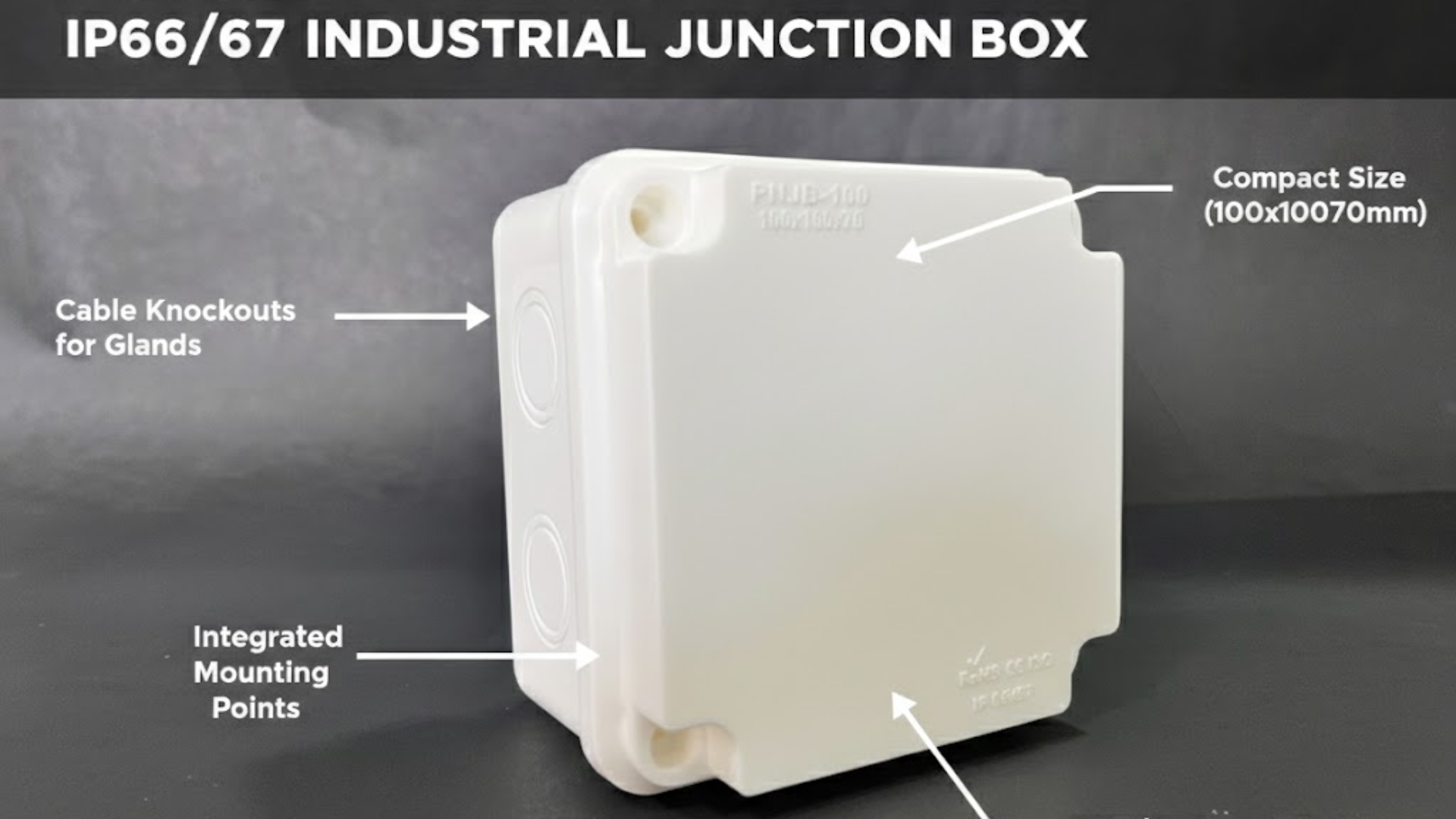
In the complex world of industrial infrastructure, the smallest components often carry the heaviest responsibilities. The industrial electrical junction box is a prime example. Whether it’s a massive oil refinery in Gujarat, a pharmaceutical hub in Hyderabad, or a tech park in Bengaluru, these enclosures are the unsung heroes protecting the electrical “nervous system” of our industries.
1. What is an Industrial Electrical Junction Box?
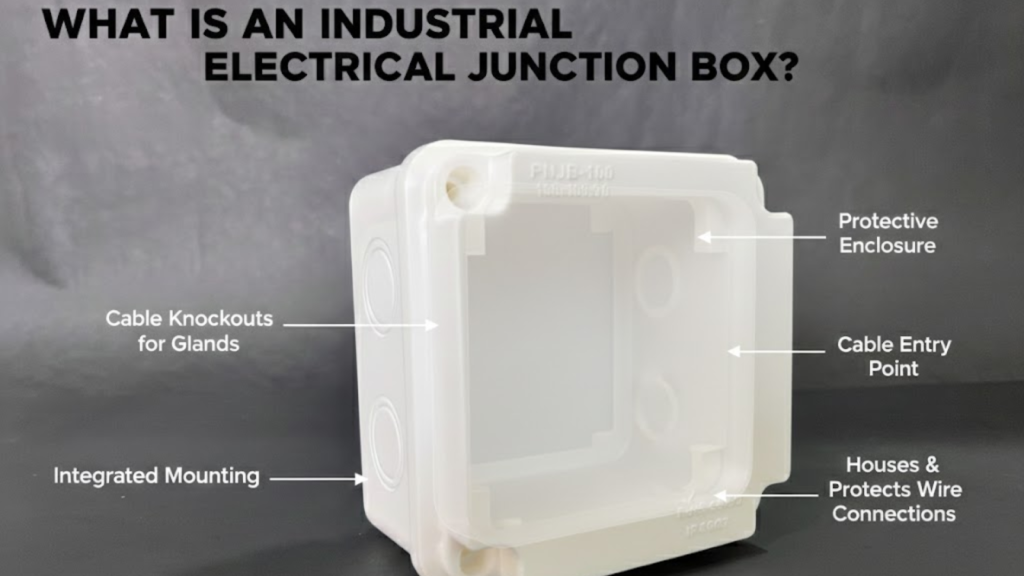
At its core, an industrial electrical junction box is a specialized enclosure designed to house electrical connections. Its primary purpose is to protect these connections from environmental hazards—such as dust, water, and corrosive chemicals—while preventing accidental electric shocks to personnel.
The Role in Industrial Ecosystems
Unlike residential junction boxes made of thin plastic, industrial versions are engineered to withstand extreme vibrations, high temperatures, and mechanical impacts. They act as a centralized hub where power or signal cables are spliced, branched, or terminated.
2. Technical Classification: Material Matters
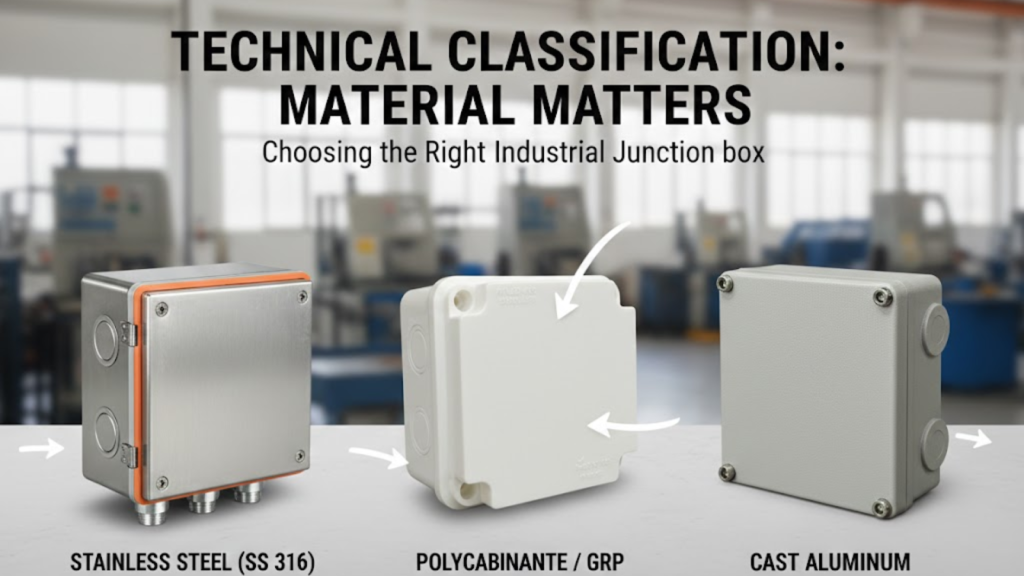
The choice of material determines the box’s lifespan and suitability for specific Indian climatic conditions.
A. Metallic Enclosures
- Stainless Steel (SS 304/316): Highly resistant to rust. SS 316 is preferred for coastal regions (like Mumbai or Chennai) due to salt-air corrosion.
- Cast Aluminum: Lightweight yet sturdy. Excellent for heat dissipation in hot climates like Rajasthan.
- Galvanized Steel: Cost-effective but prone to rusting over long periods if the coating is damaged.
B. Non-Metallic Enclosures
- Polycarbonate: Impact-resistant and UV-stable. Ideal for outdoor solar plants.
- GRP (Glass Reinforced Polyester): Does not corrode. Essential for chemical plants where metal would dissolve over time.
- ABS Plastic: Best for indoor, low-impact environments where cost is a constraint.
3. Understanding Protection Standards (IP & NEMA)
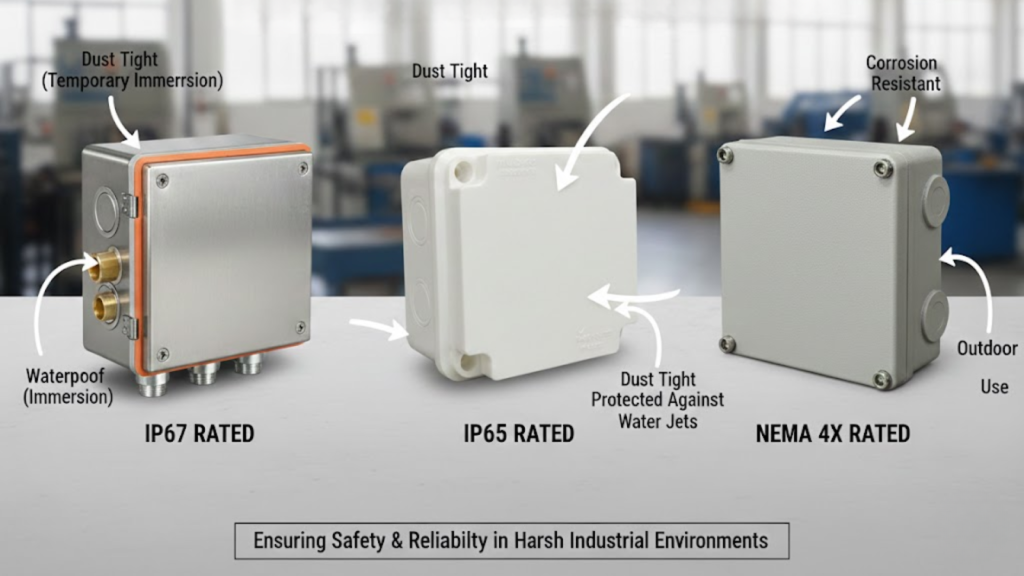
In the Indian industry, “Waterproof” isn’t a technical term—IP Ratings are.
Comparison Table: IP Ratings for Junction Boxes
| Rating | Dust Protection | Water Protection | Best Application |
| IP55 | Protected against limited dust | Protected against low-pressure water jets | Indoor workshops |
| IP65 | Dust-tight (Total) | Protected against water jets from any angle | Standard outdoor use |
| IP66 | Dust-tight (Total) | Protected against heavy seas/strong jets | Heavy monsoon areas |
| IP67 | Dust-tight (Total) | Protected against temporary immersion | Flood-prone basements |
| IP68 | Dust-tight (Total) | Protected against continuous submersion | Underwater/Submersible pumps |
4. Key Components Inside an Industrial Junction Box: An In-Depth Anatomy
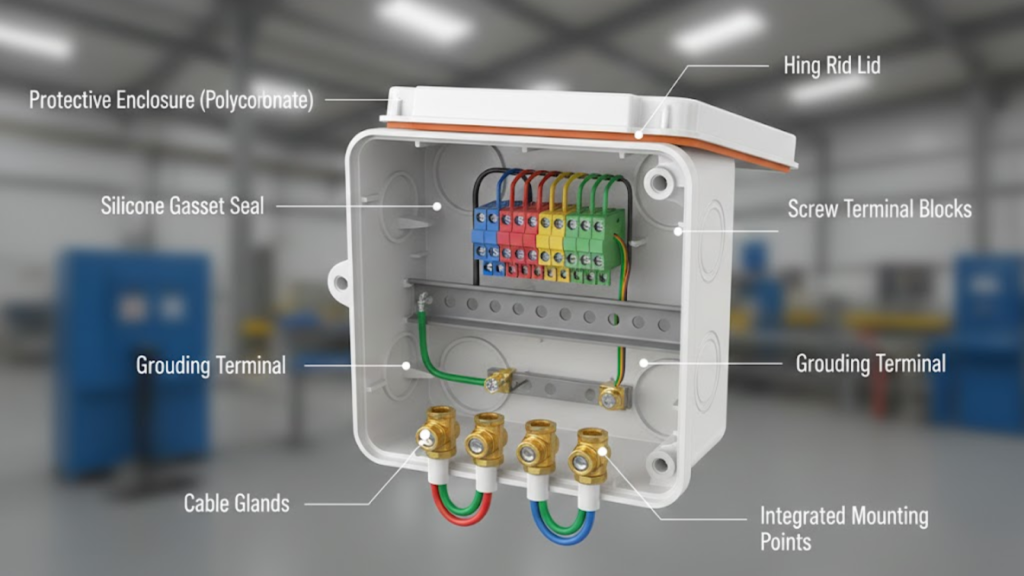
A high-quality industrial electrical junction box is more than just an empty shell. Its internal ecosystem determines how long your electrical system will last without a breakdown.
A. Terminal Blocks and DIN Rails
In a professional industrial setup, we don’t just “twist wires together” with electrical tape. We use Terminal Blocks.
- DIN Rails: These are standardized metal rails (usually 35mm wide) inside the box. They allow you to “snap-on” components like terminals, fuse holders, and even small circuit breakers.
- Push-in vs. Screw Terminals: For high-vibration environments (like a textile mill or a stone crusher in Rajasthan), Push-in/Spring-cage terminals are superior because they don’t loosen over time, unlike traditional screw-type terminals.
B. Specialized Cable Glands
The cable gland is the “gatekeeper” of the box.
- Double Compression Glands: Widely used in Indian oil and gas sectors, these provide an extra seal on the inner sheath of the cable, making them incredibly robust against moisture and mechanical pull.
- Material Choice: Use brass glands for armored cables (to ensure continuity) and PVC or Nylon glands for unarmored cables in non-corrosive environments.
C. Gaskets and Sealing Technology
The thin strip of rubber between the lid and the box is the only thing standing between your electronics and a monsoon downpour.
- Neoprene Gaskets: Excellent for general weatherproofing.
- Silicone Gaskets: Essential if the box is near a furnace or boiler, as they can withstand temperatures up to 200°C without melting or losing their shape.
D. Mounting Plates and Brackets
To maintain the IP Rating, you should never drill holes in the back of the box to mount it to a wall. Instead, use:
- Internal Mounting Plates: These allow you to mount your internal wiring without piercing the outer shell.
- External Lugs: These are “ears” attached to the outside of the box so you can bolt it to a wall or pole while keeping the enclosure’s integrity 100% airtight.
5. Critical Selection Criteria for Indian Industries: The “Trustable” Checklist
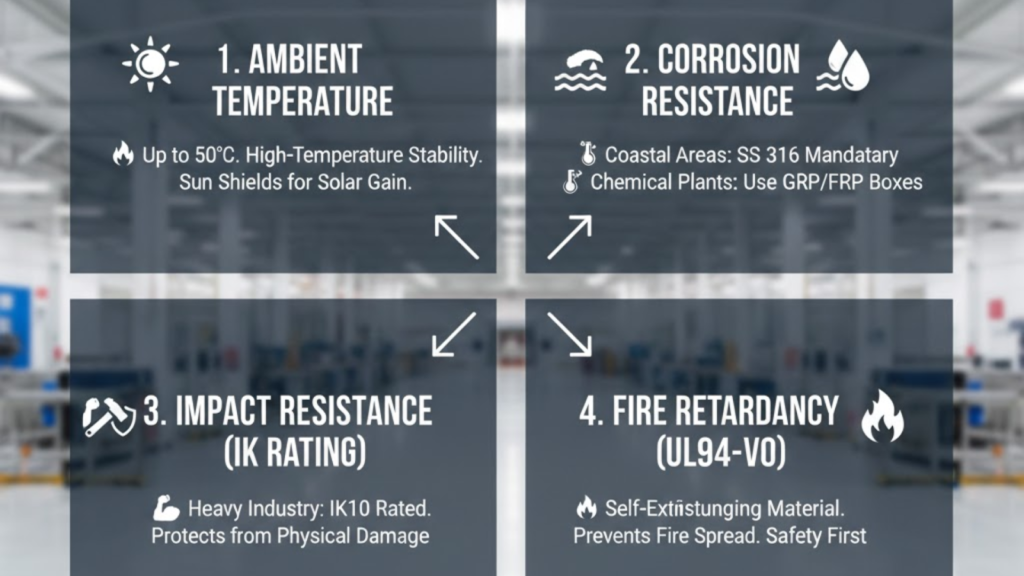
Selecting an industrial electrical junction box in India requires a deep understanding of local environmental stressors.
A. Thermal Management (The 50°C Challenge)
In many parts of India, ambient temperatures hit 48°C to 50°C. Inside a closed box with live current, the temperature can rise even higher.
- Solar Gain: If the box is under direct sunlight, it acts like an oven. You must choose enclosures with high Thermal Deflection Temperatures (TDT) or install sunshields/canopies.
- Ventilation: In some cases, you might need “breather valves” that allow air to circulate but block water droplets.
B. Corrosion Resistance (Coastal vs. Inland)
India has a massive coastline. If your factory is within 50km of the sea (e.g., Mumbai, Chennai, Vizag):
- SS 316 is Mandatory: Do not settle for SS 304; the salt air will cause “Tea Staining” (brown rust spots) within months.
- GRP (Glass Reinforced Polyester): This is the “Gold Standard” for chemical plants and coastal areas because it literally cannot rust.
C. Impact Resistance (IK Rating)
In a warehouse or heavy manufacturing unit, boxes often get hit by forklifts or falling tools.
- IK08 to IK10: This rating measures the resistance against mechanical impact. For heavy-duty Indian industries, an IK10 rating ensures the box won’t crack even under a 5kg hammer blow.
D. Fire Retardancy
A trustable junction box must be “Self-Extinguishing.” Look for materials rated UL94-V0. This means if a short circuit happens inside and a fire starts, the box material will stop burning on its own within 10 seconds.
6. Installation Best Practices: A Human-Centric Engineering Approach
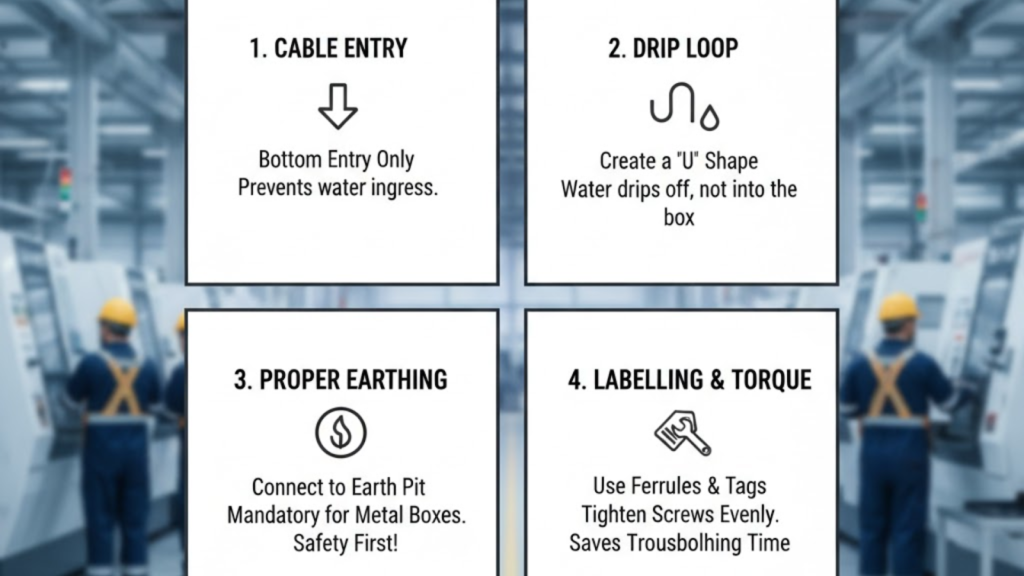
Poor installation is the #1 cause of industrial fires. Follow these detailed steps for a professional-grade setup.
Step 1: Planning the Cable Entry
Always plan your entries at the bottom of the box. If you enter from the top, gravity will eventually lead water, condensation, or cleaning fluids straight into the electrical terminals. This is a common mistake in Indian food processing units where “wash-downs” are frequent.
Step 2: The “Drip Loop” Technique
Before the cable enters the industrial electrical junction box, leave a small slack loop hanging lower than the entry point. This ensures that any moisture running down the cable drips off the bottom of the loop instead of entering the gland.
Step 3: Proper Earthing (Grounding)
- For Metal Boxes: You must connect the earth wire to the dedicated “Earthing Stud” on the box body AND the lid.
- For Plastic Boxes: Since the box doesn’t conduct, you must ensure earth continuity between the incoming and outgoing cables using an internal earth bar.
Step 4: Torque and Tightening
Using a torque screwdriver ensures that the lid screws are tightened evenly. If one side is tighter than the other, the gasket will be “pinched,” creating a microscopic gap where moisture can enter.
Step 5: Final Labeling and Documentation
A “Human Written” guide isn’t complete without emphasizing Labeling.
- Use permanent, UV-resistant markers or engraved tags.
- Place a small laminated wiring diagram inside the lid. In the middle of a midnight power failure, this small step can save hours of downtime for a technician.
Frequently Asked Questions (FAQ)
Q1. Can I use a PVC junction box for industrial use?
While high-grade PVC is used, it is generally discouraged for heavy industrial zones due to low impact resistance. Polycarbonate or GRP are better non-metallic alternatives for industrial settings.
Q2. What is an Explosion-Proof Junction Box?
In environments with flammable gases (like Petrol Pumps or Gas Plants), you need a Flameproof (Ex d) enclosure. These are designed to contain an internal explosion so it doesn’t ignite the outside atmosphere.
Q3. How do I prevent condensation inside a sealed box?
This is a common issue in humid Indian coastal areas. The solution is to install a Breather Drain Plug or use Silica Gel packets inside the box to absorb moisture.
Q4. Is SS 304 enough for outdoor use?
In inland cities like Delhi or Nagpur, SS 304 is fine. However, in coastal cities like Vizag or Kochi, SS 316 is mandatory to prevent “pitting” corrosion.