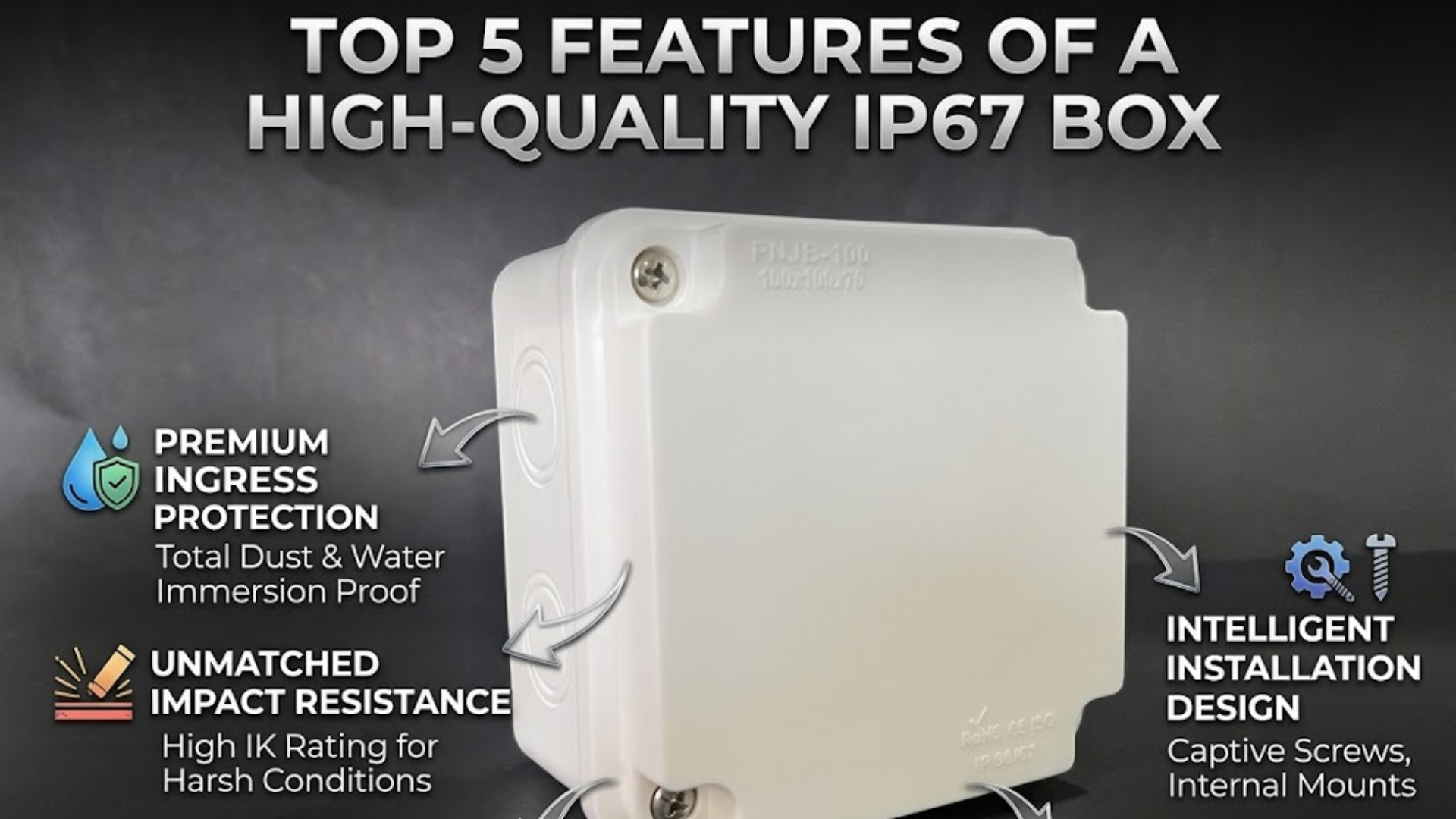
In the rapidly evolving landscape of Indian infrastructure—from the massive solar farms in Rajasthan to the high-tech smart cities in Uttar Pradesh—the safety of electrical systems is paramount. At the heart of this safety lies the IP67 box.
While many manufacturers claim to offer “waterproof” solutions, industrial-grade protection requires more than just a plastic shell. When you are sourcing for high-stakes projects under the ESA (Industrial Electrical Enclosures) brand, you need to look beyond the surface.
Understanding the “IP67” Standard
Before we dive into the features, let’s break down what IP67 actually means for an engineer or a contractor:
- IP (Ingress Protection): A global standard (IEC 60529) used to define levels of sealing effectiveness.
- The First Digit ‘6’: Represents total protection against dust and solid particles. It is “Dust-tight.”
- The Second Digit ‘7’: Represents protection against immersion in water up to 1 meter depth for 30 minutes.
1. Material Science: Beyond Basic Plastic
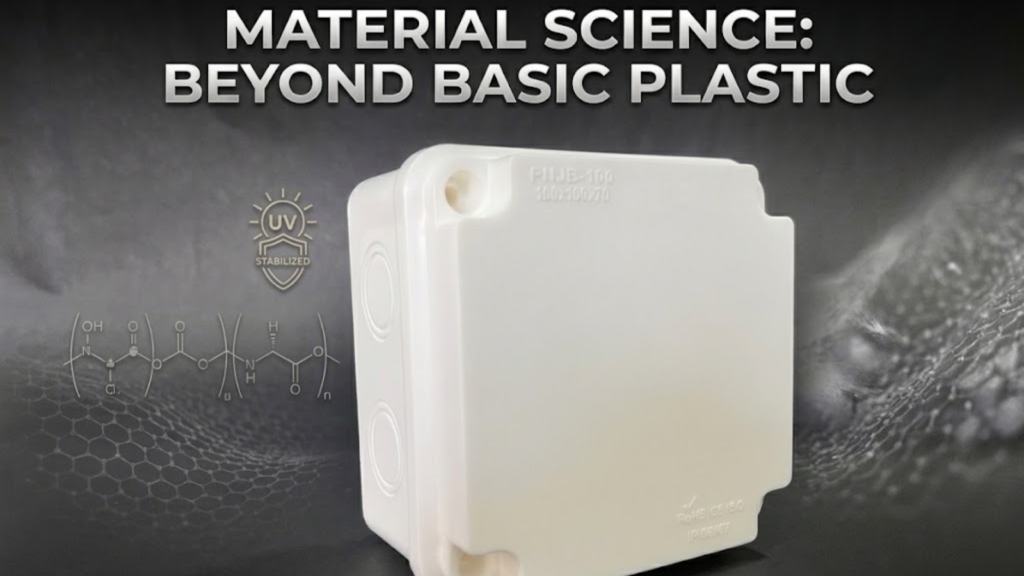
The Indian climate is brutal. With temperatures soaring above 45°C and high UV exposure, a standard plastic box will turn brittle and crack within months. A high-quality IP67 box must be built from superior materials.
Key Material Options
- Polycarbonate (PC): The gold standard for outdoor use. It is impact-resistant and UV-stabilized.
- ABS (Acrylonitrile Butadiene Styrene): Best for indoor industrial use where chemical resistance is needed but direct sunlight is minimal.
- Die-cast Aluminum: For heavy-duty electromagnetic shielding and extreme mechanical strength.
Why UV Stabilization Matters
In regions like Jaipur or Kanpur, outdoor enclosures face constant solar radiation. Without UV inhibitors, the molecular structure of the plastic breaks down (photodegradation), leading to yellowing and eventual failure of the IP rating.
2. Advanced Sealing Technology (The Gasket)
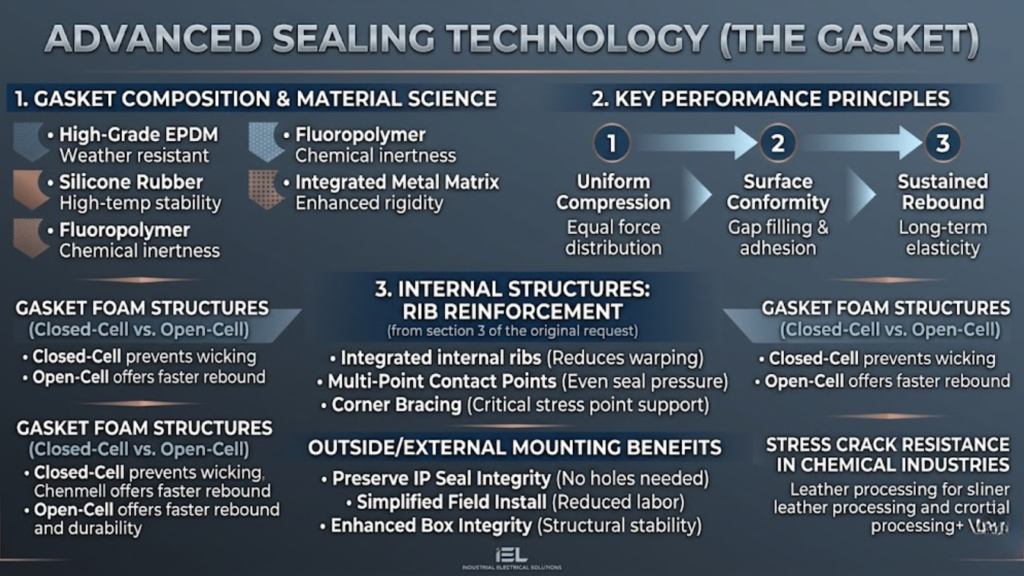
The most critical failure point of any IP67 box is the interface between the lid and the base. A high-quality enclosure is only as good as its gasket.
Comparison of Gasket Materials
| Feature | Standard Rubber Gasket | Silicon / PU Foam Gasket |
| Durability | Low (hardens over time) | High (stays flexible) |
| Temperature Range | $-10°C$ to $+60°C$ | $-40°C$ to $+120°C$ |
| Sealing Shape | May lose “memory” | Excellent shape recovery |
| Best For | Temporary/Indoor use | Long-term Outdoor/Industrial |
ESA Tip: Look for “Poured-in-place” gaskets. These are CNC-machined foam seals that have no joints or gaps, ensuring a 100% airtight seal.
3. Structural Integrity and Impact Resistance (IK Rating)
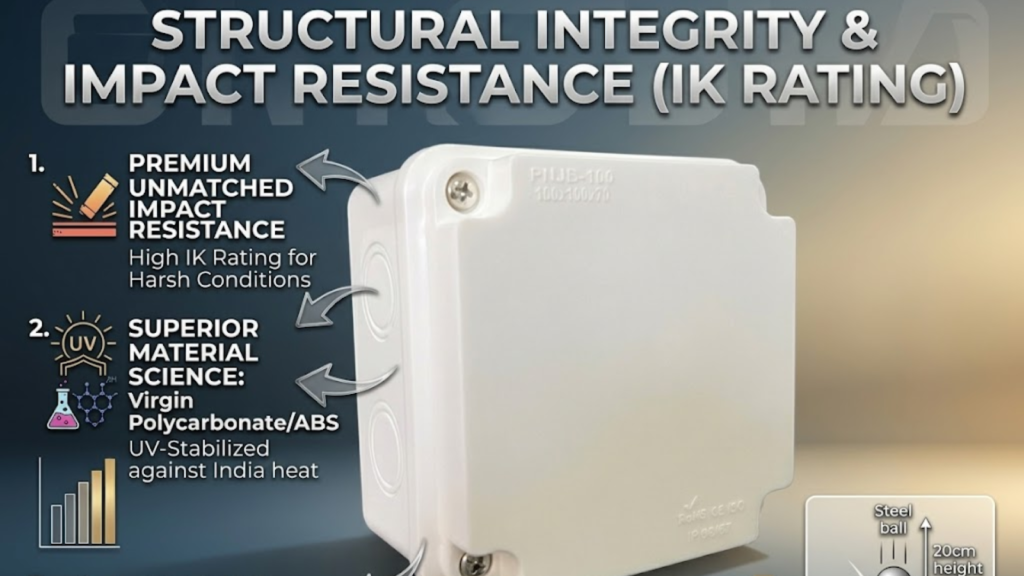
When we talk about an IP67 box, most people focus solely on water and dust. However, in an industrial setting—be it a manufacturing plant in Kanpur or a construction site in Jaipur—physical durability is just as vital as waterproofing. Structural integrity ensures that the enclosure maintains its shape and seal even when subjected to mechanical stress.
A. Understanding the IK Rating System
The IK Rating (International Mechanical Protection) is an international numeric classification (IEC 62262) that indicates the degrees of protection provided by enclosures against external mechanical impacts.
| IK Rating | Impact Energy (Joules) | Equivalent Impact |
| IK06 | 1.0 Joule | 500g object dropped from 20cm |
| IK07 | 2.0 Joules | 500g object dropped from 40cm |
| IK08 | 5.0 Joules | 1.7kg object dropped from 29.5cm |
| IK09 | 10.0 Joules | 5.0kg object dropped from 20cm |
| IK10 | 20.0 Joules | 5.0kg object dropped from 40cm |
Why it matters for ESA Enclosures: If an enclosure is struck by a falling tool or hit by moving machinery and it cracks or deforms even slightly, the IP67 seal is compromised.
B. The Role of Wall Thickness and Rib Reinforcement
A common mistake in low-cost manufacturing is thinning the walls of the box to save on raw material costs. This leads to “flexing.”
- The Flexing Risk: When you tighten the mounting screws on an uneven wall, a thin-walled box will warp. This warping creates microscopic gaps between the base and the lid, allowing moisture to seep in over time.
- The ESA Solution: Premium boxes feature internal ribbing. This ensures the gasket remains under uniform pressure across all four corners.
C. Stress Crack Resistance
In chemical-heavy industries—such as leather processing in Kanpur or textile dyeing in Rajasthan—the air is often filled with volatile organic compounds (VOCs).
- High-quality IP67 boxes are tested for Environmental Stress Cracking (ESC).
- Standard plastics might look fine but develop tiny “hairline cracks” when exposed to industrial oils or cleaning agents. A premium enclosure uses virgin polymers that are chemically inert, ensuring the box doesn’t shatter under chemical or thermal stress.
D. Hinge and Screw-Tower Strength
The corners of the box, often called Screw Towers, are the most stressed parts of the structure.
- Thread Durability: In cheap boxes, the plastic threads strip after opening the lid 2 or 3 times. ESA-grade boxes use deep-threaded pillars or brass inserts to allow for repeated maintenance without losing grip.
- Load Bearing: If you are mounting heavy components like transformers or large batteries inside the box, the structural integrity of the internal mounting plate (backplate) is crucial. A high-quality box ensures that the weight of the internals doesn’t pull the mounting pillars out of the base.
E. Thermal Stability and Dimensional Integrity
India experiences extreme temperature fluctuations. A box installed outdoors might face 48°C in the summer and 5°C in the winter.
- Thermal Expansion: Poor quality materials expand and contract significantly with temperature changes. This “breathing” effect can fatigue the plastic and eventually lead to structural failure.
- Heat Deflection Temperature (HDT): High-quality industrial boxes have a high HDT, meaning they maintain their rigid shape even when the internal components generate heat (like a power supply or a solar inverter).
4. Ease of Installation & Customization
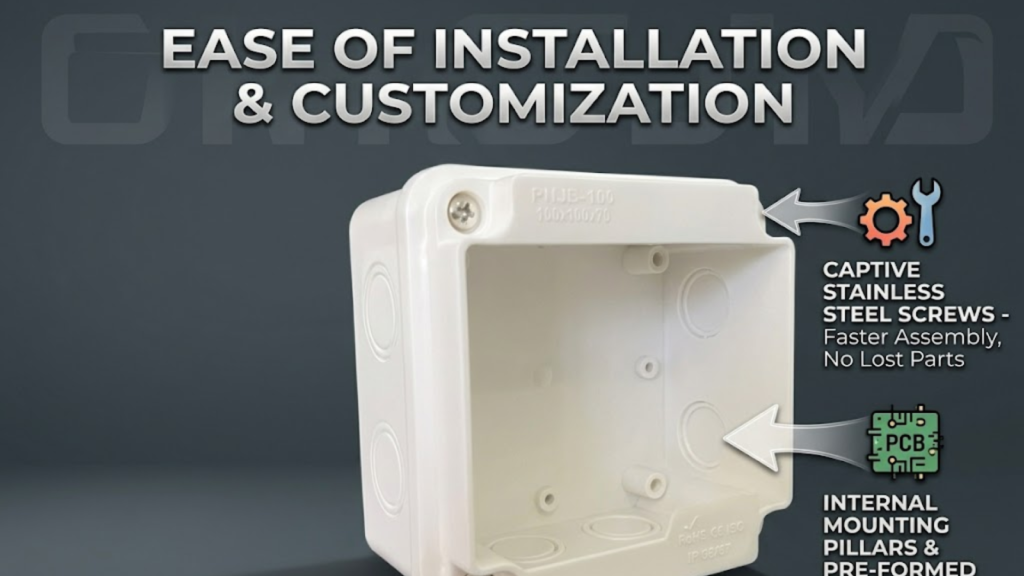
A box that is hard to install leads to errors. Essential Design Features:
- Captive Screws: The lid screws should stay attached to the lid even when unscrewed. This prevents losing small parts while working at heights or in dark panels.
- Internal Mounting Pillars: Molded-in brass inserts or plastic pillars allow you to mount PCBs, DIN rails, or mounting plates without drilling through the back of the box (which would ruin the IP rating).
- Wall Mounting Brackets: High-quality boxes offer external mounting ears so you can fix the box to a wall without opening the sealed compartment.
5. Certification and Compliance
In the Indian B2B sector, trust is built on certification. A high-quality IP67 box must be backed by documented proof.
- RoHS Compliance: Ensures no hazardous substances (like lead or cadmium) are used.
- NABL Lab Reports: Always ask if the IP67 rating has been tested in an Indian NABL-accredited laboratory.
- CE & UL Standards: For exports or high-end corporate projects, these global certifications are non-negotiable.
Comparison Table: Standard vs. ESA Premium IP67 Box
| Specification | Standard Market Box | ESA Premium IP67 Box |
| Material | Recycled ABS | Virgin UV-Stabilized Polycarbonate |
| Gasket | Glued Rubber Strip | Integrated PU Foam / Silicon |
| Screw Type | Normal Steel (Rusts) | Stainless Steel / Plastic Captive |
| Warranty | None | Performance Guarantee |
| Application | Low-cost DIY | Industrial / Solar / Smart City |
Frequently Asked Questions (FAQ)
Q1: Can I use an IP67 box underwater permanently?
No. IP67 is for temporary immersion (30 mins). For permanent underwater use, you need an IP68 rated enclosure.
Q2: Does drilling a hole for a cable ruin the IP67 rating?
Yes, unless you use a Cable Gland. To maintain the rating, you must use a PG or Metric threaded cable gland with a proper rubber seal.
Q3: Is Polycarbonate better than Metal for IP67 boxes?
It depends. Polycarbonate is rust-proof, lightweight, and non-conductive (safer), whereas Metal is better for heavy-duty mechanical protection and EMI shielding.
Q4: Why is my IP67 box fogging up inside?
This is usually due to condensation from temperature changes. We recommend using a Pressure Compensation Valve (Breather Vent) to allow the box to “breathe” without letting water in.