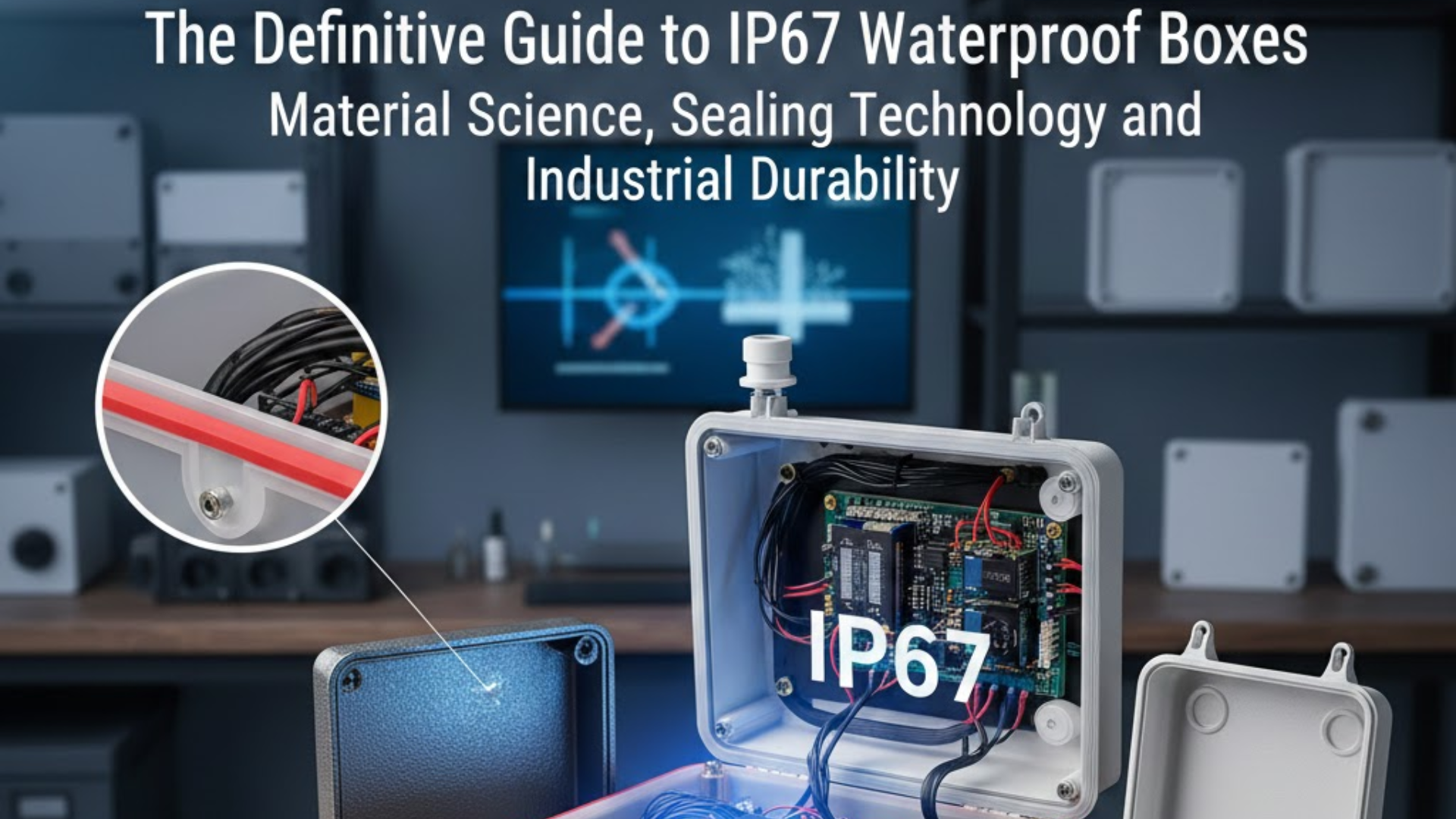
In the world of electrical engineering and outdoor infrastructure, protection is not just an option—it is a necessity. In India, where environmental conditions range from the salt-laden humid air of Mumbai and Chennai to the bone-dry, dust-heavy heat of Rajasthan, an ordinary plastic container won’t suffice. You need an IP67 waterproof box.
This 3000-word guide serves as the ultimate resource for procurement managers, DIY enthusiasts, and solar installers to understand how to select, install, and maintain the perfect IP67 waterproof box for long-term reliability.
1. The Science Behind the IP67 Standard
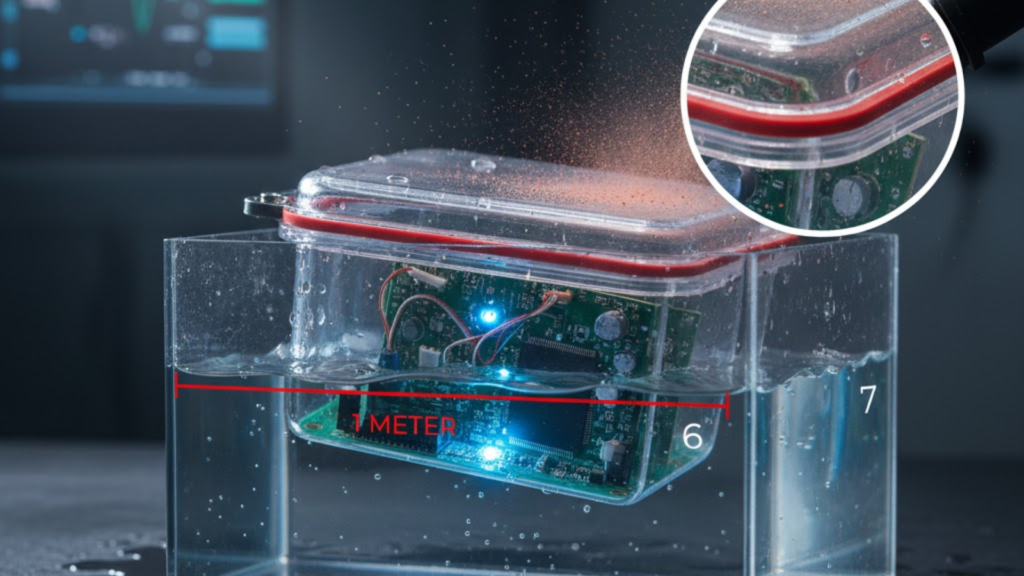
When we talk about an IP67 waterproof box, we are referring to the Ingress Protection code defined by the international standard IEC 60529.
A Technical Breakdown of the Digits
- The First Digit ‘6’ (Solid Protection): This is the highest possible rating for solid ingress. It means the enclosure is “Dust-Tight.” In cities like Delhi, where PM2.5 and PM10 levels are high, fine dust can enter standard boxes and create a conductive layer on PCBs, leading to short circuits. A true IP67 waterproof box prevents this entirely.
- The Second Digit ‘7’ (Liquid Protection): This signifies that the enclosure can withstand temporary immersion in water. The test involves placing the box in 1 meter of water for exactly 30 minutes.
Why IP67 is the “Sweet Spot” for India
While IP65 (water jets) and IP66 (powerful water jets) are common, they are often not enough for the Indian Monsoon. During heavy flooding or water-logging, a junction box at ground level might find itself submerged for short periods. An IP67 waterproof box ensures that even if the area is flooded, your internal components remain bone-dry.
2. Material Selection: Choosing the “Skin” of Your Enclosure
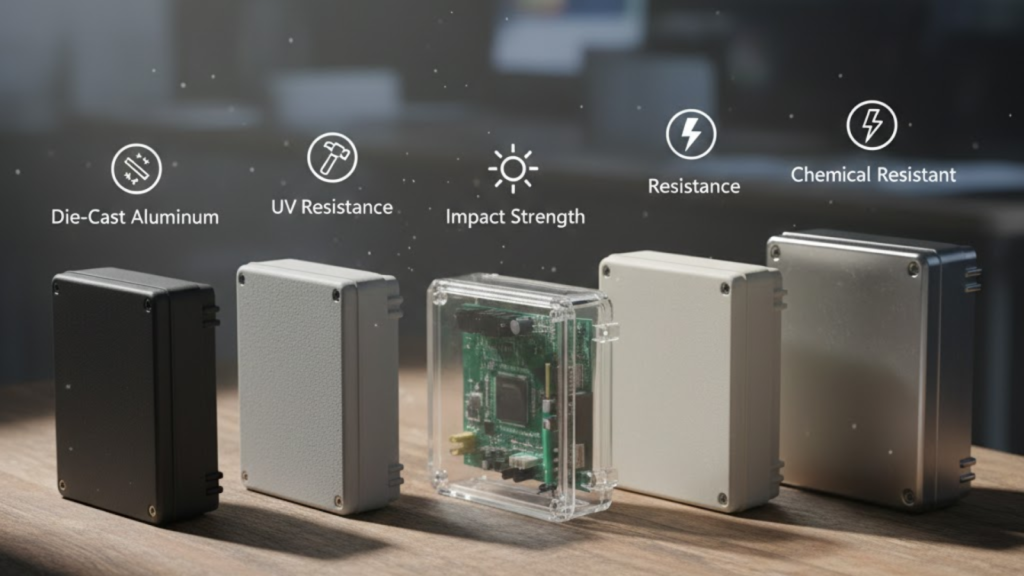
The longevity of your IP67 waterproof box depends on what it is made of. The Indian climate subjects materials to high UV radiation and extreme thermal expansion.
Detailed Material Comparison Table
| Material | UV Stability | Impact Strength (IK) | Thermal Conduct. | Best Indian Application |
| ABS Plastic | Low | IK07 | Low | Indoor IoT Gateways, Smart Homes. |
| Polycarbonate (PC) | Excellent | IK08 – IK10 | Low | Solar Rooftops, CCTV Poles. |
| Die-Cast Aluminum | High | IK10 | High | Heavy Industry, High-Heat Zones. |
| Fiberglass (GRP) | High | IK09 | Low | Railways, Chemical Plants. |
| Stainless Steel | Maximum | IK10 | Medium | Marine, Food & Beverage Industry. |
Deep Dive: Polycarbonate vs. ABS
Many buyers choose ABS because it is cheaper. However, in the Indian sun, ABS can turn yellow and become brittle within 12 months. For any outdoor IP67 waterproof box, Polycarbonate (PC) is the professional choice because it is virtually unbreakable and UV-stabilized.
3. The Role of Gasket Technology in Waterproofing
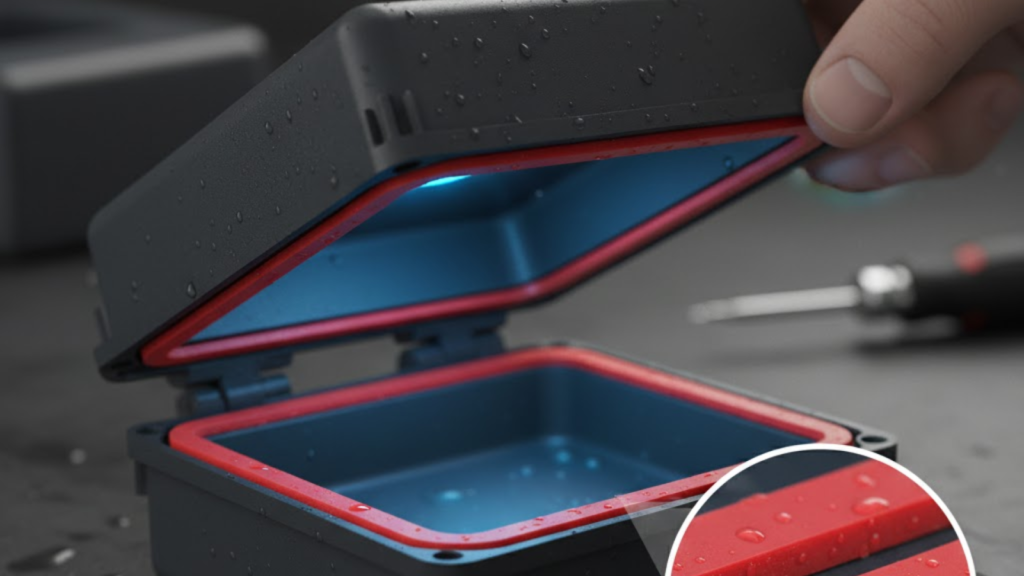
The seal is the most frequent point of failure in a waterproof enclosure. A high-quality IP67 waterproof box uses one of three main types of gaskets:
- Silicone Gaskets: These are the gold standard. They remain soft and pliable even in the 48°C heat of an Indian summer. They do not “bond” to the lid, allowing you to open the box for maintenance without tearing the seal.
- EPDM (Ethylene Propylene Diene Monomer): Highly resistant to weather and ozone. Common in industrial junction boxes.
- PU Foam (Formed-In-Place): This is a machine-applied liquid that hardens into a seamless gasket. Because there is no “cut and glue” joint, there is 0% chance of water seeping through a seam.
Checklist for Gasket Quality:
- Is the gasket “nested” in a deep groove?
- Does it return to its original shape after the lid is opened?
- Is it resistant to oil and chemicals (if used in a factory)?
4. Why “Breather Vents” are Essential in Humid Regions
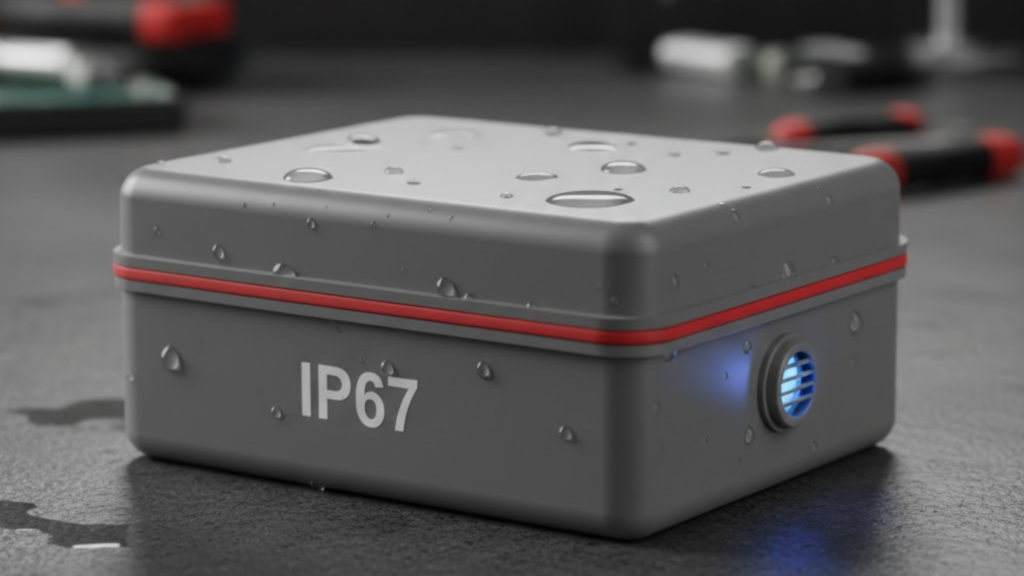
One of the most misunderstood aspects of an IP67 waterproof box is internal condensation.
In humid coastal regions like Kerala or West Bengal, the air inside your box contains moisture. During the day, the box heats up and the air expands. At night, it cools down and creates a vacuum. This vacuum can actually suck moisture through the microscopic gaps in the seal or cable glands.
The Solution: An IP67 Pressure Compensation Plug (Breather Vent).
- It allows air to pass through a membrane.
- It blocks liquid water and dust.
- It prevents “seal fatigue” and internal fogging.
5. Industrial Use Cases in the Indian Market
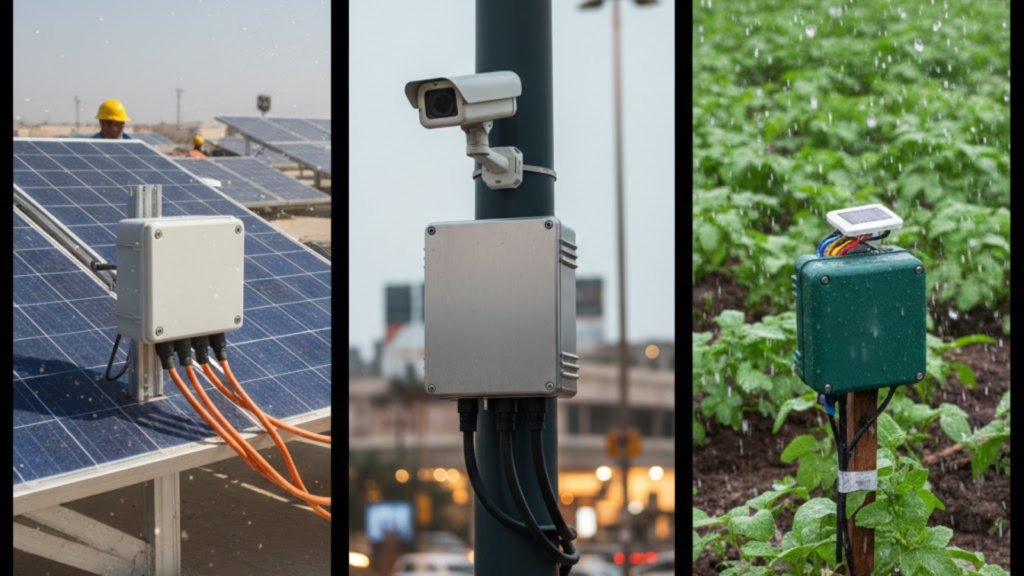
A. Solar Energy (Photovoltaic Systems)
Indian solar plants face massive dust storms and heavy rains. An IP67 waterproof box is used as a string combiner box or to house micro-inverters. Without IP67 protection, the high-voltage DC current would arc due to moisture, leading to fire hazards.
B. Smart City & CCTV Surveillance
Across cities like Bangalore and Hyderabad, thousands of cameras are mounted on poles. These cameras require a junction box for power adapters and media converters. A Polycarbonate IP67 waterproof box is used because it doesn’t block Wi-Fi/4G signals and resists tampering.
C. Agriculture & Irrigation Automation
Smart farming in Punjab and Maharashtra involves sensors placed in fields. These IP67 waterproof boxes must survive being sprayed by pesticides and fertilizers while protecting the delicate LoRaWAN or GSM modules inside.
6. Installation Best Practices (The “Pro” Way)
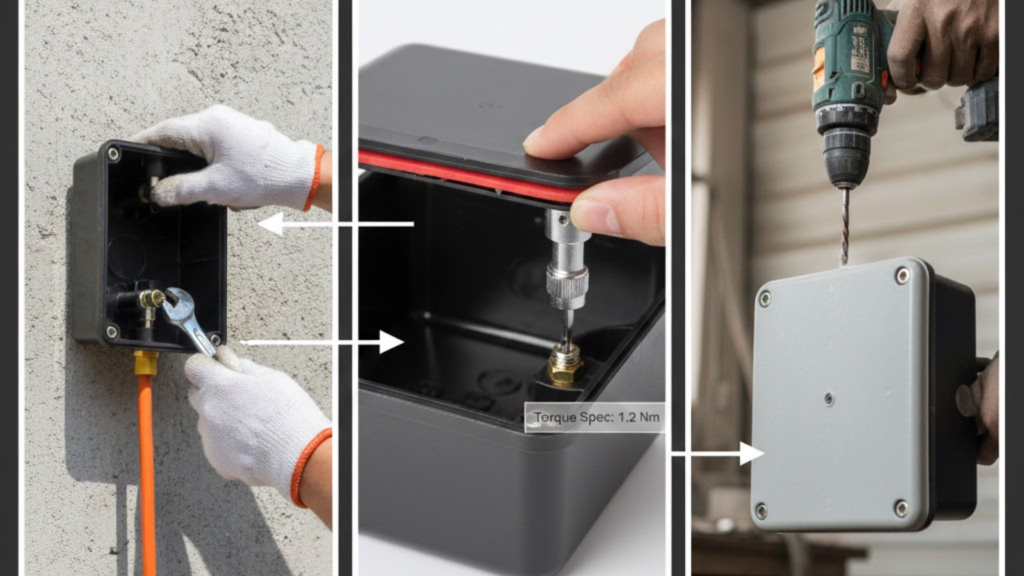
Buying a high-end IP67 waterproof box is useless if it is installed incorrectly. Follow these steps:
- Vertical Mounting: Always mount the box vertically if possible.
- Bottom Entry: Cables should always enter from the bottom. If they enter from the side or top, gravity will guide water directly into the entry point.
- Cable Glands: Use the correct size. A “loose” gland is not waterproof. If you have a 6mm cable, use a gland rated for 4-8mm.
- Drip Loops: Always leave a slack loop of cable below the entry point so water drips off before reaching the box.
- Torque: Do not over-tighten lid screws. Over-tightening can warp the plastic and create a gap in the seal.
Frequently Asked Questions (FAQ)
Q1: Can I use an IP67 waterproof box for an underwater swimming pool light?
Answer: No. For permanent underwater use, you must use IP68. IP67 is only for “temporary” immersion (up to 30 minutes).
Q2: Does “Waterproof” also mean “Fireproof”?
Answer: Not necessarily. Most IP67 waterproof boxes are made of “Flame Retardant” plastic (UL94-V0), which means they won’t catch fire easily, but they are not “fireproof” like a safe.
Q3: Why is my IP67 box fogging up inside?
Answer: This is usually due to “Pressure Differential.” The air trapped inside has moisture that condenses on the cold lid. Installing a Breather Vent will solve this.
Q4: Are metal boxes better than plastic ones?
Answer: Not always. Metal (Aluminum) is better for heat dissipation and strength, but Plastic (Polycarbonate) is better for weight, price, and wireless signal transparency.
Summary Table: Choosing Your Box
| Feature | Low-End Box | High-End IP67 Box |
| Screws | Plain Steel (Rusts) | Stainless Steel / Captive |
| Inserts | Plastic Threads (Strips) | Brass Inserts |
| Gasket | Glued Rubber | Integrated Silicone/PU |
| UV Protection | None | UV Stabilized (F1 Rating) |
Conclusion
Protecting your electronics with an IP67 waterproof box is an investment in the reliability of your system. In the harsh and diverse Indian environment, cutting corners on enclosure quality can lead to expensive downtime and safety risks. Always prioritize UV-stabilized materials, high-quality silicone seals, and proper cable gland installation.