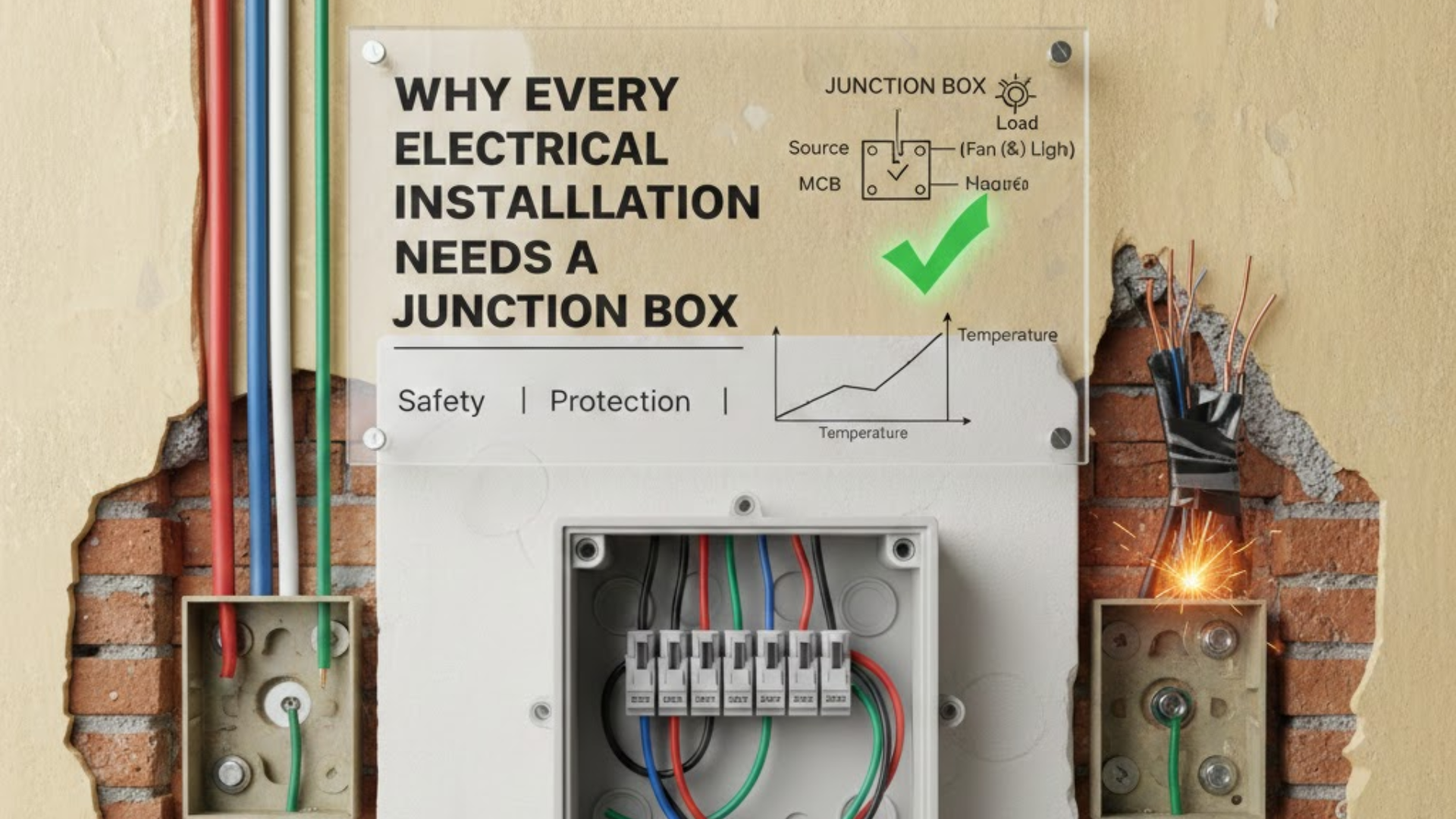
In the modern Indian household, electricity is the invisible force that powers our lives—from the ACs fighting the Delhi heat to the grinders in a Chennai kitchen. However, this power comes with a risk. Most electrical fires in India are not caused by appliance failure but by poor wiring connections.This is where the junction box electrical unit becomes the unsung hero of your home’s infrastructure. In this exhaustive guide, we will explore why skipping a junction box is a gamble you should never take.
1. What is a Junction Box Electrical? (The Technical Definition)
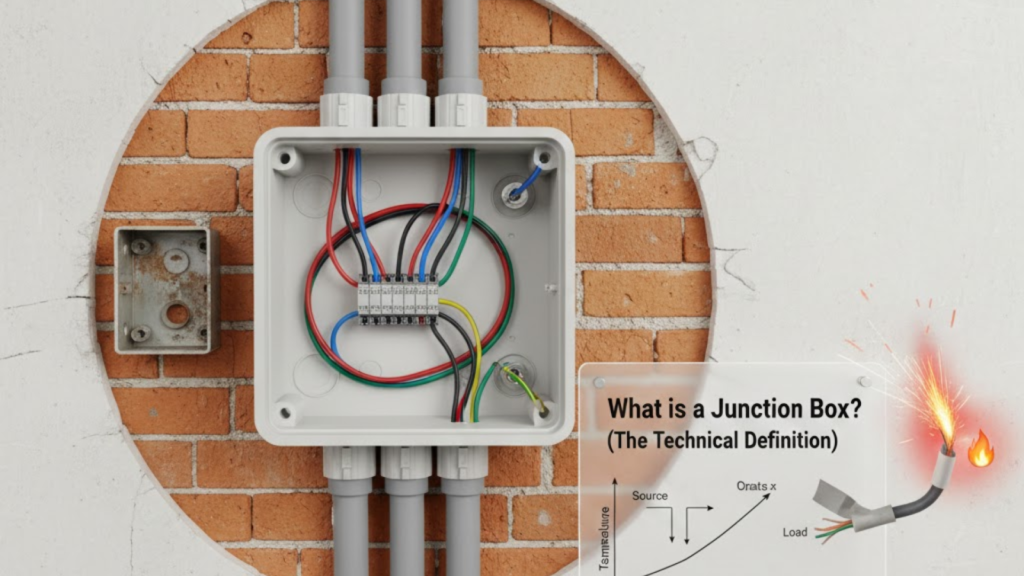
A junction box electrical enclosure is a protective housing where electrical wires are joined, branched, or terminated. Think of it as a “transit hub” for electricity. Instead of having a continuous wire from the main breaker to every single socket (which is impossible and expensive), we use junction boxes to split the power safely.
Anatomical Components of a Junction Box:
- The Enclosure: The outer shell made of PVC, ABS plastic, or Galvanized Iron (GI).
- Knockouts: Circular areas on the sides that can be popped out to allow conduits (pipes) to enter.
- Mounting Lugs: Points where the box is screwed into the wall or ceiling.
- Grounding Screw: A specific point (in metal boxes) to connect the Earth wire, ensuring the box itself doesn’t become live.
2. The Core Pillars: Why You Can’t Ignore a Junction Box Electrical System
A. Fire Containment: Your First Line of Defense
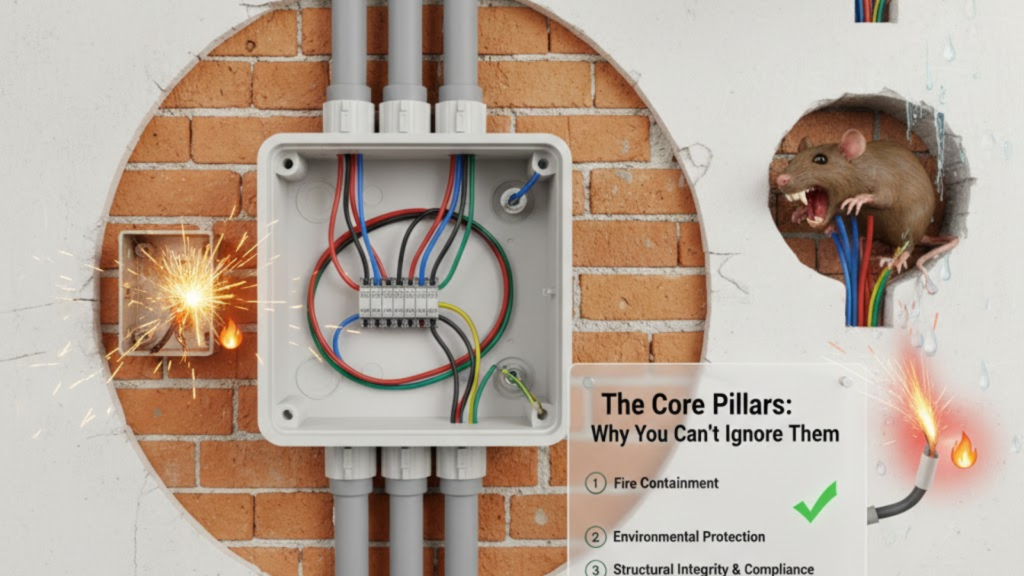
In a country like India, where high-voltage fluctuations are common, wire joints are prone to arcing (sparks jumping between loose wires).
- The Science of Heat: When a joint is loose, resistance increases. According to Joule’s Law , heat increases with resistance.
- The Box’s Role: If a wire melts or sparks, the junction box is designed to contain that intense heat. Without it, a spark could land on a dry curtain, wooden furniture, or plastic insulation, leading to a full-scale house fire within minutes.
B. Environmental Protection: Humidity, Dust, and Monsoon
India’s climate is diverse. From the humid coasts of Mumbai and Kerala to the dusty plains of Rajasthan, wires face constant environmental stress.
- Oxidation: Exposed copper reacts with oxygen and moisture to form copper oxide, which is a poor conductor. A sealed junction box electrical setup prevents this “greening” of wires.
- Pest Menace: Rats and cockroaches are the hidden enemies of Indian wiring. Junction boxes prevent these pests from nesting near wire joints or chewing through the connections.
C. Structural Integrity and Organization
Without junction boxes, your wiring would be a “spider web” of tapes and loose ends hidden behind the plaster.
- Strain Relief: Junction boxes provide a secure point where wires are clamped. This prevents the weight of the wires from pulling on the connections, which could lead to disconnection over time.
3. Deep Dive: Types of Junction Boxes in the Indian Market
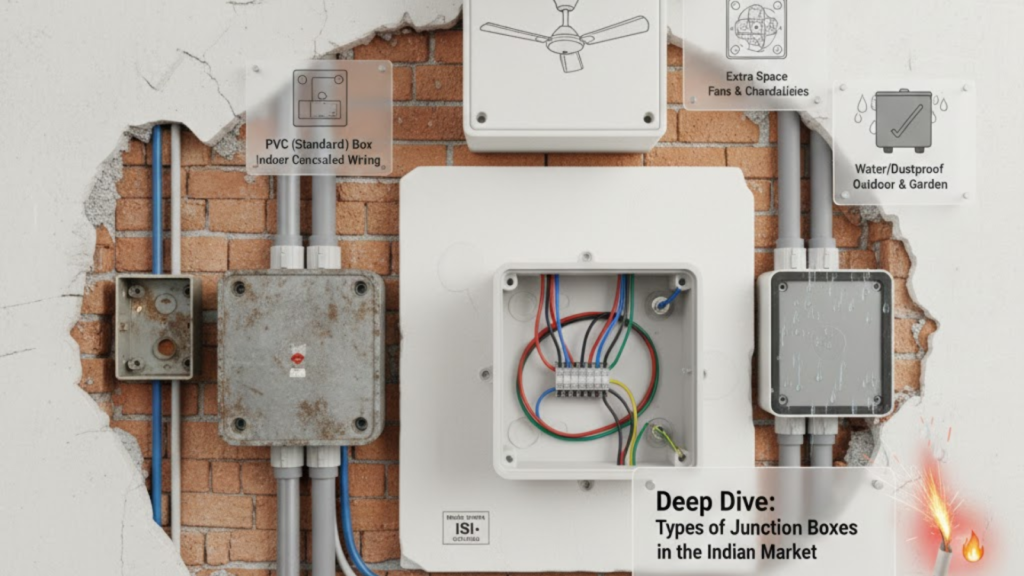
Choosing the right box depends on the location and the type of wiring (Concealed vs. Surface).
| Box Type | Material | Ideal Use Case | Pros | Cons |
| PVC (Standard) | Polyvinyl Chloride | Indoor Concealed Wiring | Cheap, Rust-proof, Easy to install | Can crack under extreme impact |
| Galvanized Iron (GI) | Zinc-coated Steel | Industrial / Exposed Piping | Extremely strong, Fire-proof | Risk of rust if poor quality; needs earthing |
| Deep Junction Box | PVC/Metal | Ceiling Fans / Chandelier points | Extra space for heavy wires | Takes more space in the slab |
| Weatherproof (IP65) | Hardened Plastic/Rubber Seal | Gardens, Terraces, Pump sets | Waterproof and Dustproof | More expensive |
4. Deep Dive into Compliance: The Indian Electrical Legal Framework
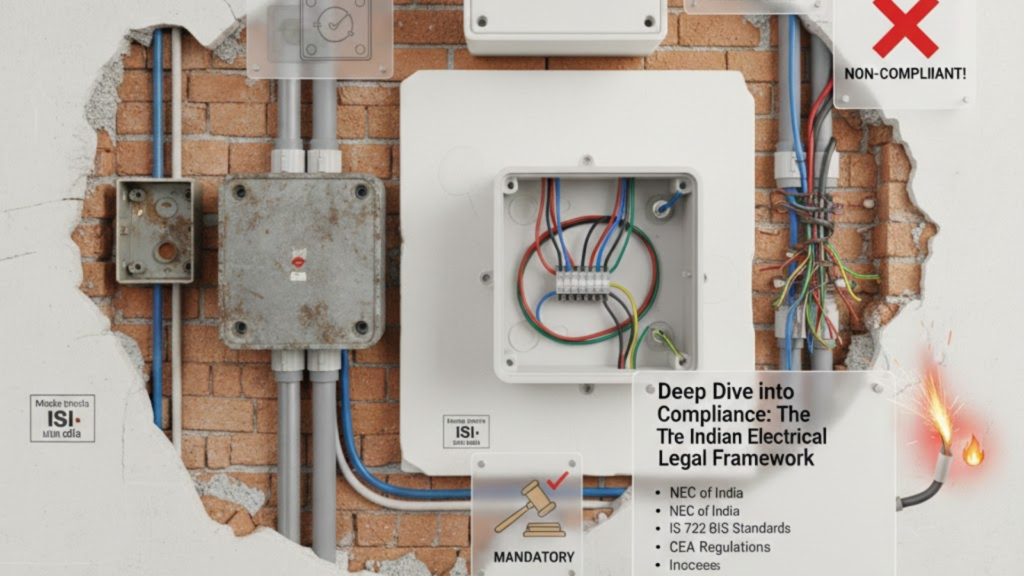
In India, electrical installations are not just about “making the lights turn on”; they are governed by strict safety codes. Using a junction box electrical setup is a non-negotiable part of these standards.
- The National Electrical Code (NEC) of India: The NEC provides the blueprint for safe wiring. It explicitly states that every tap-off point (where a wire splits) must be accessible and enclosed.
- IS 732 (Code of Practice for Electrical Wiring Installations): This Bureau of Indian Standards (BIS) code is the “Bible” for Indian electricians. It mandates that:
- Joints must be mechanically secure.
- They must be placed in a non-combustible or fire-retardant enclosure.
- The enclosure must provide protection against “IP” (Ingress Protection) factors like dust and water.
- The Role of the Central Electricity Authority (CEA): The CEA regulations (2010) emphasize that all electrical supply lines and apparatus shall be of sufficient rating and of “sufficient mechanical strength.” A junction box provides that mechanical strength, protecting the fragile copper junctions from external pressure during building settlement or accidental impact.
- Home Insurance and Liability: This is a crucial point for modern Indian homeowners. If an electrical fire occurs, the Surveyor from the insurance company will check if the wiring followed “Standard Engineering Practices.” If they find wires twisted together and plastered over without a junction box electrical enclosure, they can categorize it as “gross negligence,” potentially leading to a total rejection of your insurance claim worth lakhs.
5. Step-by-Step Guide: The Anatomy of a Professional Installation
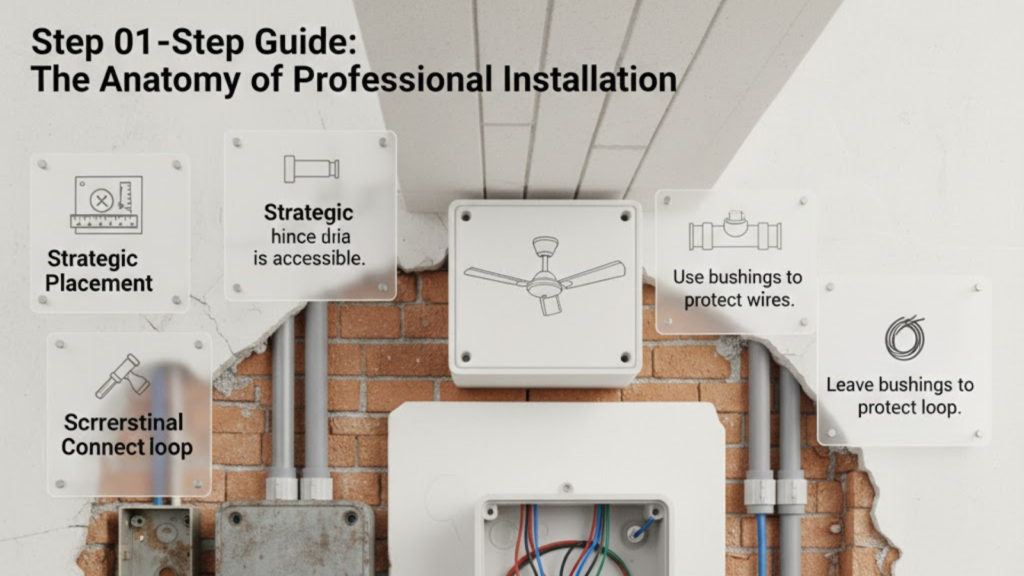
To ensure your home is a fortress against electrical mishaps, follow this professional installation workflow. This is what you should demand from your contractor or “Thekedaar.”
Step A: Strategic Placement and Sizing
Before the walls are plastered, identify the “Hubs.”
- Calculation: For a standard 12ft x 12ft room, you usually need at least two junction boxes—one for the fan/light distribution and one for power sockets.
- Size Matters: Do not use a 3×3 inch box if you have more than 4 wires. Upgrade to a 4×4 inch or a “deep box” to prevent Wire Crowding, which is a leading cause of localized heating.
Step B: Managing the Conduit Entry
The pipes (Conduits) must enter the box cleanly.
- Use of Adapters: Always use a female adapter or a “bush” at the entry point. Why? Because the sharp edges of a cut PVC pipe can vibrate against the wire insulation over time, eventually cutting through it and causing a “Live Wall” (where your wall gives you a shock).
- Secure Seating: The box must be flushed with the brickwork. If it sits too deep, the electrician will struggle to reach the wires; if it sticks out, your plaster will crack.
Step C: The “6-Inch Rule” for Wire Dressing
Inside the junction box electrical unit, the “Dressing” of wires is an art.
- The Service Loop: Always leave a 150mm (6 inch) loop of wire inside the box. Copper becomes brittle over years of heating and cooling. If a wire end breaks, that 6-inch loop allows you to strip a fresh end without replacing the entire run of wire from the MCB.
Step D: Mechanical Connection vs. Hand-Twisting
In India, “Joint Lagana” usually means twisting two wires and applying black tape.
- Connector Strips/Wago Clips: Insist on using screw-type connector strips or spring-loaded clips inside the box. These provide a much tighter surface-to-surface contact, reducing resistance and heat.
6. Common Mistakes and “Hidden Dangers” (The Expert’s Warning)
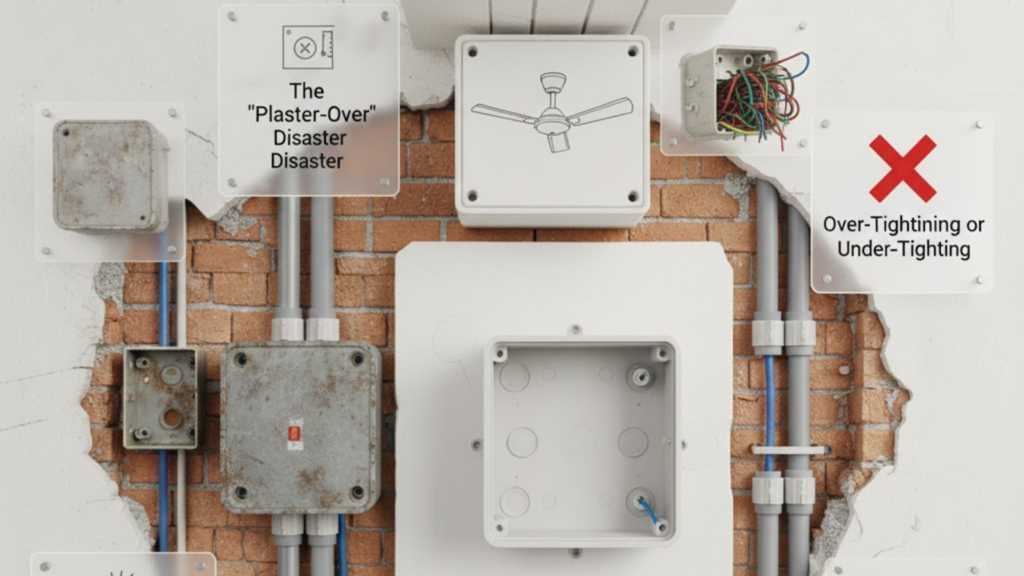
Avoid these frequent errors that even “experienced” Indian electricians make:
- The “Plaster-Over” Disaster: This is the most common mistake in Indian renovations. To achieve a “seamless” look, owners let painters put Putty and Paint over the junction box cover.
- The Danger: If a wire burns out, the electrician has to use a hammer to find the box, ruining your expensive paint job.
- The Solution: Use decorative, “modular” blank plates that match your switchboard design.
- Over-Tightening or Under-Tightening: * If a screw is too loose, it creates Arcing (sparking).
- If too tight, it can “neck” or thin out the copper wire, making it a “hot spot” that could melt the PVC.
- Mixing High and Low Voltage: Never run your Internet (Cat6) or Dish TV cables through the same junction box electrical unit as your 240V power lines. This causes “Electromagnetic Interference” (EMI), leading to slow internet and “ghosting” on your TV screens. More importantly, if a high-voltage wire leaks, it could send 240V straight into your expensive Laptop or Router.
- Ignoring the Earth Wire: Many local electricians skip the Earth connection inside the junction box, especially in GI (Metal) boxes.
- The Risk: If a phase wire touches the metal box due to insulation failure, the entire box—and potentially your wall—becomes “Live.”
Frequently Asked Questions (Detailed FAQ)
Q1. Why is my junction box making a humming sound?
Answer: A humming sound usually indicates a loose connection or “arcing.” The electricity is struggling to jump across a gap, creating vibrations. You must call an electrician immediately to tighten the terminals before it melts the box.
Q2. Is it okay to use wooden junction boxes?
Answer: Absolutely NOT. While common in old Indian houses (pre-1990s), wooden boxes are highly flammable. If you have them, replace them with FR (Flame Retardant) PVC or Metal boxes immediately.
Q3. How do I identify a high-quality “junction box electrical” unit?
Answer: Look for the ISI Mark. It ensures the plastic is “self-extinguishing” (it won’t continue to burn once the flame is removed).
Q4. Can I join wires without a box if I use high-quality tape?
Answer: No. Tape adhesive dries up over time due to heat, causing it to unwrap. A box provides a permanent mechanical barrier that tape cannot.