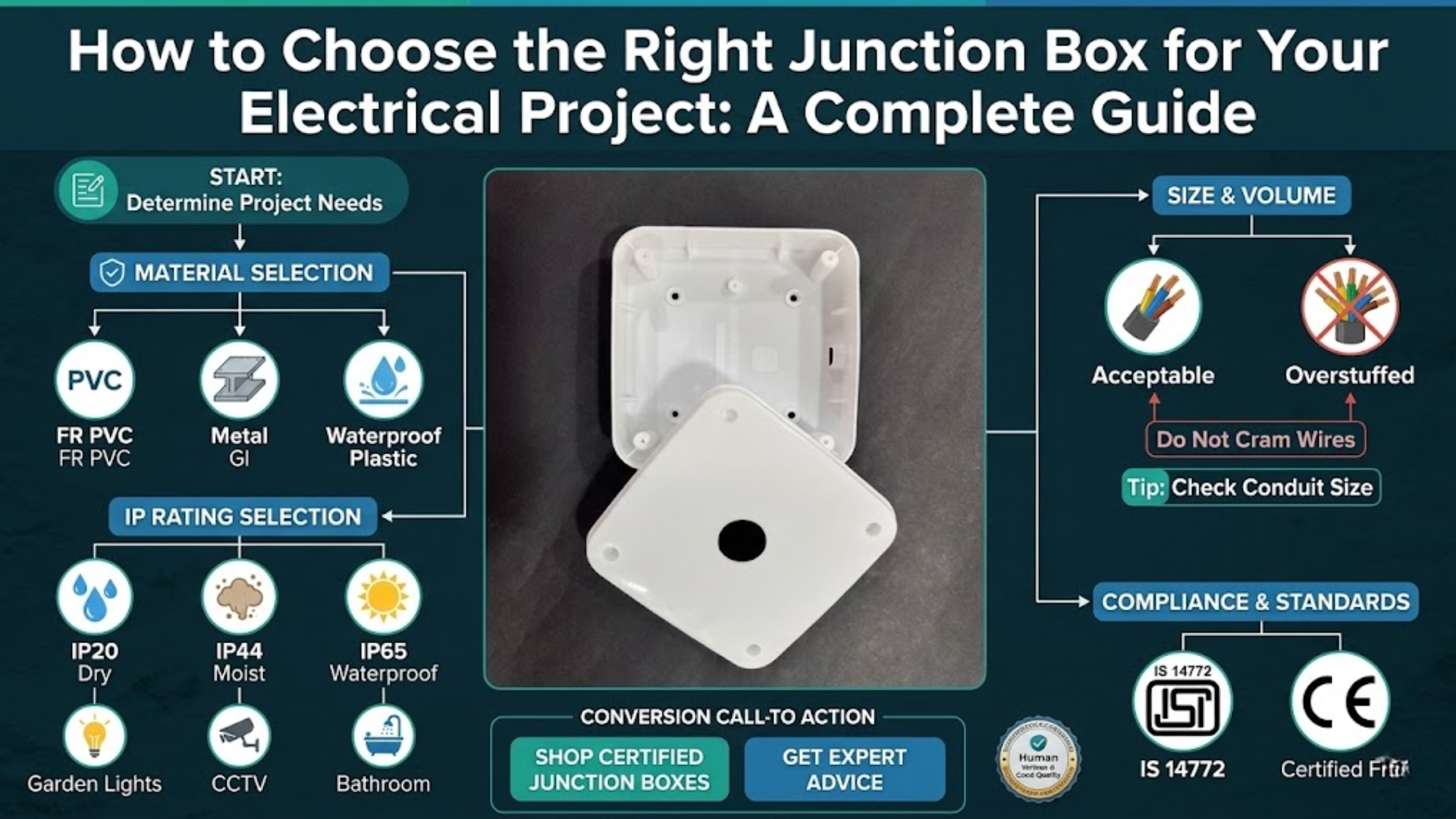
In the modern world of construction and home renovation, the junction box electrical unit is the most critical safety component of any wiring system. Whether you are a digital marketing expert for solar companies, an interior designer, or a professional contractor, understanding the nuances of these enclosures is vital for building trust and ensuring long-term safety.
Below is the definitive 5-pillar guide to selecting, installing, and maintaining electrical junction boxes in the Indian context.
1. Material Engineering: PVC, Metal, and Polycarbonate Analysis
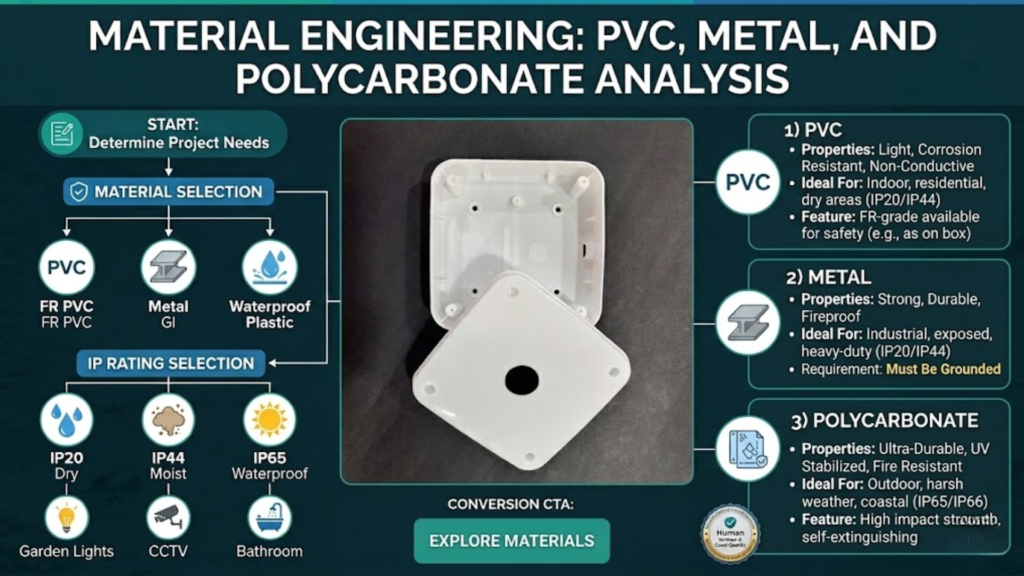
The material of your junction box electrical unit determines its lifespan, fire resistance, and suitability for specific environments. In India’s diverse climate, making the wrong choice can lead to corrosion or structural failure.
A. FR-Grade PVC (Flame Retardant)
Most residential projects in India utilize PVC. However, there is a massive difference between “local” plastic and High-Grade FR PVC.
- Safety Feature: FR-grade material is “Self-Extinguishing.” This means if a wire sparks, the box will not catch fire; it will simply char and go out.
- Best For: Concealed home wiring, apartment complexes, and office cabins.
- Key Advantage: It is non-conductive, meaning the box itself cannot give you an electric shock if a wire touches the internal wall.
B. Galvanized Iron (GI) & Cast Iron
Metal boxes are the “Heavyweights” of the industry.
- Durability: They offer superior protection against physical impact (hammers, drills, or falling debris).
- Best For: Industrial warehouses, factories, and outdoor parking lots.
- Installation Note: These must be grounded (earthed).
C. Polycarbonate & ABS
These are the premium “all-rounders.”
- UV Resistance: Unlike cheap PVC which turns brittle and cracks under the sun, Polycarbonate is UV-stabilized.
- Best For: Solar power installations, terrace wiring, and coastal regions.
2. The Indian Monsoon Factor: IP Ratings and Weatherproofing
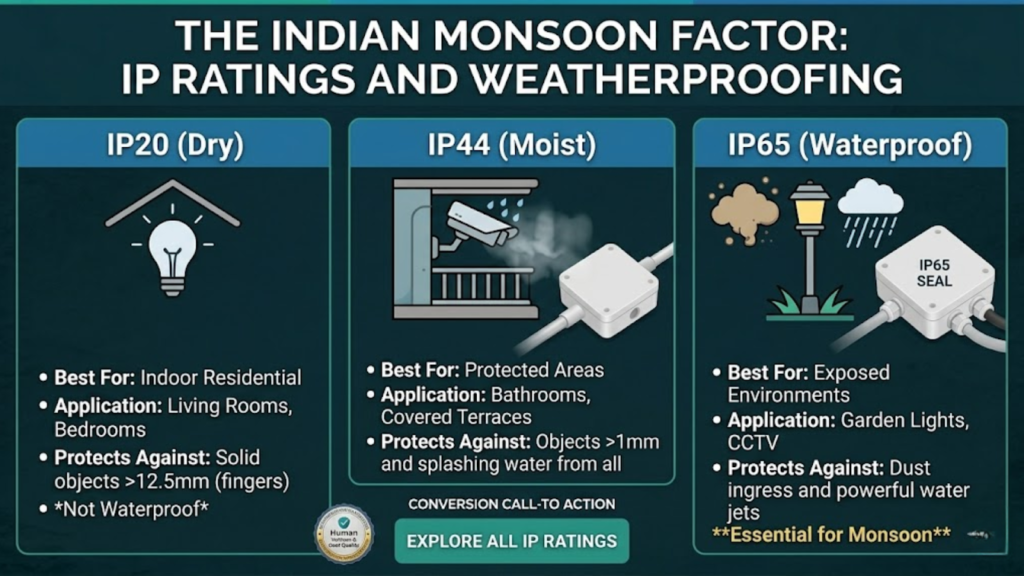
In India, dust during the summer and heavy rain during the monsoon are the biggest enemies of electrical connections. The IP (Ingress Protection) rating is a mandatory check for any junction box electrical purchase.
Understanding the IP Code Table
The first digit represents protection against solids (dust), and the second digit represents protection against liquids (water).
| IP Rating | Protection Level | Ideal Application in India |
| IP20 | Finger-safe; no water protection | Indoor bedrooms, dry living areas |
| IP44 | Splash-proof from all angles | Bathrooms, kitchens, covered balconies |
| IP65 | Dust-tight & Heavy Rain protection | Garden lights, CCTV cameras, Signboards |
| IP67 | Submersible for 30 minutes | Low-lying areas prone to water-logging |
| IP68 | Continuous submersion | Swimming pools and fountain pumps |
Pro Tip: For any outdoor project in India, never settle for anything less than IP65. A single drop of monsoon rain inside a junction box can trip your entire building’s MCB.
3. Installation Architecture: Concealed vs. Surface Mounting
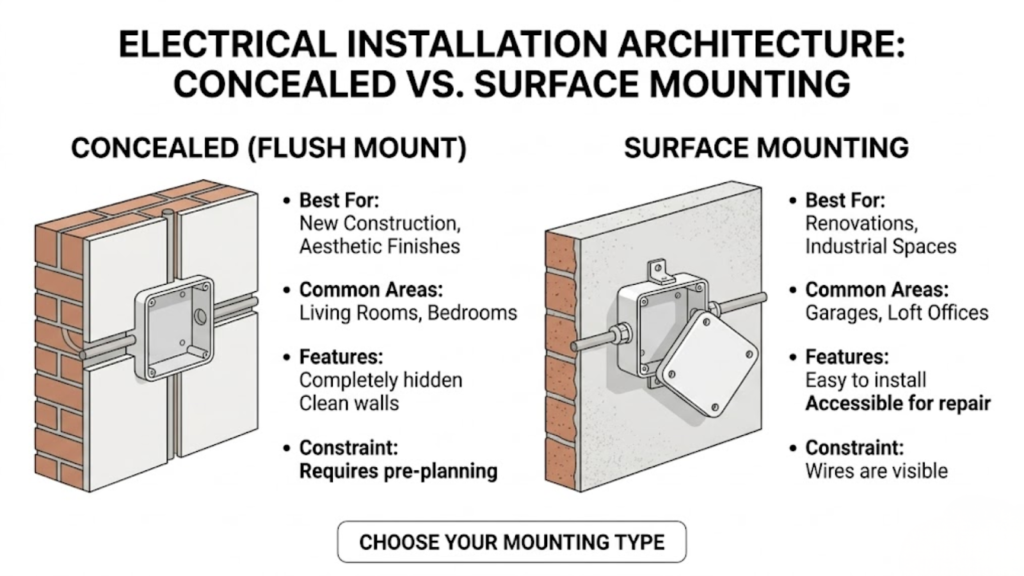
The visual finish of a project depends on the mounting style. As an interior designer or architect, this is the most important aesthetic decision.
A. Concealed Wiring (Flush Mount)
This is the standard for modern Indian luxury homes. The box is embedded inside the brickwork before plastering.
- Benefits: Completely hidden, clean walls, and child-safe.
- Constraint: Requires precise planning.
B. Surface Mounting
- Benefits: Easier for maintenance and upgrades. Very popular in “Industrial Loft” themed offices.
- Critical Hardware: Always use Cable Glands or Conduit Adapters. These small accessories seal the hole where the pipe enters the box, preventing lizards, spiders, and dust from nesting inside.
4. Size, Volume, and the “Wire Fill” Safety Standard
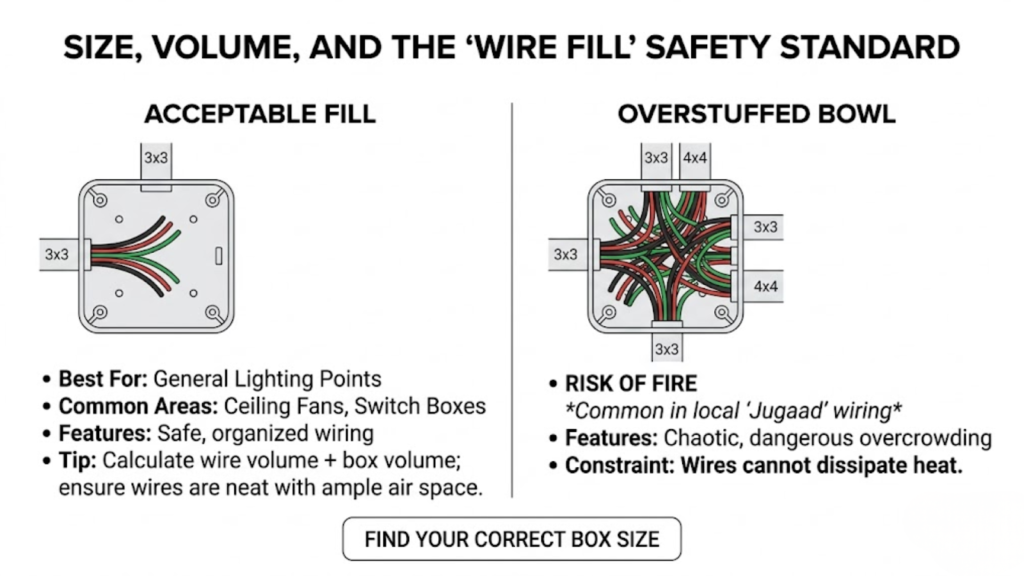
One of the most common mistakes in Indian electrical work is “Wire Crowding.”
The Safety Checklist for Sizing:
- The 40% Volume Rule: A junction box should never be more than 40% full. The remaining 60% of “empty space” is actually air for heat dissipation.
- Standard Sizes:
- 3×3 / 4×4 Square: Used for standard light and fan junctions.
- Deep Modular Boxes: Essential for high-ampere appliances like Air Conditioners (AC), Geysers, and EV Chargers.
- Conduit Entry Points: Ensure the box has enough “knockouts” (pre-cut holes). Forcing a new hole into a box often cracks the structure, ruining its IP rating.
5. Compliance & Certification: The Gold Standard of Electrical Safety
When buying a junction box electrical unit in India, the most important mark you can look for is the ISI mark, governed by the Bureau of Indian Standards (BIS) under IS 14772. This isn’t just a sticker; it is a guarantee that the box has undergone rigorous laboratory testing to prevent electrical fires and structural failure.
A. Why Compliance is Non-Negotiable for Indian Buildings
In India, nearly 40% of urban fires are caused by short circuits. Most of these fires start at “joints” or “junctions” where wires are spliced. If you use a non-certified, “local” junction box made of recycled plastic, that box becomes fuel for the fire. A certified box, however, acts as a containment chamber.
Key Tests Conducted for IS 14772 Certification:
- The Glow Wire Test (Safety from Fire): This is the most critical test. The material of the junction box electrical unit is subjected to a heated wire at 650°C, 750°C, or 850°C. A certified box must not catch fire, or if it does, the flame must extinguish itself within 30 seconds of removing the wire.
- Heat Resistance Test: The box is placed in an oven at 70°C to 100°C for several hours. It must not deform, melt, or lose its shape. This is vital for Indian summers where roof temperatures can soar.
- Impact Resistance (The Hammer Test): On a busy construction site in cities like Jaipur or Delhi, boxes are often hit by hammers or heavy tools. A certified box must not crack or shatter under a specific force, ensuring the internal wiring remains protected.
- Insulation Resistance: This ensures that even if a live wire touches the internal wall of the PVC box, no current passes through to the outside. This prevents accidental electrocution for anyone touching the wall.
B. Comparison: Certified vs. Non-Certified Junction Boxes
| Feature | ISI Marked (Our Products) | Non-Branded “Local” Box |
| Material Quality | Virgin FR (Flame Retardant) PVC | Recycled Plastic Scraps |
| UV Protection | UV Stabilized (Doesn’t turn brittle) | Cracks within 6-12 months |
| Screw Quality | Brass or Stainless Steel (Rust-proof) | Iron screws (Rust and jam quickly) |
| Seal Integrity | Precision-engineered gaskets | Poor fit, allows ants and dust |
| Safety | Prevents fire spread | Can ignite and spread fire |
C. The Business Value of Buying Certified Products
If you are a contractor, interior designer, or an agency like Mocaup handling large-scale projects, using certified junction box electrical units is a massive “Trust Signal” for your clients.
- Insurance Compliance: Most commercial insurance policies in India will reject a fire claim if it is found that the electrical fittings used were not ISI-compliant.
- Legal Protection: For builders and developers, using BIS-standard products protects you from legal liabilities in case of electrical accidents.
- Maintenance Savings: High-quality boxes use brass inserts for screws. This means that 10 years later, when an electrician needs to open the box for a repair, the screws won’t be jammed or rusted. In “local” boxes, the plastic threads often strip, forcing you to break the wall to replace the whole box.
D. Global Standards vs. Indian Standards
While IS 14772 is the Indian benchmark, many high-end projects also look for international certifications:
- CE Marking: Indicates the product meets European safety, health, and environmental protection requirements.
- RoHS Compliance: Ensures the junction box electrical unit is free from hazardous substances like lead, mercury, and cadmium, making it eco-friendly and safer for residential use.
Frequently Asked Questions (FAQ)
Q1: Can I use a PVC junction box for heavy industrial machinery? While PVC is durable, for high-impact industrial zones, we recommend Cast Aluminum or GI boxes. They offer better protection against mechanical damage and better heat dissipation for heavy-duty wires.
Q2: What happens if I don’t use a junction box and just tape the wires? This is a “Jugaad” that leads to disasters. Electrical tape dries up and peels over time. Without a box, a loose connection can spark and ignite nearby curtains, wood, or dust, causing a major fire.
Q3: Are these boxes suitable for Solar DC wiring? Yes, but for solar projects, always choose UV-stabilized Polycarbonate boxes. Since solar junctions are exposed to direct sunlight 365 days a year, standard plastic will become brittle and break within 2 years.
Q4: How do I know if my box is genuinely waterproof? Check for a Silicon or Rubber Gasket (the O-ring) around the lid. A truly waterproof box will also have “threaded” screw holes to ensure a tight seal.
Conclusion: Quality is an Investment
A junction box electrical unit may be a small part of your budget, but it is the biggest part of your safety. By choosing ISI-certified, FR-grade, and correctly IP-rated boxes, you protect your property from the most common cause of urban fires: electrical short circuits.
Are you looking for reliable, high-performance electrical solutions? At pineseed, we specialize in manufacturing and supplying premium junction boxes that meet the rigorous demands of the Indian environment.