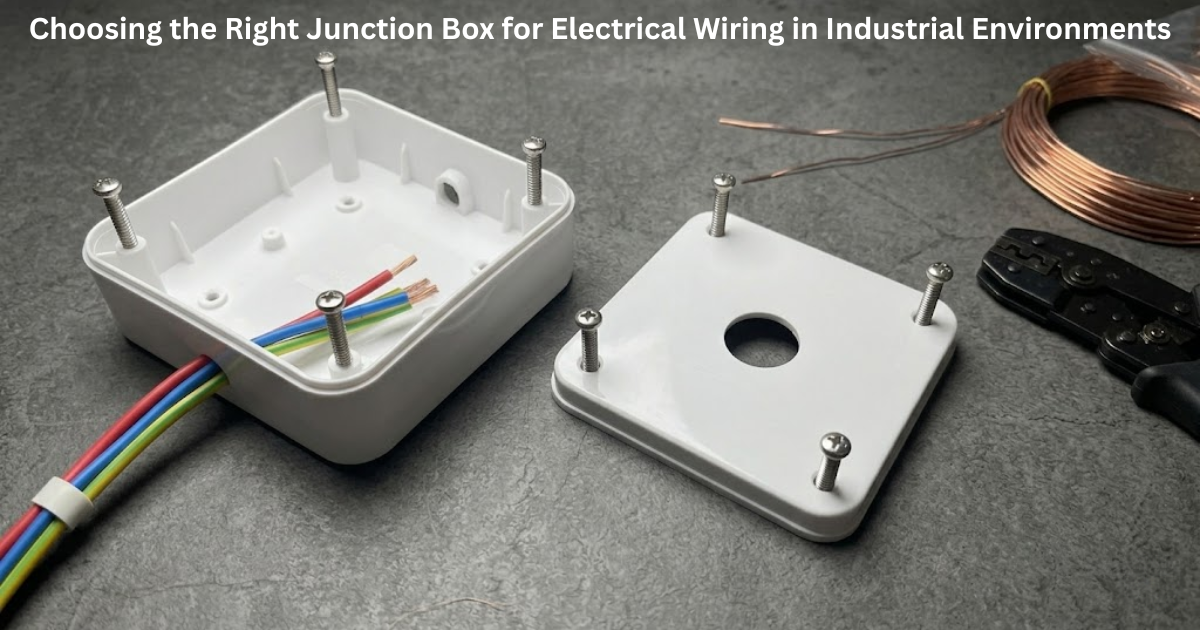
In any industrial ecosystem—whether it is a sprawling automobile assembly plant in Pune, a chemical processing unit in Gujarat, or a heavy engineering workshop in Chennai—electrical infrastructure serves as the vital lifeline. Unlike residential or light commercial buildings, industrial facilities operate under grueling conditions. They are constantly subjected to extreme thermal fluctuations, relentless mechanical vibrations, corrosive chemical vapors, abrasive dust, and high humidity levels.Within these volatile settings, junction box electrical wiring acts as the primary shield protecting electrical connections. A single weak link or an inappropriately selected enclosure can trigger catastrophic short circuits, expensive equipment failures, and prolonged production downtime that costs millions of rupees.
This comprehensive guide delivers an absolute technical breakdown of how to evaluate, select, and install the perfect industrial junction box to ensure maximum operational safety, longevity, and strict regulatory compliance.
1. Understanding the Core Purpose of Industrial Junction Boxes
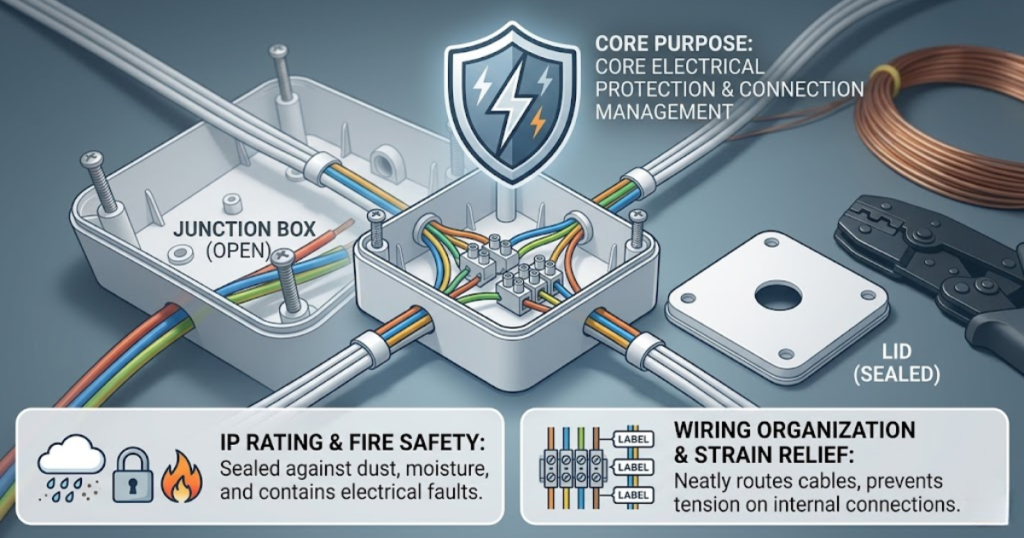
At its fundamental level, an electrical junction box (JB) is a protective enclosure housing electrical connections where multiple wires or cables meet, terminate, or splice.
[Main Power Feed] —> [ Junction Box Enclosure ] —> [ Branch Circuit 1 ]
|—> (Terminal Blocks) |—> [ Branch Circuit 2 ]
|—> (Proper Earthing) |—> [ Branch Circuit 3 ]
In industrial heavy-duty applications, a junction box is far more than a simple plastic or metal container. It performs three critical, non-negotiable functions:
- Environmental Isolation: It forms an impenetrable barrier preventing airborne contaminants, moisture, and corrosive substances from degrading bare copper or aluminum conductors.
- Containment of Electrical Hazards: If an overload or loose termination causes a spark, arc, or localized electrical fire, a robust industrial junction box contains the combustion within the enclosure, preventing it from igniting surrounding flammable materials.
- Mechanical Integrity & Strain Relief: Industrial floors experience constant structural shifting and machinery vibrations. The junction box, when paired with appropriate cable glands, secures the cables tightly, preventing physical strain from loosening terminal connections over time.
2. Comprehensive Material Analysis: Metal vs. Non-Metallic
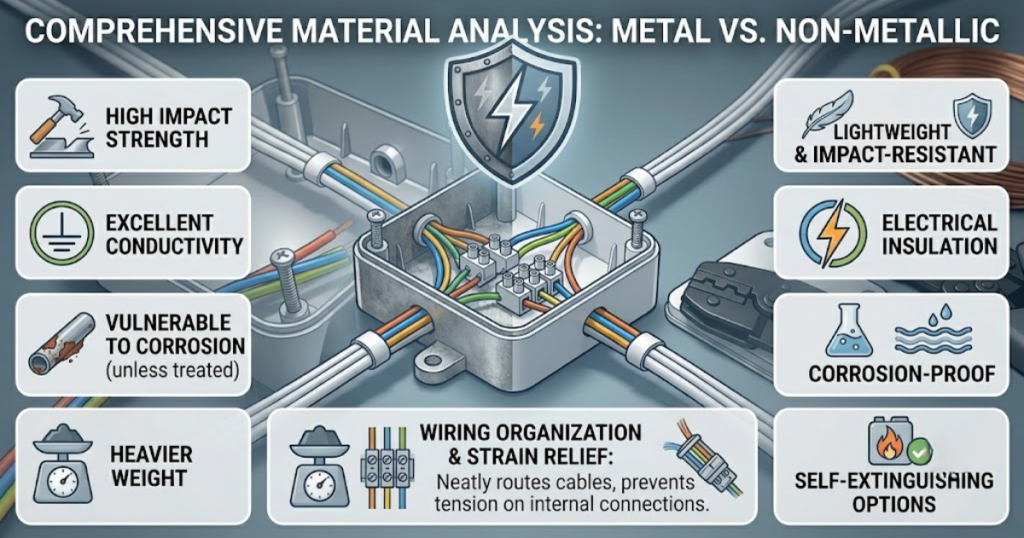
Selecting the correct structural material is the most crucial decision when designing an industrial layout. The material must withstand the specific ambient atmosphere of the facility without oxidizing, degrading, or warping.
Metallic Enclosures
Stainless Steel (SS304 and SS316)
Stainless steel represents the absolute gold standard for harsh, high-hygiene, or highly corrosive industrial environments.
- SS304 provides exceptional strength and excellent resistance to atmospheric corrosion, making it perfect for general manufacturing and material handling facilities.
- SS316 contains molybdenum, which grants superior resistance against chlorides and highly aggressive chemicals. It is extensively deployed in pharmaceutical plants, coastal maritime industries, fertilizer units, and wastewater treatment facilities.
Cast Aluminum
Cast aluminum enclosures are incredibly rugged, lightweight compared to steel, and offer excellent thermal conductivity, allowing heat generated by internal components to dissipate quickly. They possess high impact resistance, making them ideal for heavy machinery manufacturing, mines, and transport hubs where physical impact risks are high.
Non-Metallic Enclosures
Fiberglass Reinforced Polyester (FRP / GRP)
FRP enclosures blend fiberglass strands with polyester resin to form an exceptionally tough, non-conductive material. FRP is completely immune to rust, highly resistant to acids and alkalis, and incredibly stable under UV exposure. It is the ideal choice for outdoor substations, chemical storage areas, and highly humid environments.
Polycarbonate & ABS
High-grade Polycarbonate is a lightweight, impact-resistant thermoplastic. While not as structurally heavy-duty as stainless steel or FRP, it is highly cost-effective, easy to drill on-site for custom modifications, and provides excellent electrical insulation. It is widely used for localized sensor terminations, automation junction points, and indoor control circuitry.
3. Material Selection Matrix
To help you make an immediate engineering decision, the table below compares industrial enclosure materials across key performance metrics:
| Material Type | Corrosion Resistance | Impact Strength (IK Rating) | Max Temperature Tolerance | Best-Suited Indian Industrial Sectors | Cost Index |
| Stainless Steel (SS316) | Outstanding (Highest) | Very High (IK10) | Extreme (> 500^\circ\text{C}) | Pharmaceuticals, Chemical Processing, Petrochemicals | Premium / High |
| Cast Aluminum | Moderate to High | Excellent (IK10) | High (> 250^\circ\text{C}) | Mining, Automotive Assembly, Heavy Engineering | Medium to High |
| Fiberglass (FRP/GRP) | Excellent | High (IK08-IK09) | Medium (> 150^\circ\text{C}) | Fertilizer Plants, Outdoor Substations, Paper Mills | Medium |
| Polycarbonate | Good (Rust-proof) | Moderate (IK07-IK08) | Low to Medium (< 120^\circ\text{C}) | Food Processing (Indoor), Textil Mills, Water Pumping | Economical |
4. Deconstructing IP (Ingress Protection) Ratings
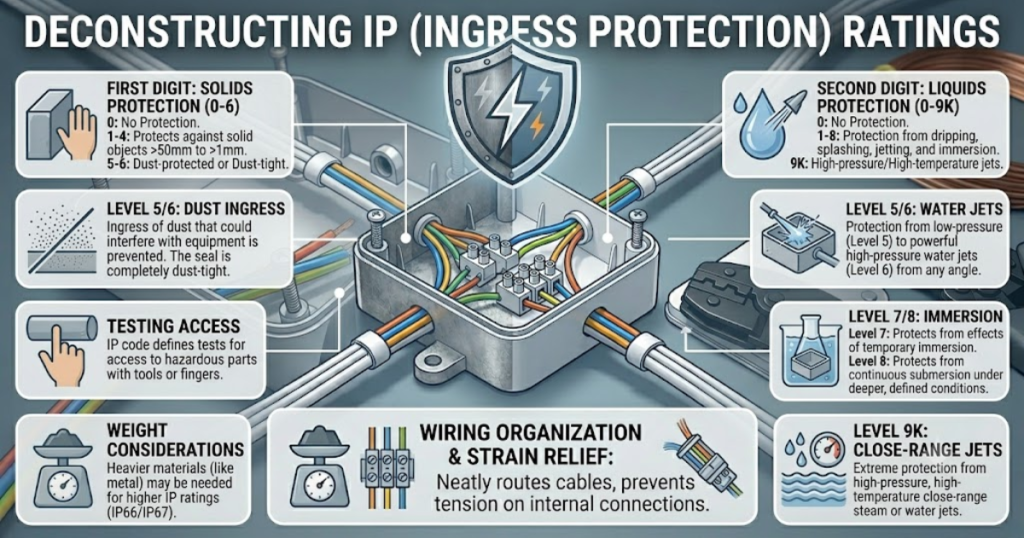
In India, industrial facilities must combat two major environmental threats: fine airborne dust (common in cement, textile, and grain mills) and torrential monsoon rains. To classify how well an enclosure seals against these elements, the international IEC 60529 standard (harmonized with Indian Standards) utilizes IP (Ingress Protection) ratings.
An IP rating consists of two distinct digits:
- The First Digit (0–6) measures protection against solid objects and dust particles.
- The Second Digit (0–9K) measures protection against liquids and water ingress.
IP [ 6 ] [ 7 ]
| |
| +—> Second Digit: Liquid Protection (Immersion up to 1 meter)
+———> First Digit: Solid Protection (Dust-tight)
Essential Industrial IP Ratings:
- IP65 (Dust-Tight & Water-Jet Proof): Offers total protection against dust ingress and can withstand low-pressure water streams from any direction. Recommended for indoor conveyor belts, packaging assembly lines, and machine shops that undergo standard washdowns.
- IP66 (Dust-Tight & Powerful Water-Jet Proof): Designed to handle heavy, high-pressure water jets. This is the minimum requirement for outdoor industrial installations exposed to heavy monsoon downpours or facilities that use high-pressure hoses for cleaning.
- IP67 (Dust-Tight & Temporary Immersion): Prevents water from entering even when the junction box is completely submerged in water up to 1 meter deep for 30 minutes. Critical for sub-surface pump rooms, drainage pits, and areas prone to flash flooding.
- IP68 / IP69K (Continuous Submersion & High-Pressure Steam Cleansing): Built for specialized scenarios.
5. Hazardous Areas & Explosion-Proof (Ex) Classification
One of the most dangerous oversights in industrial junction box electrical wiring is using standard enclosures in areas where explosive gases, flammable vapors, or combustible dust clouds are present. These environments are formally categorized into Zones under Indian Electricity Rules and international IEC standards.
Hazardous Zone Classifications:
- Zone 0 / Zone 20: Explosive atmosphere is present continuously or for long periods (e.g., inside fuel storage tanks).
- Zone 1 / Zone 21: Explosive atmosphere is likely to occur during normal operations (e.g., near chemical mixing vats).
- Zone 2 / Zone 22: Explosive atmosphere is unlikely to occur during normal operation, and if it does, it will only exist for a very short period (e.g., storage areas with sealed chemical drums).
| Hazardous Plant Area (Zone 1 / Zone 21) |
| |
| [Ex-d Flameproof Junction Box]
| | Internal Spark Contained Inside Heavy Cast Body | |
| | No Flame Escapes to Outer Atmosphere | |
| +—————————————————-+ |
+————————————————————+
When wiring within Zone 1 or Zone 2 areas, standard junction boxes are strictly prohibited. You must deploy certified Explosion-Proof (Ex-d) or Increased Safety (Ex-e) enclosures.
- Flameproof Enclosures (Ex-d): Constructed with thick, heavy-duty cast metal walls designed to withstand an internal explosion without cracking. The precision-machined joints (“flame paths”) cool down escaping hot gases so that by the time they reach the outside atmosphere, they cannot ignite the surrounding hazardous air.
- Increased Safety Enclosures (Ex-e): Focus on preventing any spark, arc, or high temperature from occurring inside the enclosure by using high-grade insulation, secure terminals, and superior clearance distances.
6. Step-by-Step Best Practices for Industrial Junction Box Installation
Even the most expensive, top-tier junction box will fail prematurely if the electrical wiring inside is poorly executed. Follow this rigorous structural blueprint for installation:
Phase A: Enclosure Preparation & Mounting– junction box electrical wiring
- Vibration Dampening: If mounting a junction box directly onto a vibrating structural pillar or heavy machine frame, always install heavy-duty neoprene or rubber vibration-isolation pads behind the mounting brackets.
- Proper Orientation: Ensure the enclosure doors or lids open facing away from primary overhead water or chemical lines.
Phase B: Cable Entry & Gland Management– junction box electrical wiring
- Bottom Entry Only: Whenever possible, route all incoming and outgoing cables through the bottom wall of the junction box. Avoid top entry completely, as gravity will pull any overhead condensation directly into the box.
- Double Compression Cable Glands: For industrial armored cables (such as XLPE/PVC cables widely used in India), always install brass or stainless steel double-compression cable glands. The inner compression ring seals against the inner cable sheath to keep out moisture, while the outer compression ring securely grips the armor wire to provide mechanical strain relief and electrical continuity.
Incoming Armored Cable – junction box electrical wiring
Outer Sheath
Armored Wire Wire —> [Grip by Outer Compression Ring]
Inner Sheath —> [Sealed by Inner Neoprene Ring]
Copper Conductors —> [Enters Junction Box Safely]
- Shroud Installation: Cover all external cable glands with durable PVC shrouds to offer an additional layer of protection against direct rain, dust accumulation, and UV degradation.
Phase C: Internal Wiring & Termination
- Eliminate Wire Twisting (No Taping): Never allow technicians to twist copper wires together and wrap them with standard PVC insulation tape inside an industrial box. Under load cycles, thermal expansion causes twisted wires to loosen, leading to high-resistance joints, localized overheating, and eventual fire hazards.
- Utilize DIN-Rail Mounted Terminal Blocks: Securely mount a metallic DIN rail inside the enclosure and snap on high-quality screw-clamp or spring-clamp terminal blocks (such as those made by Elmex or Wago). Terminal blocks ensure precise, predictable contact pressure that resists vibrations.
- Bootlace Ferrules: Strip the wire insulation cleanly, apply an anti-oxidant paste if using aluminum, crimp a matching bootlace ferrule over the stranded copper wire, and only then insert it into the terminal block. This prevents individual wire strands from splaying or breaking under pressure.
[Bare Stranded Wire] + [Bootlace Ferrule] + [Correct Crimp Tool] – junction box electrical wiring
|
v
[Perfect Gas-Tight Solid Termination]
- Wire Management: Keep the interior clean. Leave 15% to 20% free space inside the box for easy wire routing. Use flame-retardant nylon cable ties to bundle conductors neatly, preventing them from pressing hard against sharp internal metal corners.
Phase D: Earthing & Final Sealing
- Dual-Point Grounding: For all metallic enclosures, connect an external earth loop from the plant’s main grounding grid to the box’s dedicated external earth bolt. Additionally, connect an internal earth wire from the box body to the DIN rail or internal mounting plate.
- Inspect the Gasket: Before bolting down the junction box lid, carefully inspect the continuous neoprene or polyurethane foam gasket embedded in the cover. Ensure it is completely clean, free of cuts, and fully seated in its groove to maintain its IP rating.
- Torque Control: Tighten all lid screws crosswise in a diagonal pattern using a calibrated torque screwdriver. Unevenly tightened screws distort the gasket, leaving micro-gaps where water can seep in.
7. Regulatory Standards and Indian Compliance Framework
When executing industrial electrical installations within India, adherence to the national regulatory framework is a strict legal requirement enforced by electrical inspectors.
- IS/IEC 60529: Defines the exact classification and testing protocols for Ingress Protection (IP codes) for all electrical enclosures.
- IS 2148: Lays down the specific technical parameters, design criteria, and testing methodologies for Flameproof (Ex-d) enclosures used in hazardous gas environments.
- The National Electrical Code (NEC) of India: Provides explicit instructions regarding maximum fill capacities for wires inside enclosures, separation of High Voltage (HV) and Low Voltage (LV) wiring networks, and mandatory color-coding standards (Red-Yellow-Blue for 3-Phase lines, Black for Neutral, and Green/Green-Yellow for Protective Earth).
Comprehensive Frequently Asked Questions (FAQs)
Q1: Can we mix high-voltage power cables and low-voltage control signal wires inside the same junction box?
Answer: No, it is highly unsafe and violates the National Electrical Code to route high-voltage power lines alongside sensitive low-voltage control or communication signals within a single junction box unless an un-perforated, grounded metal partition wall completely separates them.
Q2: What is the primary difference between single compression and double compression cable glands for junction boxes?
Answer: Single compression cable glands grip only the outer sheath of the cable, offering basic weather protection; they are typically used in light commercial applications. Double compression glands grip the cable at two points: on the inner sheath (providing a moisture-proof seal around the core wires) and on the steel armor wire (providing rock-solid mechanical strain relief). Double compression glands are mandatory across heavy industries to handle heavy cable weights and intense machinery vibrations.
Q3: How do we prevent moisture condensation inside a fully sealed IP66 junction box?
Answer: Condensation is a major problem in tropical, high-humidity regions like India. This temperature differential draws moisture out of the trapped air, forming water droplets on the walls. To prevent this, install specialized breather-drain valves at the lowest point of the enclosure.
Q4: When should I choose fiberglass (FRP) over Stainless Steel (SS316) for chemical industry wiring?
Answer: Choose FRP enclosures when weight reduction is an important factor, when the environment contains highly acidic fumes that specifically attack metals, or when absolute electrical insulation is required to eliminate shock hazards completely.