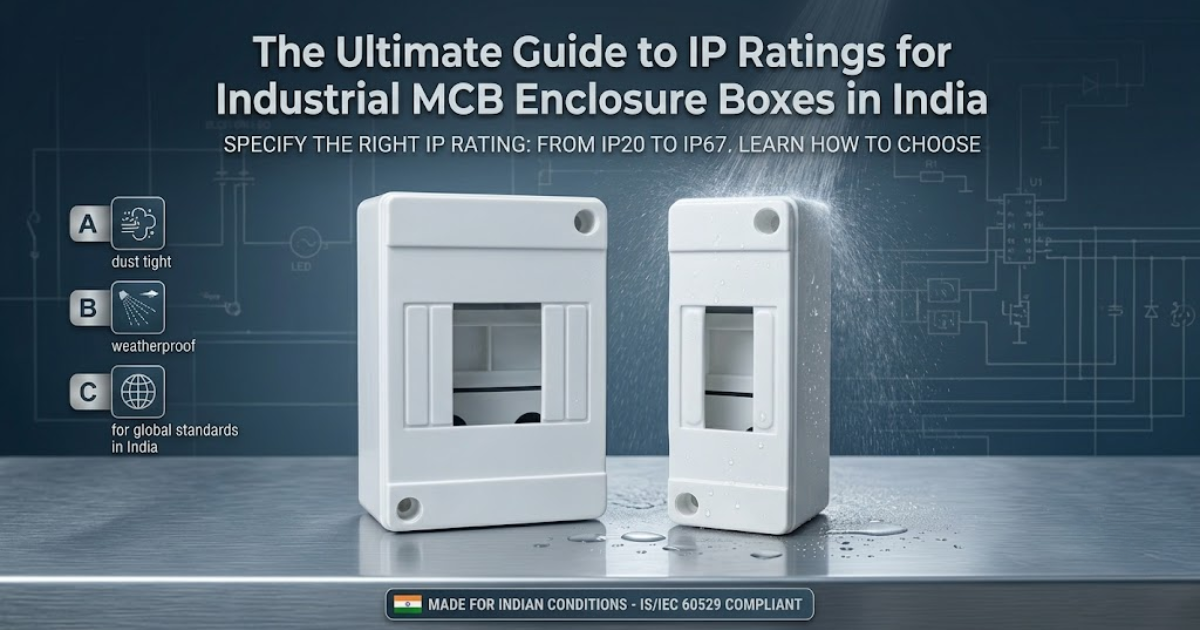
When setting up an electrical distribution system in an Indian manufacturing plant, a textile mill, an automobile assembly line, or a massive outdoor utility-scale solar farm, one humble component bears the ultimate brunt of the environment: the MCB enclosure box.
In an industrial ecosystem, an MCB (Miniature Circuit Breaker) is the first line of defense protecting million-dollar machinery and human lives from short circuits and overloads. However, an MCB can only do its job if it is housed in an enclosure that can survive the harsh surrounding atmosphere. Choosing the wrong enclosure doesn’t just mean a minor short circuit; it translates directly into expensive production downtime, ruined electronic switchgear, massive financial liabilities, and severe workplace safety hazards.
In industrial engineering setups, the single most critical technical metric that determines the survival, reliability, and longevity of your internal switchgear components is the IP (Ingress Protection) Rating.
With choices ranging anywhere from basic IP20 boxes to ultra-rugged IP67 heavy-duty distributions panels, how do you pick the right one without over-engineering your costs or under-specifying your safety? This comprehensive guide breaks down every single aspect of choosing the perfect IP-rated MCB enclosure box, specifically contextualized for Indian operating conditions, industrial washdown routines, and national safety compliance standards.
1. Deconstructing the IP Rating Framework (IEC 60529)
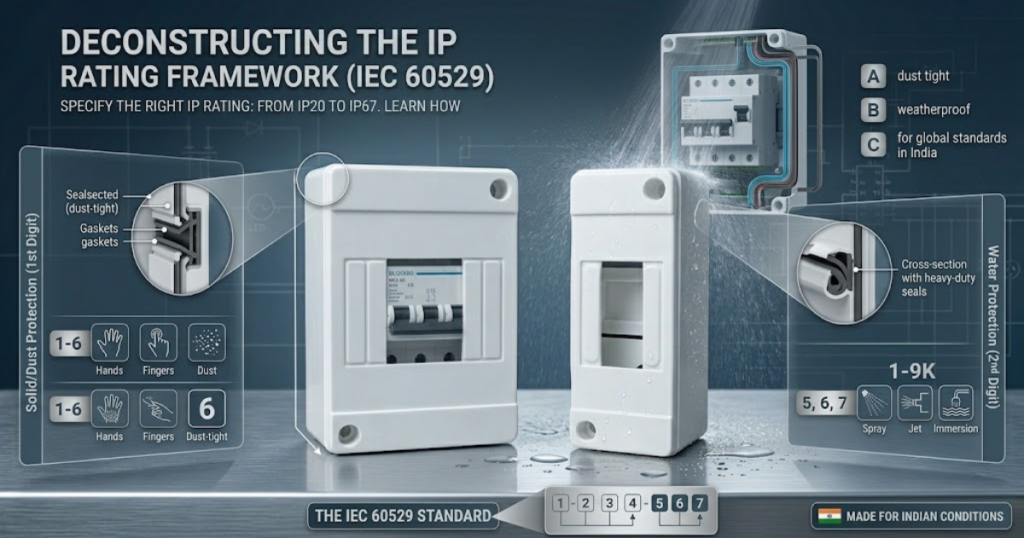
An IP (Ingress Protection) rating is a universally recognized international standard defined by the International Electrotechnical Commission (IEC 60529). It classifies and rates the degree of protection provided by mechanical enclosures and electrical cabinets against the intrusion of solid objects, dust, accidental contact, and liquids.
When you look at an industrial MCB enclosure box, you will always see the letters “IP” followed by two distinct digits (e.g., IP65). Each digit has a completely independent, highly specific technical meaning.
Understanding the First Digit: Solid & Dust Protection
The first digit ranges from 0 to 6 and defines how well the enclosure prevents solid objects, human body parts, and airborne particulates from reaching the live electrical components inside.
- IP0X: No protection whatsoever against physical contact or object ingress.
- IP1X: Protected against solid objects larger than 50 mm (e.g., the back of an engineer’s hand).
- IP2X: Protected against solid objects larger than 12.5 mm (e.g., an operator’s finger accidentally poking the box).
- IP3X: Protected against solid objects larger than 2.5 mm (e.g., small hand tools, thick wires).
- IP4X: Protected against solid objects larger than 1 mm (e.g., fine wires, small screws, ants, and large insects).
- IP5X (Dust-Protected): Ingress of dust is not totally prevented, but dust does not enter in an amount sufficient to interfere with the safe, satisfactory operation of the MCBs inside.
- IP6X (Dust-Tight): Complete protection against any dust ingress.
Understanding the Second Digit: Liquid & Moisture Protection
The second digit ranges from 0 to 9K and defines the enclosure’s capability to seal out moisture, water droplets, heavy splashing, high-pressure water jets, and total immersion.
- IPX0: No protection against water.
- IPX1: Protected against vertically falling drops of water (e.g., mild condensation dripping from a ceiling).
- IPX2: Protected against vertically falling drops of water when the enclosure is tilted up to 15° from its normal position.
- IPX3: Protected against spraying water or rain falling at an angle up to 60° vertically.
- IPX4: Protected against water splashing from any direction (e.g., general light splashes on a factory floor).
- IPX5: Protected against low-pressure water jets projected by a 6.3 mm nozzle from any direction at a flow rate of 12.5 liters per minute.
- IPX6: Protected against powerful, high-pressure water jets projected by a 12.5 mm heavy nozzle at a massive flow rate of 100 liters per minute.
- IPX7: Protected against the effects of temporary immersion in water under defined conditions of pressure and time (submerged up to 1 meter for 30 minutes).
- IPX8: Protected against continuous submersion in water under deeper, harsher conditions specified by the manufacturer.
2. Comprehensive IP Rating Matrix for Indian Industries
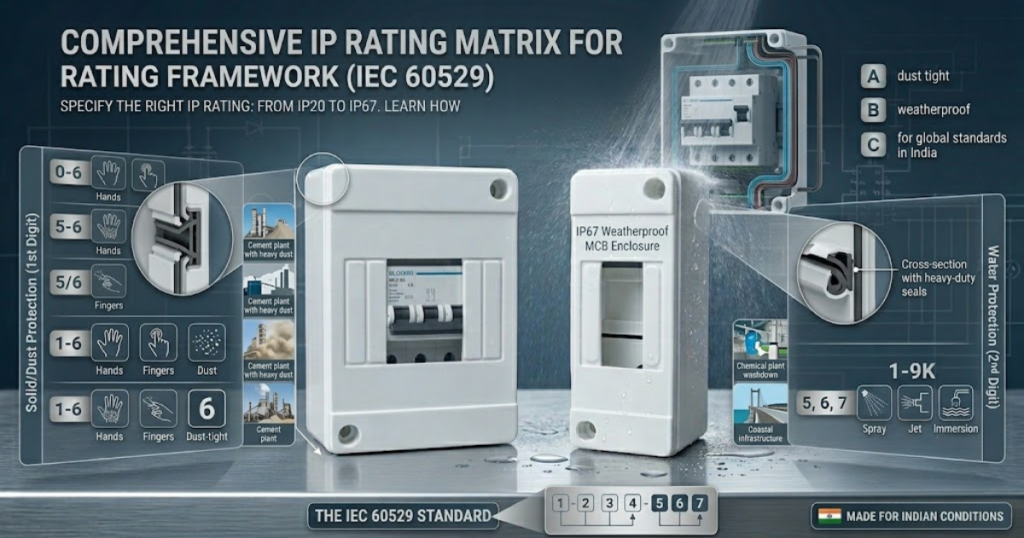
India presents a deeply challenging environmental cocktail for industrial switchgear: extreme tropical monsoon downpours, soaring summer temperatures, high ambient humidity, and heavy dust loading across mining, manufacturing, and rural zones.
The master matrix below maps out exactly how standard IP ratings translate to real-world applications within Indian industrial facilities:
| IP Rating Code | Technical Solid Protection | Technical Liquid Protection | Ideal Real-World Application (Indian Context) |
| IP20 | Non-hand/finger intrusion protection. | No protection against water entry. | Strictly indoor, air-conditioned environments like server rooms, IT parks, clean commercial office cabins, and main MCC rooms. |
| IP40 | Protection from fine wire inputs (>1mm). | No protection against liquids. | Indoor commercial building passage boards, shopping malls, and clean packaging zones where water handling is absent. |
| IP54 | Dust-protected (safe, limited entry allowed). | Protection from multidirectional water splashes. | Standard indoor factory floors, mechanical workshops, CNC machining zones, and covered automotive assembly lines. |
| IP65 | Absolute dust-tight sealing (0% dust entry). | Protected against basic low-pressure water streams. | Dusty processing industries like cement plants, stone crushing units, flour mills, and areas cleaned via light wiping/spraying. |
| IP66 | Absolute dust-tight sealing (0% dust entry). | Protected against heavy high-pressure water streams. | Heavy rain-exposed outdoor setups, chemical processing plants, marine/coastal industrial complexes, and industrial washdown bays. |
| IP67 | Absolute dust-tight sealing (0% dust entry). | Protected against temporary water immersion (1 meter). | Outdoor solar power generation sites (ACDB/DCDB boxes), wastewater treatment facilities, and low-lying zones prone to flash waterlogging. |
3. Step-by-Step Selection Framework for Project Managers
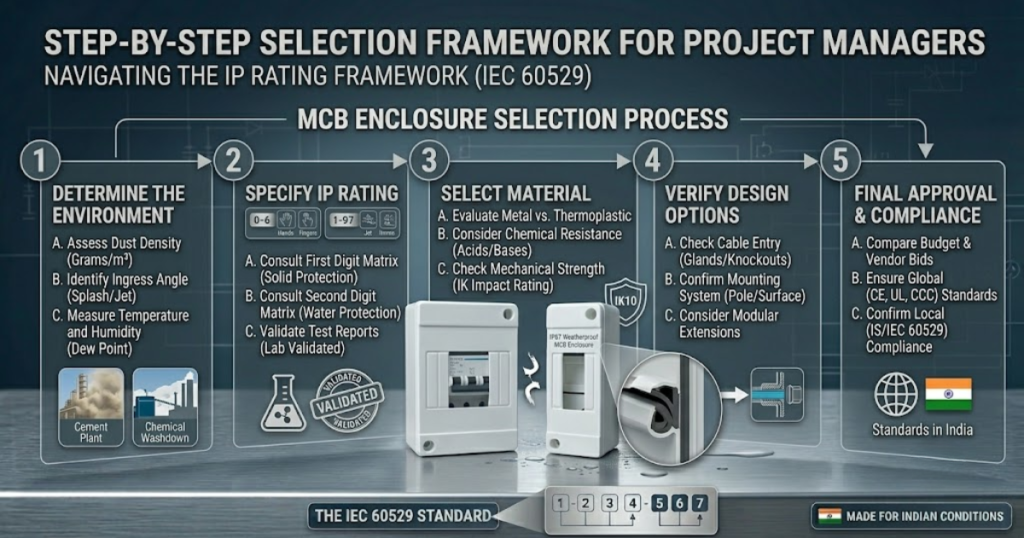
Selecting the ideal MCB enclosure box is an exercise in balancing engineering safety with financial pragmatism. Under-specifying leads to catastrophic system failure, while over-specifying across thousands of distribution points burns an unnecessary hole in your project budget. Use this structured 4-step framework to finalize your choice:
Step 1: Deep-Dive Into the Micro-Environment
Do not just evaluate the general climate of the city where your project is based. Look specifically at the exact coordinates where the enclosure box will physically hang.
- The Indoors-Dust Dilemma: A marble cutting factory in Rajasthan, an iron foundry in Punjab, or a rice mill in Haryana might technically be fully enclosed “indoor” operations. In these environments, an open or low-rating IP20/IP40 box will experience rapid dust accumulation on the internal MCB contacts. This triggers high resistance, massive thermal build-up, erratic tripping, or localized arcing fires. You must install a minimum of an IP65 dust-tight enclosure here.
- The Outdoors-Climate Challenge: Outdoor installations, such as open-yard power substations or rooftop commercial solar arrays across regions like Assam or Gujarat, face a double-pronged threat. They must survive relentless, high-volume seasonal monsoons on one end, and baking ultraviolet (UV) solar radiation on the other. For these setups, a robust IP66 or IP67 enclosure is the baseline standard.
Step 2: Analyze Facility Maintenance & Washdown Protocols
In modern manufacturing, hygiene and cleanliness dictate infrastructure choices.
- High-Pressure Cleaning Zones: In pharmaceutical cleanrooms, dairy processing units, and food & beverage bottling plants, entire production lines are systematically cleaned using high-pressure hot-water washdown hoses combined with chemical sanitizers.
- If your MCB enclosure box is mounted anywhere near these processing floors, a standard IP54 splash-proof box will fail rapidly. The direct, high-impact force of a maintenance water hose will easily breach light foam gaskets.
- For washdown zones, specify IP66 enclosures with heavy-duty polyurethane (PU) poured gaskets that can withstand intense, multi-directional water jet impact forces without losing structural integrity.
Step 3: Choose the Ideal Enclosure Base Material
An IP rating is not a permanent, magical guarantee—it is completely dependent on the physical stability of the material housing the switchgear. Over time, physical impacts, chemical vapors, and sunlight can degrade materials, causing the IP seal to collapse entirely.
Industrial Enclosure Materials
├── Metal Solutions (MS, SS 304/316) -> High impact resistance, but prone to rust/corrosion in humid coastal regions.
└── Thermoplastic Solutions (Polycarbonate, ABS) -> Rust-proof, chemical-resistant, built-in electrical insulation.
- Mild Steel (MS) and Stainless Steel (SS): Metal boxes provide unparalleled structural strength and mechanical impact resistance (high IK ratings). They are ideal for heavy engineering zones where heavy machinery moves around. However, in highly humid or coastal environments (such as Chennai, Mumbai, or Kolkata), MS boxes are prone to structural oxidation and rust the moment their powder coating chips. Once rust eats into the frame, the IP seal is permanently compromised.
- High-Grade Polycarbonate and Engineered ABS: Thermoplastic enclosures have become the definitive modern choice for high-IP applications. They are completely impervious to rust, offer excellent chemical resistance against industrial acids, provide natural electrical insulation, and are exceptionally lightweight.
Step 4: Verify Mechanical Impact (IK Rating) Coordination
An enclosure’s IP rating protects against environment entry, but what if a worker accidentally drops a heavy metal wrench or bangs a material trolley against the box? If the enclosure body dents, deforms, or cracks, its dust-tight and water-tight sealing properties vanish instantly.
- Always match your high IP rating requirement with a corresponding IK Rating (IEC 62262), which measures resistance to external mechanical impacts.
- For rugged industrial shop floors, look for an IK08 or IK10 certified MCB enclosure box to guarantee that the box can take hard physical blows without compromising its internal IP-rated rubber or silicone gaskets.
4. The Critical Engineering Gap: Managing Internal Condensation
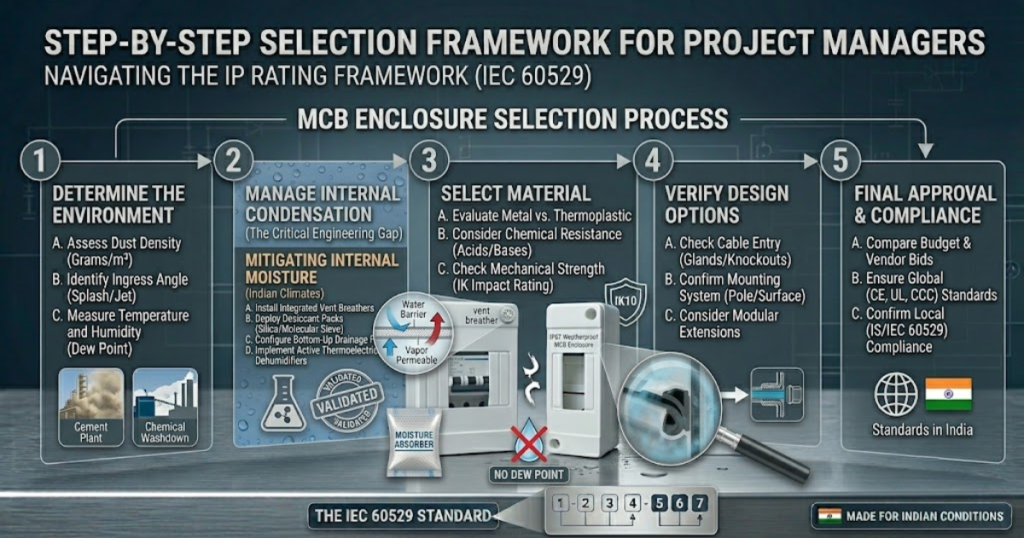
A common, highly frustrating mistake made by electrical contractors across India is what engineers refer to as the “Hermetic Sealing Trap.”
Imagine an electrical contractor buying a premium, ultra-expensive, absolute top-tier IP67 MCB enclosure box.
Within six months, the main incomer MCB mysteriously trips, and upon opening the box, the team discovers a pool of liquid water sitting right at the bottom of the enclosure, with heavily corroded, blackened terminal blocks. How did water enter an unbreached IP67 box?
The Mechanics of Internal Condensation
- Heat Generation: When electric current flows through the MCBs, busbars, and internal wiring terminals, it naturally generates localized thermal heat due to internal electrical resistance. This causes the air inside the sealed enclosure box to expand and grow warm.
- Night-time Cooling: During the night, or when the plant shuts down its machines, the outside ambient temperature drops significantly.
- The Dew Point Phenomenon: The warm, moisture-laden air trapped inside the sealed enclosure encounters the rapidly cooling walls of the box. The air reaches its dew point, causing the humidity to transition from an invisible gas into physical, liquid water droplets on the interior ceiling and walls of the box.
- Corrosion & Short Circuits: Since the high-IP enclosure is completely airtight, this condensed water has absolutely no way to escape. It slowly pools at the base, leading to tracking paths, insulation degradation, terminal corrosion, and sudden short-circuit blowouts.
The Engineering Solution
To defeat condensation in high-IP setups, you must allow the enclosure box to breathe without losing its dust or water protection.
- Integrated Ventilation Breathers: Always select industrial enclosures that are equipped with specialized IP-rated pressure compensation valves or breathers. These breathers contain a micro-porous ePTFE (expanded Polytetrafluoroethylene) membrane. This membrane allows gaseous air molecules and moisture vapor to freely pass out of the box, balancing the internal and external pressure, while completely blocking heavy liquid water molecules and fine dust particles from entering.
- Bottom Drain Plugs: For highly humid outdoor installations, install certified IP-rated condensation drain valves at the lowest physical point of the box. These unique valves open automatically under gravitational water weight to let pooled condensation drain out, then instantly seal back up against external ingress.
5. B2B Buying & Compliance Checklist for Indian Procurement Managers
When floating a commercial RFQ (Request for Quote) or sourcing bulk quantities of MCB enclosure boxes for major industrial projects in India, relying solely on a catalog printout that reads “IP65” or “IP67” is a major compliance risk.
Use this highly rigorous, structured procurement checklist to verify product authenticity and ensure total alignment with National Quality and Safety Directives:
- [ ] IS/IEC 60529 Lab Certification: Demand the official, third-party test reports validating the IP rating.
- [ ] CE and RoHS Markings: Verify that the materials used are fully compliant with international safety, health, and environmental protection standards (CE) and are free from hazardous substances (RoHS).
- [ ] Flame Retardancy Check (UL 94 Validation): Industrial enclosures must never act as fuel for an electrical fire. Ensure the plastic material (Polycarbonate/ABS) is certified to UL 94 V-0 or V-1 standards, meaning it is self-extinguishing within seconds of ignition and will not drop flaming plastic particles.
- [ ] Glow Wire Test Compliance (IEC 60695-2-11): Confirm that the enclosure base material can successfully pass a high-temperature Glow Wire Test at 650°C or 850°C to ensure absolute thermal stability during extreme overcurrent faults.
- [ ] High-Quality Cable Glands Selection: An enclosure box’s IP rating is entirely continuous with its entry points. If your installer punches random holes in an IP67 box and passes cables through without protection, the rating drops to zero. Always procure matching IP65/IP66/IP67 nylon or brass cable glands with robust inner neoprene compression seals to lock down every single wire entry point perfectly.
Industrial Frequently Asked Questions (FAQ)
Q1: Can I safely use an IP20 rated MCB enclosure box inside a production plant if it is kept inside a larger metal cabinet?
Answer: Yes, this is a standard industrial practice known as “Nested Protection.” If you have a primary, heavy-duty outer distribution panel that is already fully certified to an IP54 or IP65 standard, you can safely mount modular IP20 MCB enclosure boxes inside it. The outer panel handles the heavy dust and moisture management, while the inner IP20 box serves as a touch-proof finger barrier for maintenance technicians working on individual sub-circuits.
Q2: What is the main structural difference between an IP65 box and an IP66 MCB enclosure box?
Answer: The primary engineering differentiator lies in how they handle high-velocity water entry. An IP65 enclosure is designed to protect against low-pressure, gentle streams of water (like ambient rain or low-volume pipe leaks).
An IP66 enclosure, however, features a significantly higher grade of structural sealing and tighter mechanical latching mechanisms. This allows it to withstand intense, high-pressure, forceful water torrents, such as heavy monsoon storms at sea or high-velocity industrial washdown hoses used on chemical shop floors.
Q3: Why do some outdoor thermoplastic MCB boxes turn yellow and crack after a few years, even if they have a certified IP65 rating?
Answer: This happens because the enclosure material lacks UV (Ultraviolet) stabilization. An IP rating only measures protection against dust and water ingress under immediate lab conditions; it does not measure resistance to long-term sunlight exposure.
Standard plastics degrade rapidly under solar radiation, breaking down their molecular chains, causing them to turn yellow, warp, become brittle, and eventually crack. Q4: Can an IP67 rated MCB enclosure box be safely installed permanently underwater?
Answer: No, absolutely not. An IP67 rating signifies protection against temporary immersion in water (specifically up to 1 meter of depth for a maximum duration of 30 minutes). It is designed to survive flash floods, heavy temporary waterlogging, or accidental dropping into fluid tanks.
Q5: Do I need to buy special MCBs to match my high-IP enclosure box?
Answer: No. Standard DIN-rail mounted MCBs, RCCBs, and isolating switches feature a factory-standard IP20 (finger-safe) design, which is perfectly tailored for interior mounting.
The primary job of your external high-IP (IP65/IP66) enclosure box is to create an absolute environmental shield around these standard IP20 components.