
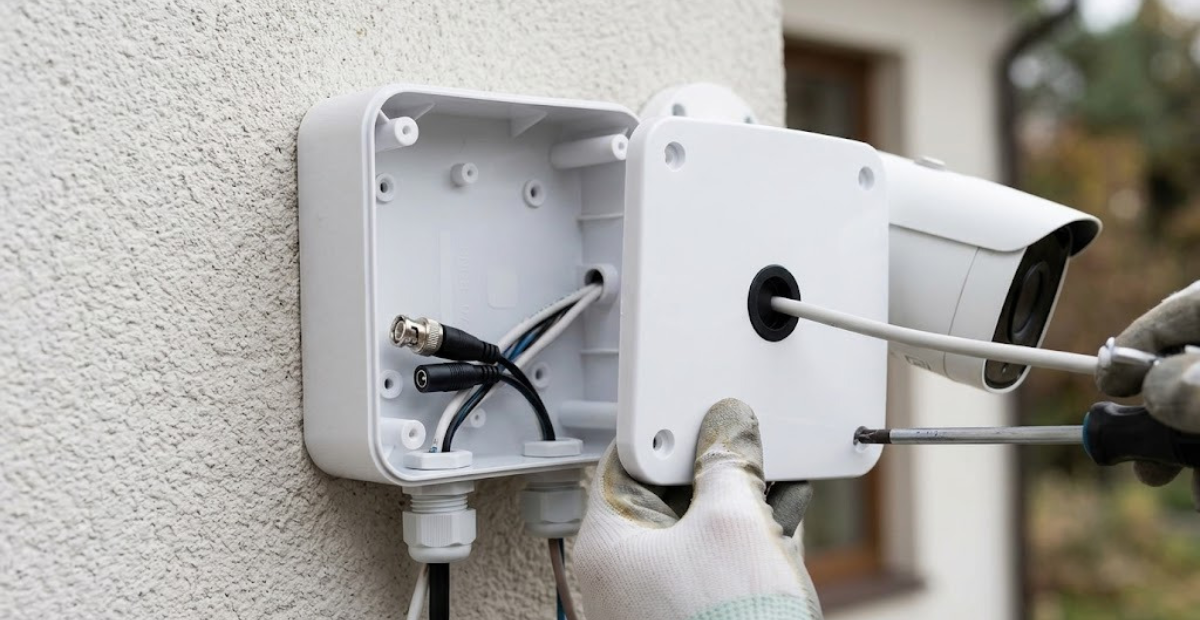
.When planning an outdoor surveillance setup, most property owners focus almost entirely on high-resolution 4K sensors, color night vision, and AI motion tracking. Yet, the most critical vulnerability of any outdoor security system is often overlooked: the wiring and connector joints.Indian weather conditions are demanding. Installations routinely endure 45°C summer heatwaves, intense UV exposure, fine sandstorms, and prolonged, torrential monsoon rains. When BNC, DC power, or RJ45 Ethernet connectors are left exposed—or stuffed into makeshift electrical covers—moisture penetrates the joints within weeks. The result is contact corrosion, intermittent signal drops, short circuits, and permanently damaged camera hardware.A high-grade waterproof CCTV camera junction box is the most cost-effective insurance policy for your security system.
Choosing the right enclosure requires matching the box to your camera type, installation environment, and local climate. Here is a practical, field-tested guide to selecting the right size, IP rating, and material for your setup.
1. Why a Standard Box Fails (The Real Role of a CCTV Junction Box)
Ordinary household PVC switch boxes or electrical tape wraps fail outdoors within months. A dedicated waterproof junction box serves three vital functions:
- Corrosion Isolation: PoE (Power over Ethernet) RJ45 connectors carry both data and low-voltage current. The slightest atmospheric humidity triggers galvanic corrosion across the RJ45 copper pins, degrading network throughput or severing the link entirely.
- Tamper & Vandal Resistance: Cleanly enclosing the excess wire pigtail prevents deliberate cable cutting and protects wires from rodent damage.
- Condensation Control: Proper junction boxes use closed-cell seals that prevent external moisture intrusion while giving enough air buffer to minimize internal condensation during sudden temperature shifts.
2. Deciphering Ingress Protection: IP65 vs. IP66 vs. IP67
Every reliable waterproof CCTV camera junction box carries an Ingress Protection (IP) rating. The two digits indicate resistance against solid particles (dust) and liquids (water).
IP 6 6
│ │
│ └── Liquid Protection (Water jets & heavy rain)
└──── Solid Protection (Completely dust-tight)
IP65 (Weather-Resistant)
- Protection Level: Dust-tight; protects against low-pressure water splashes from any angle.
- Where to Use: Semi-sheltered outdoor locations, such as under porch ceilings, balconies, carports, or deep building eaves.
- Limitations: Not suited for direct, unsheltered monsoon rainfall.
IP66 (Heavy Weatherproof — The Recommended Standard)
- Protection Level: Dust-tight; resists powerful, high-pressure water jets and driving rains.
- Where to Use: Direct wall mounts, rooftop parapets, perimeter boundary walls, and open pole installations.
- Verdict: This is the baseline rating you should demand for unsheltered outdoor CCTV installations across most Indian regions.
IP67 (Immersion-Proof)
- Protection Level: Dust-tight; withstands temporary submersion in water up to 1 meter for 30 minutes.
- Where to Use: Flood-prone low-lying properties, basements with water seepage risks, or coastal piers.
- Verdict: Excessive for standard wall-mounted cameras, but essential if the mounting surface risks temporary waterlogging.
Crucial Inspection Detail: Always inspect the inner perimeter of the junction box cover. A genuine waterproof box must feature an integrated silicone or continuous rubber O-ring gasket. A plastic-on-plastic lip without an elastomeric seal will leak under wind-driven rain, regardless of any claim on the packaging.
3. Sizing Guide: Matching Dimensions to Your Hardware
A common mistake is buying a junction box sized purely to the footprint of the camera base. The interior cavity must accommodate cable slack, bulky connectors, and potential power supplies without pinching the wiring.
| Enclosure Size | Camera Compatibility | Internal Capacity |
| 4″ × 4″ (Small / Deep) | Standard IP Bullets & Analog HD | RJ45 waterproof coupler or BNC + DC pigtail joints |
| 5″ × 5″ (Medium) | Eyeball Domes, Turrets, Heavy Bullets | Connectors + Compact 12V 1A/2A SMPS power adapter |
| 8″ × 6″ or larger (Enclosure) | Long-range PTZ cameras, Multi-lens units | PoE splitters, inline surge protectors, and service loops |
Key Dimensional Factors to Keep in Mind:
- Bend Radius Safety: Category 6 Ethernet cables require a minimum bend radius roughly four times the outer cable diameter. Forcing a tight 90-degree fold inside an undersized 3-inch box cracks internal copper conductors and ruins gigabit transfer speeds.
- Dome Base Overhang: If you plan to surface-mount a dome or turret camera directly onto the junction box faceplate, verify that the camera’s mounting ring does not extend beyond the box edges. Overhang exposes screw channels to direct rainfall runoff.
4. Material Selection: ABS Plastic vs. Die-Cast Aluminum
The choice of enclosure material determines longevity under relentless sunlight and regional environmental factors.
Option A: ABS Engineering Plastic / Polycarbonate
- Advantages: Non-corrosive, non-conductive, lightweight, and economical. Ideal for coastal belts (such as Mumbai, Chennai, or Gujarat) where salt-laden ocean air rapidly pits metal surfaces.
- Risks: Standard non-UV plastics degrade quickly under intense sunlight, turning brittle, yellowing, and cracking within 12 to 18 months.
- Buying Rule: Look specifically for UV-stabilized ABS or flame-retardant Polycarbonate resin (UL94-V0 rated).
Option B: Die-Cast Aluminum Alloy
- Advantages: Superior structural strength, high impact resistance (IK10 vandal protection), natural heat dissipation, and a secure platform for heavy motorized varifocal cameras.
- Risks: Heavier to anchor into porous masonry; susceptible to surface oxidation over time if the powder coating is scratched.
- Buying Rule: Best suited for high-exposure commercial projects, perimeter fences, industrial plants, and pole-mounted traffic cameras.
5. Cable Entry Points & Gland Architecture
Water rarely penetrates the solid body of a junction box; it almost always enters through unsealed wiring knockouts. Reliable waterproof boxes incorporate dedicated cable gland hardware.
- Compression Cable Glands (PG7 / PG9 / M16): Ensure the enclosure includes threaded cable glands equipped with internal rubber bushings. As the gland nut tightens, the bushing compresses uniformly around the jacket of the CAT6 or 3+1 coaxial cable, establishing an airtight seal.
- The “Bottom Entry” Rule: Always run conduit or exposed wiring into the box through the bottom faceplate. Never route cables into the top panel. Gravity turns cables entering from the top into water channels, directing rainwater straight past loose threads into the enclosure.
- Pre-Molded Knockouts: Boxes with precision-molded, stepped knockouts yield clean cutouts. Ragged holes cut with dull drills compromise gasket contact and invite insect nesting.
6. Pro Installation Techniques for Long-Term Reliability
Even an industrial-grade waterproof CCTV camera junction box will fail if mounted carelessly. Follow these field practices:
- Form a Drip Loop: Before the incoming cable enters the cable gland, form a slight downward “U-shaped” dip in the wire. Surface runoff drips off the bottom of the loop rather than tracking straight into the fitting.
- Seal Mounting Screw Channels: Apply a small bead of neutral-cure silicone sealant over the screw heads holding the box base to the brick or concrete wall. Water can seep along anchor threads into the box interior.
- Insert a Silica Gel Packet: Place a 5g or 10g regenerative silica gel pouch inside the enclosure before sealing the faceplate. This absorbs ambient humidity trapped during installation, preventing lens fogging and pin oxidation during temperature drops.
Frequently Asked Questions
Can I use a standard home electrical PVC junction box for outdoor CCTV?
Standard domestic PVC boxes lack UV inhibitors and continuous rubber perimeter gaskets. Within one summer season, the sun makes the plastic brittle, and monsoon rains leak past the unsealed cover plates, ruining your camera’s pigtail connectors.
Is it safe to store a 12V camera power adapter inside a waterproof junction box?
Yes, provided the enclosure is at least 5″ × 5″ to allow sufficient internal air volume for passive heat dissipation. Ensure neither the adapter nor the connectors rest directly on the bottom floor of the box where trace condensation might collect.
What is the practical difference between IP65 and IP66 for outdoor security cameras?
IP65 is designed to resist light rain and gentle splashes, making it suitable only for covered exterior locations like balconies or overhangs. IP66 is engineered to withstand forceful, driving rain and high-pressure storms, making it the proper standard for fully exposed outdoor walls.
