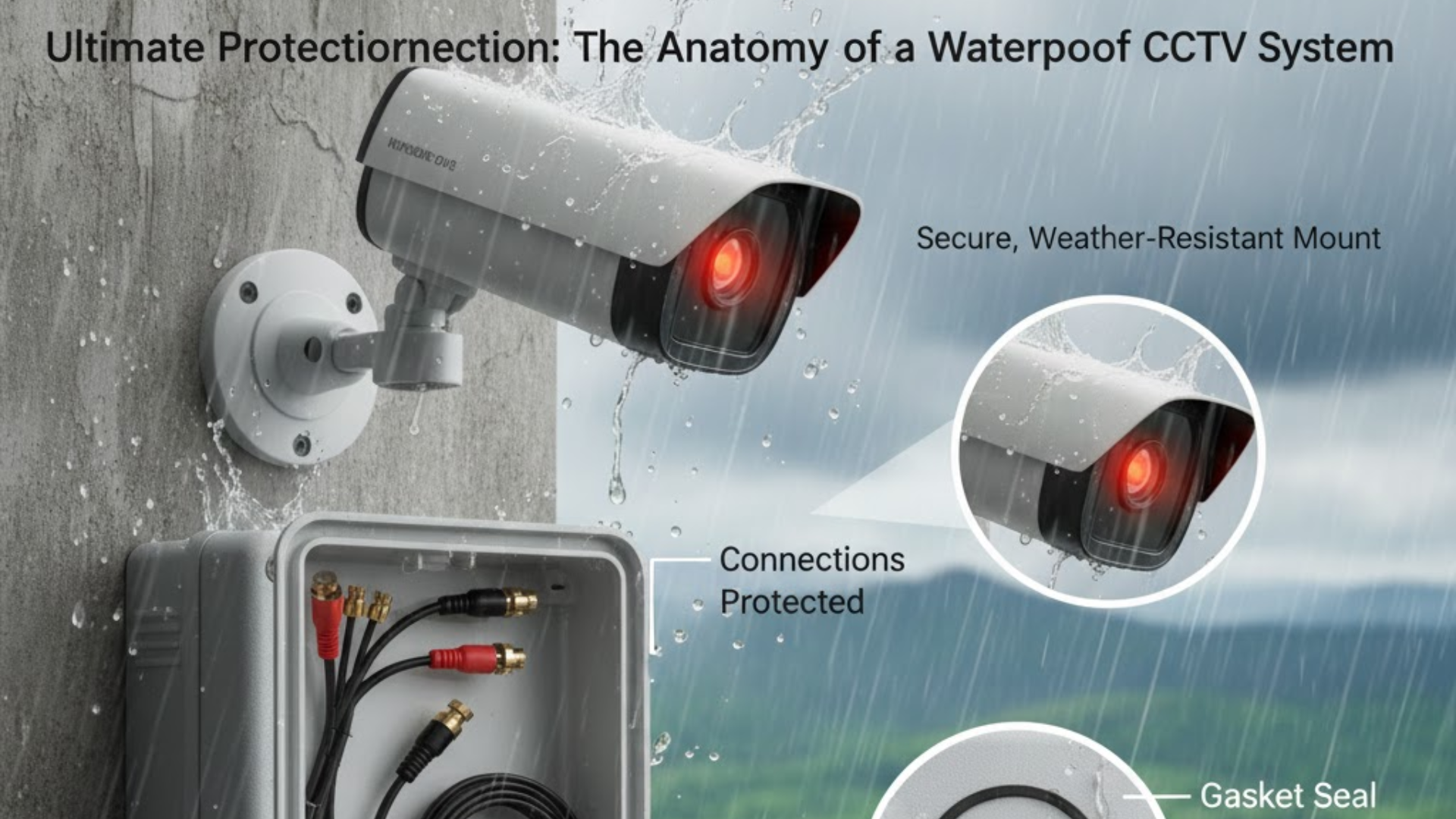
When we talk about home or business security in India, we usually focus on the “Big Three”: The Camera (Resolution), the DVR/NVR (Storage), and the Hard Drive (Reliability). But there is a silent guardian that often goes overlooked during the installation process—the Waterproof CCTV Junction Box.
In a country where the climate ranges from the salt-laden humid air of Mumbai to the bone-dry heat of Rajasthan and the torrential monsoons of Cherrapunji, your camera’s wiring faces an uphill battle. This 3,000-word deep dive will explain why this small plastic or metal box is the single most important accessory for your security system.
1. What Exactly is a Waterproof CCTV Junction Box? | Complete Guide to Waterproof CCTV Junction Box
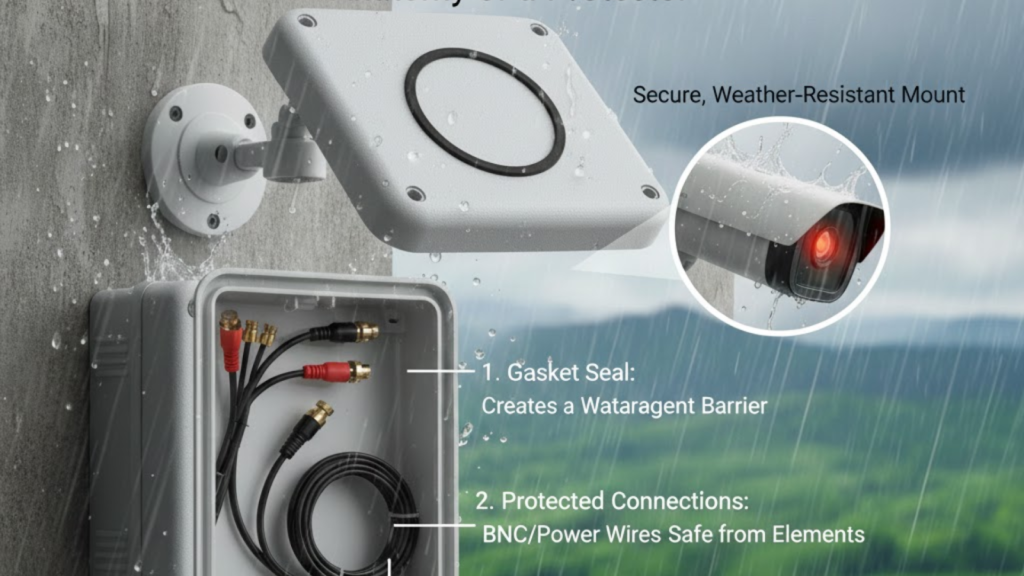
A waterproof CCTV junction box is a specialized, weather-sealed enclosure designed to house the critical connection points of a security camera.
Every CCTV camera—whether it is an Analog HD camera (using BNC/DC pins) or an IP Camera (using RJ45 connectors)—has a “pigtail” or a set of wires coming out of its rear. These wires are the “nervous system” of your security. If they are left exposed to the air, they are prone to:
- Oxidation: Green gunk forming on copper pins.
- Short Circuits: Water droplets bridging the power and video lines.
- Physical Stress: Wires hanging and stretching under their own weight.
The junction box acts as a fortified “room” for these connections, keeping them dry, clean, and secure.
2.Why the Indian Climate Demands Specialized Protection for Waterproof CCTV Junction Box
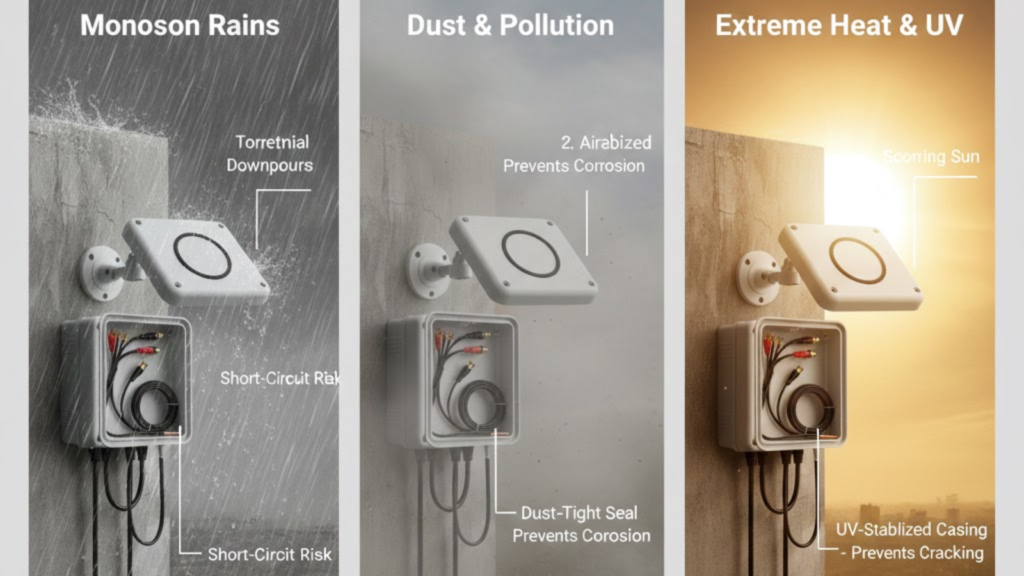
In Western countries, weather is often consistent. In India, your waterproof CCTV junction box must survive extreme variables:
A. The Monsoon Factor
During July and August, Indian rains aren’t just drizzles; they are high-pressure downpours. Standard electrical tape or “M-Seal” is not enough. A box with an IP66 rating ensures that even if a bucket of water is thrown at the camera, the internal circuitry remains bone-dry.
B. The Dust and Pollution Challenge
In cities like Delhi or Bangalore, fine particulate matter (PM2.5) can enter even the smallest cracks. Dust acts as an insulator; if it settles on your power pins, it can cause overheating or “video noise” (static lines on your screen).
C. UV Radiation and Brittle Plastic
The Indian sun can reach $48^\circ\text{C}$. Cheap plastic boxes that aren’t UV-stabilized will turn yellow, become brittle, and eventually crack like a biscuit within 12 months. This is why choosing a high-quality material is non-negotiable.
3.Deep Dive: Types of Materials Used in Waterproof CCTV Junction Box
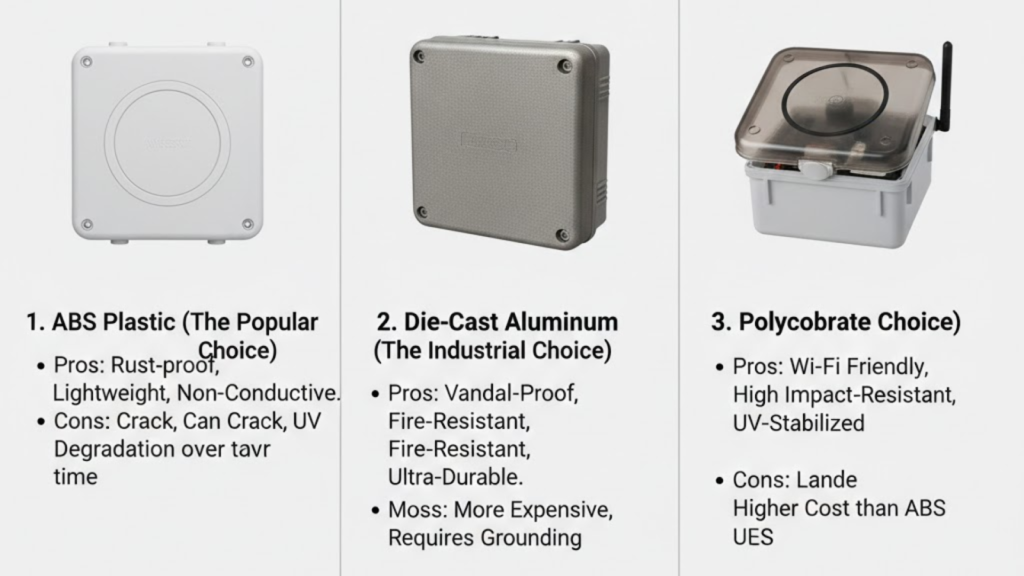
Not all boxes are created equal. Depending on your location, you need to choose the right material.
1. ABS Plastic (The Popular Choice)
Most residential installations in India use ABS (Acrylonitrile Butadiene Styrene) plastic.
- Pros: Rust-proof, lightweight, non-conductive (safe from electric shocks).
- Cons: Can crack if hit by a heavy object.
2. Die-Cast Aluminum (The Industrial Choice)
Used in factories, petrol pumps, and high-security zones.
- Pros: Fire-resistant, vandal-proof, and can withstand physical impact.
- Cons: More expensive and requires grounding to prevent static buildup.
3. Polycarbonate (The Premium Choice)
The “middle ground” between plastic and metal. It is transparent to Wi-Fi signals, making it the best junction box for Wi-Fi cameras.
4. Technical Comparison: PVC vs. Metal vs. Hybrid
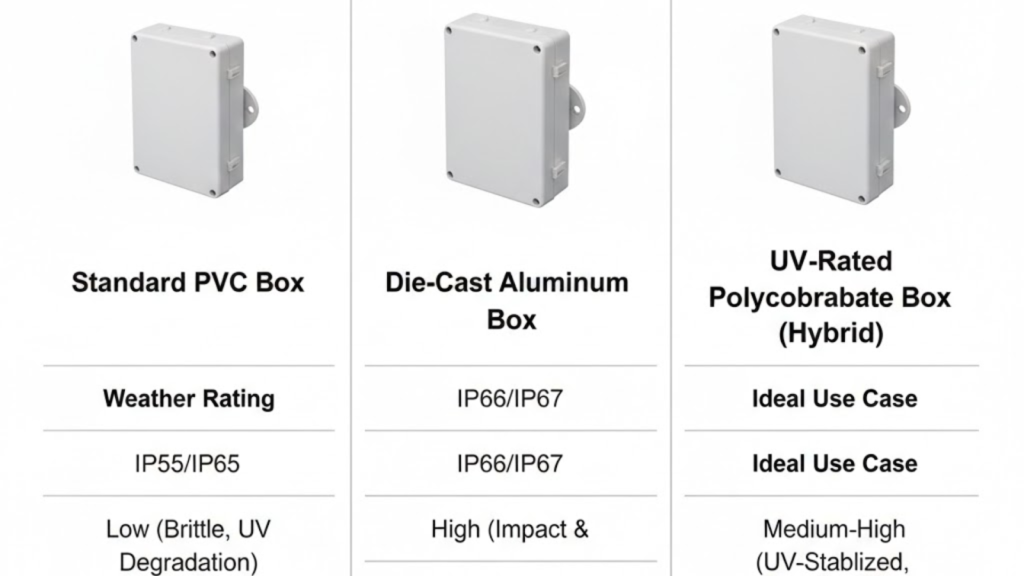
| Feature | Standard PVC Box | UV-Rated ABS Box | Die-Cast Aluminum |
| Waterproofing | IP65 (Basic) | IP66 (High) | IP67 (Ultra) |
| Heat Resistance | Up to 40; C | Up to 70;C | Up to 120 ; C |
| Typical Price | ₹60 – ₹100 | ₹150 – ₹300 | ₹500 – ₹1,200 |
| Lifespan | 1-2 Years | 5-7 Years | 15+ Years |
| Corrosion Risk | Zero | Zero | Low (if painted) |
5. Understanding the IP Rating (Ingress Protection)
If you see a waterproof CCTV junction box without a certified IP rating, do not buy it. In the professional security industry, an unrated box is just a “plastic container,” not a protective enclosure.
The IP (Ingress Protection) rating is an international standard (IEC 60529) that classifies the degrees of protection provided against the intrusion of solid objects, dust, accidental contact, and water.
Decoding the Numbers: What do “6” and “7” actually mean?
An IP rating consists of two digits.
- The First Digit (0-6): Indicates protection against Solids (Dust, debris, fingers).
- The Second Digit (0-9): Indicates protection against Liquids (Rain, splashing, immersion).
For a waterproof CCTV junction box, the first digit should always be 6 (Dust-tight). The second digit is where the real choice lies.
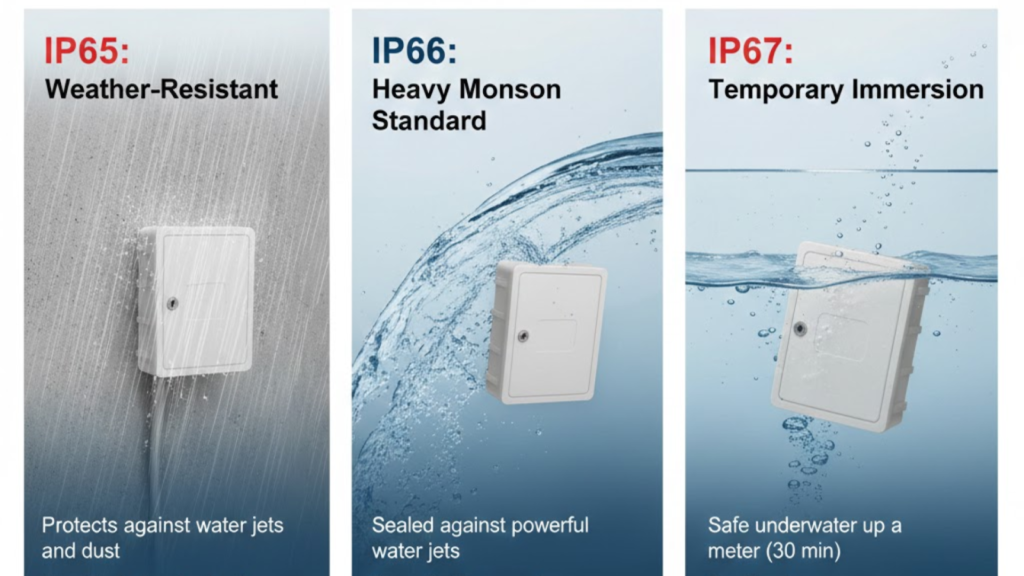
A. IP65: The “Weather-Resistant” Standard
Best For: Semi-outdoor areas like balconies, porch ceilings, under-eaves, or covered parking lots.
- Solid Protection (6): Completely dust-tight. No ingress of dust; complete protection against contact.
- Liquid Protection (5): Protection against water jets. Specifically, water projected by a nozzle (6.3MM) against the enclosure from any direction shall have no harmful effects.
- Indian Context: If your camera is under a “Chajja” or a balcony where direct heavy rain doesn’t hit it constantly, IP65 is sufficient. It handles the humidity of Bangalore or the dusty winds of Jaipur perfectly.
B. IP66: The “Heavy Monsoon” Standard
Best For: Open terrace walls, boundary walls, street light poles, and high-rise building exteriors.
- Solid Protection (6): Total protection against dust and airborne particles.
- Liquid Protection (6): Protection against powerful water jets. This means water projected in powerful jets (12.5 mm nozzle) against the box from any direction.
- Why it’s the “Sweet Spot” for India: During an Indian Monsoon, rain doesn’t just fall; it gets blown sideways by high winds. IP66 ensures that even during a thunderstorm in Mumbai or Kolkata, the high-pressure water hitting the box cannot enter the seal.
C. IP67: The “Extreme/Flood-Prone” Standard
Best For: Low-lying areas, basements prone to waterlogging, and coastal areas with high-pressure sea spray.
- Solid Protection (6): Dust-tight.
- Liquid Protection (7): Protection against Immersion. This means the waterproof CCTV junction box can be dropped into water up to 1meter deep for 30 minutes without a single drop entering the internal chamber.
- Practical Use: In cities like Chennai or parts of Delhi that face seasonal waterlogging, an IP67 box ensures that even if the ground level floods and stays high for a few minutes, your camera wiring remains intact.
6. Detailed Installation Guide: The Professional Way
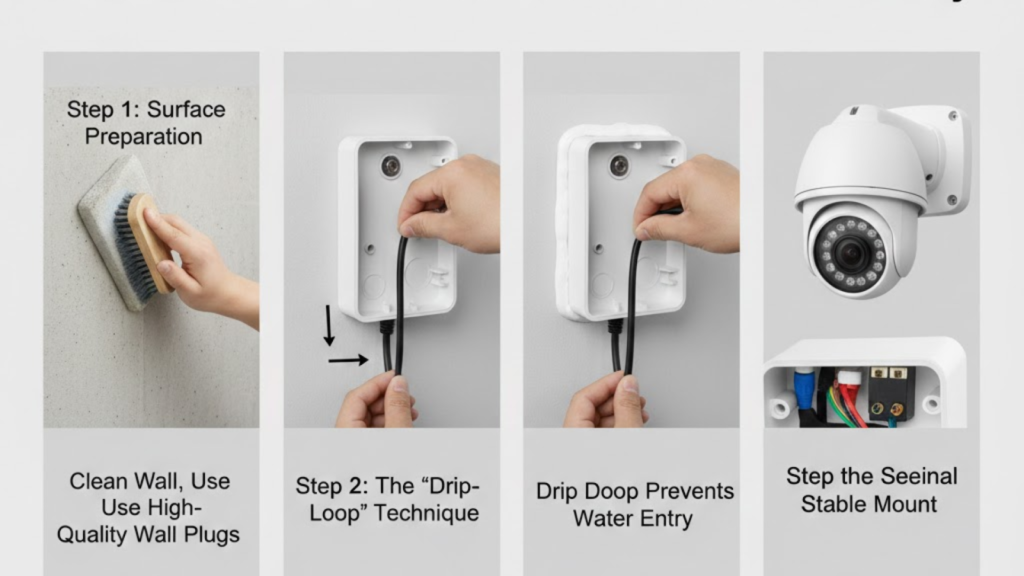
If you are a DIY enthusiast or a professional installer, follow this “Gold Standard” installation procedure:
Step 1: Surface Preparation
Clean the wall surface. If the wall is damp, avoid mounting directly; use a spacer or a high-quality wall plug to create a gap.
Step 2: The “Drip Loop” Technique
This is a secret used by pro-installers. Even with a waterproof junction box, always leave a small loop of wire hanging below the box before it enters. This ensures that rainwater runs down the wire and drips off the bottom of the loop instead of running directly into the box entry point.
Step 3: Sealing the Glands
Use rubber cable glands for the entry holes. If your box doesn’t come with them, use Silicon Sealant or “Weather-proof Caulk” to seal the gaps.
Step 4: Internal Organization
Don’t just jam the wires in. Use small zip-ties (cable ties) to keep the BNC and DC pins separate. This prevents accidental disconnections when you open the box for maintenance later.
7. Common Mistakes That Kill Your CCTV System
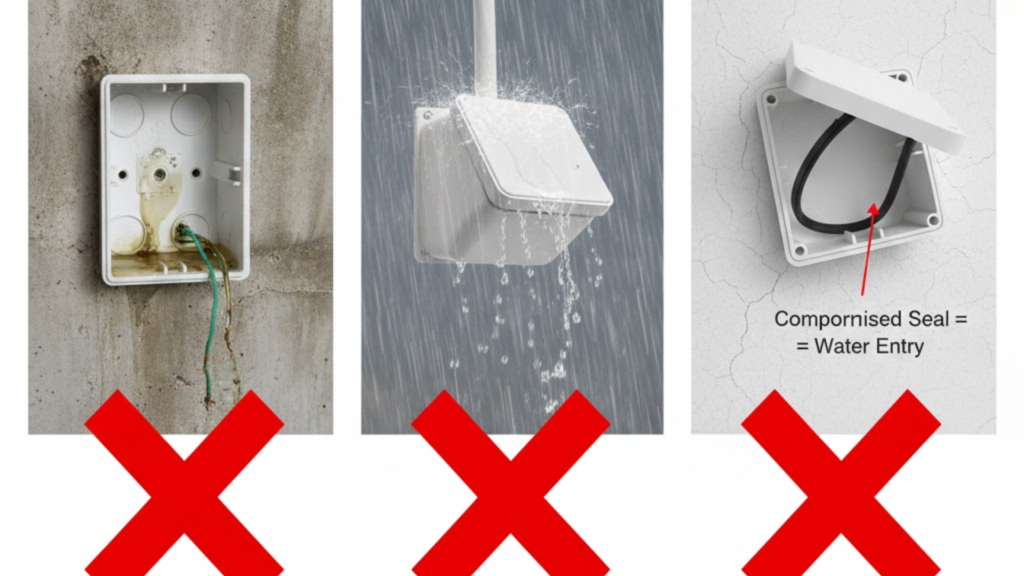
- Using “Gang Boxes”: People often use standard 4×4 electrical switch boxes. These are not UV-rated and usually have holes in the back that let moisture in.
- Mounting the Box Upside Down: Ensure the lid opening faces a direction where gravity assists water runoff.
- Ignoring the Gasket: Many installers lose the rubber ring (gasket) that sits between the lid and the box. Without this, the box is just a plastic container, not a waterproof shield.
8. Frequently Asked Questions (FAQ)
Q1: Will a junction box affect my camera’s Night Vision?
Answer: No. In fact, it helps. By providing a stable mount, it reduces vibrations that can cause “motion blur” in night vision IR (Infrared) mode.
Q2: Can I paint the junction box to match my wall color?
Answer: Yes, but use high-quality exterior plastic paint. Do not paint the rubber gaskets or the camera lens!
Q3: Is one junction box enough for two cameras?
Answer: It depends on the size. A standard 4×4 box is meant for one camera. Attempting to fit wiring for two cameras might lead to “signal crosstalk” or interference.
Q4: Which brand is best for the Indian market?
Answer: Popular reliable brands in India include CP Plus (CP-junction boxes), Hikvision, and local high-quality manufacturers like Veto or D-Link.
Conclusion: The ROI of a Junction Box
Think of it this way: A high-definition CCTV camera costs anywhere between ₹2,000 and ₹10,000. A waterproof CCTV junction box costs around ₹200.
By spending just 2% to 5% extra, you are ensuring that your camera doesn’t fail when you need it most—during a heavy storm or a dusty summer night. It improves the video signal, stops corrosion, and keeps your property looking professional.