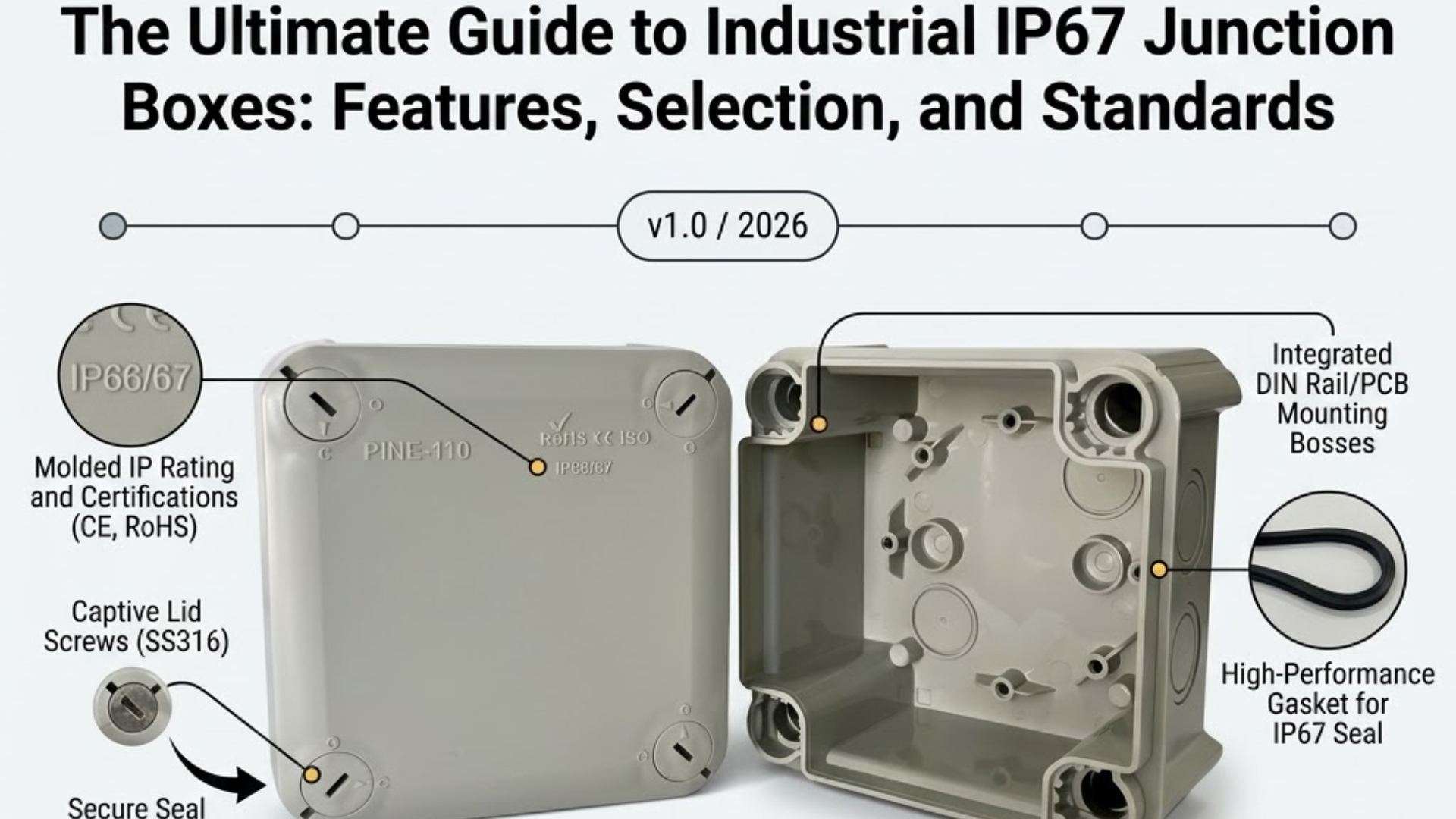
In the rapidly evolving industrial landscape of India—from the humid coastal regions of Maharashtra to the dusty industrial corridors of NCR—electrical integrity is the backbone of productivity. At the heart of this protection lies the industrial IP67 junction box.
But what exactly separates a “standard box” from a “heavy-duty” enclosure? This guide explores every technical detail you need to know.
Understanding the IP67 Rating: Beyond the Basics
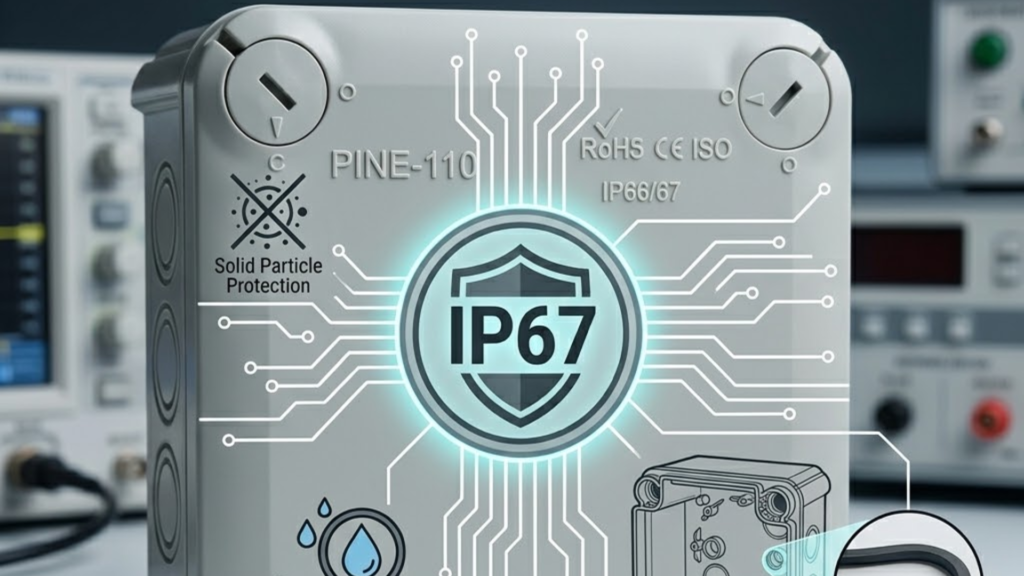
Before diving into features, it is vital to understand the technical definition of IP67 under the IEC 60529 standard.
- IP (Ingress Protection): A global standard for defining the sealing effectiveness of electrical enclosures.
- The First Digit (6): Dust-tight. No ingress of dust; complete protection against contact.
- The Second Digit (7): Protection against immersion. The enclosure can be submerged in water up to 1 meter (3.3 feet) for 30 minutes without harmful leakage.
Comparison: IP65 vs. IP66 vs. IP67
| Feature | IP65 | IP66 | IP67 |
| Dust Protection | Complete | Complete | Complete |
| Water Protection | Low-pressure jets | High-pressure jets | Temporary Immersion |
| Best Use Case | Indoor/Light Rain | Heavy washdowns | Flood-prone/Heavy Monsoon |
1. Deep Dive into Material Science: PC, ABS, and Aluminum
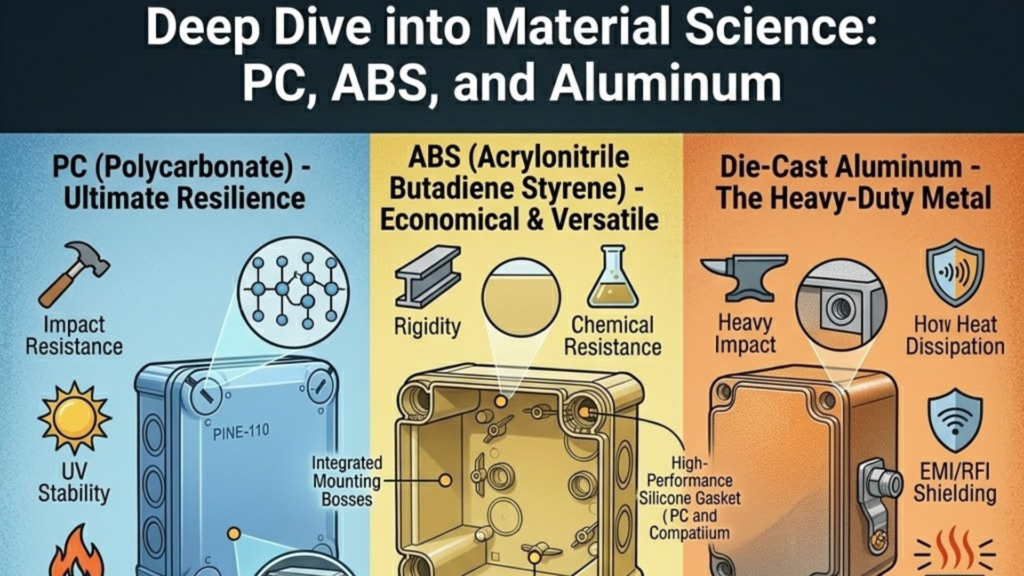
The material of your industrial IP67 junction box determines its lifespan. In India, environmental stress is high.
A. Polycarbonate (PC) – The Professional Choice
Polycarbonate is a high-grade engineering plastic.
- High Impact Resistance: It can withstand physical blows without cracking (IK08 rating).
- UV Stability: Essential for solar projects in places like Rajasthan, where high UV can degrade standard plastics.
- Thermal Range: Can usually handle -40°C to +120°C.
B. ABS (Acrylonitrile Butadiene Styrene)
- Pros: Cost-effective and rigid.
- Cons: Not naturally UV stable. Best for indoor industrial use or shaded areas.
C. Die-Cast Aluminum
For oil and gas plants or heavy machinery zones, metal is king.
- EMI/RFI Shielding: Protects sensitive electronics from radio frequency interference.
- Heat Dissipation: Metal acts as a heat sink for internal components.
2. The Sealing Engineering: Gaskets and Design
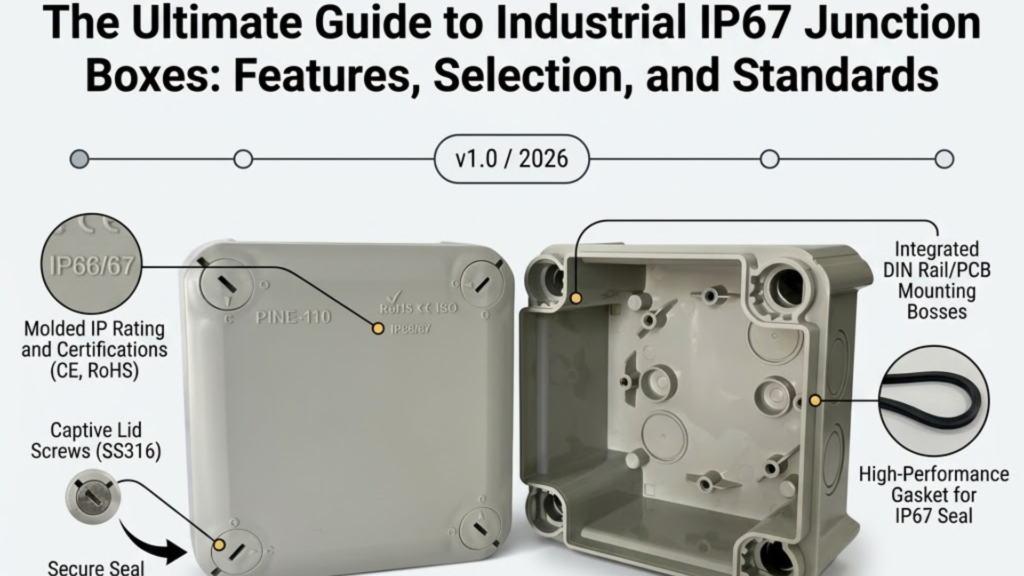
A box is only as waterproof as its weakest point: the seal. For an industrial IP67 junction box, the sealing mechanism is a work of engineering.
Types of Sealing Methods:
- CNC Poured Gaskets: A liquid polyurethane is poured into the lid groove and hardens. This creates a seamless seal with no joints.
- Silicon O-Rings: Best for extreme temperatures. Silicon remains flexible even in the freezing winters of North India or the scorching heat of Central India.
- EPDM Seals: Highly resistant to chemicals and acids, making them ideal for pharmaceutical factories.
Important Note: Always check for a “Tongue and Groove” design. This ensures that even if the box is under pressure, the gasket is squeezed from multiple sides, preventing water from “sneaking” in.
3. Advanced Mechanical Features for Longevity
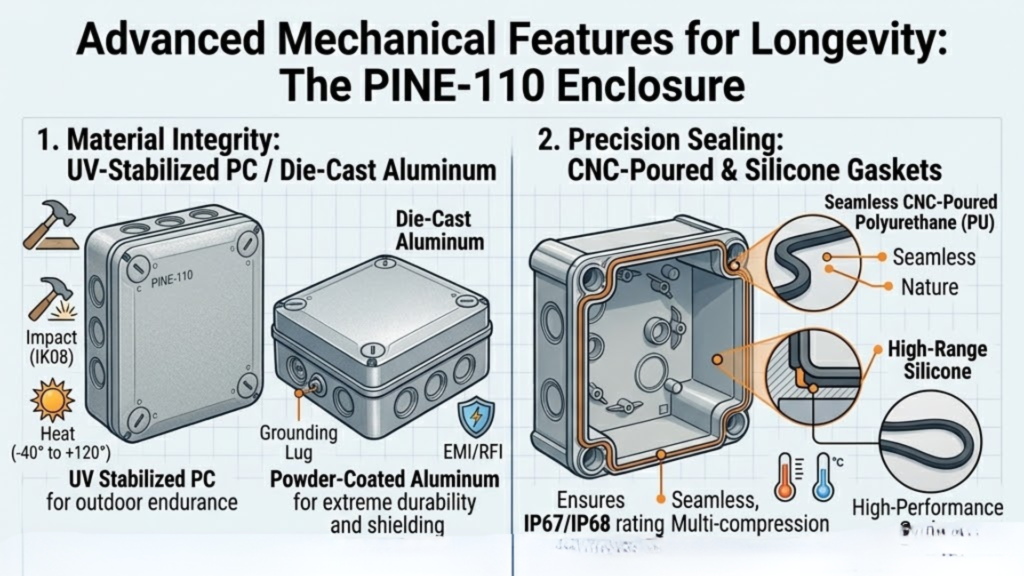
When you are installing hundreds of boxes in a solar farm or a warehouse, small mechanical features save hours of labor and lakhs in maintenance.
Key Mechanical Elements:
- Captive Stainless Steel Screws:
- Standard screws rust. SS 304 or SS 316 screws are mandatory for IP67.
- Captive design means the screw stays in the lid. You won’t lose them while standing on a 10-foot ladder.
- Internal Mounting Pillars: High-quality boxes have pre-molded “bosses.” This allows you to mount a DIN Rail or a mounting plate without drilling through the back, which would compromise the IP rating.
- Wall Mounting Brackets: To maintain the IP67 seal, you should never drill through the base of the box to fix it to a wall. Instead, use external mounting ears or sealed screw holes.
4. Safety Standards and Certifications in India
To ensure the “Heavy-Duty” claim is real, look for these specific certifications:
- IK Rating (Impact Protection): Look for IK07 or IK08. This ensures the box won’t shatter if hit by a tool or falling debris.
- Flammability Rating: Look for UL94-V0. This means if a short circuit occurs inside, the plastic will stop burning within 10 seconds.
- RoHS Compliance: Ensures the box is free from toxic heavy metals like lead and mercury.
5. Installation Best Practices: Don’t Ruin the Rating
Even the best industrial IP67 junction box will leak if installed poorly.
- Cable Glands: You must use IP67-rated cable glands. If you drill a hole and just push a wire through, the box is no longer waterproof.
- Torque Settings: Over-tightening the lid screws can warp the gasket. Use a calibrated screwdriver.
- Orientation: Whenever possible, install the box so that cable entries are at the bottom to prevent water from “pooling” around the seals.
Frequently Asked Questions (FAQ)
Q1: Can I use an IP67 box underwater permanently?
A: No. IP67 is for temporary immersion. For permanent underwater use (like in a swimming pool or deep well), you need an IP68 rated enclosure.
Q2: Does “Industrial” mean it’s fireproof?
A: Not necessarily. It means it is “Flame Retardant” (UL94-V0). It won’t act as fuel for a fire, but it will eventually melt in an active fire. For fire-rated areas, you need specialized Ceramic or Steel boxes.
Q3: Why should I choose Polycarbonate over PVC?
A: PVC becomes brittle and cracks under the Indian sun. Polycarbonate is much tougher and has a significantly higher melting point, making it safer for industrial loads.
Q4: Do these boxes require maintenance?
A: Yes. We recommend checking the gasket every 12–24 months in harsh environments to ensure it hasn’t dried out or cracked due to chemical exposure.
Conclusion
Investing in a high-quality industrial IP67 junction box is a strategy to minimize risk. For Indian industries where the monsoon can be unpredictable and the summer heat is intense, these enclosures provide the peace of mind that your electrical infrastructure is safe.
By choosing the right material and ensuring proper installation with IP67 cable glands, you are not just buying a box—you are buying uptime for your business.